Paint flexibility
Inspect chips, cracks, edge lifting, corrosion, repaint and filler. Refinished surfaces can respond differently to pushing, glue tabs or temperature and may fail without warning.
Book Audi dent repair in Dubai for paintless dent repair, panel shaping, bumper damage and localized refinishing. Start with the Audi model and clear damage photos. We provide a free workshop inspection in Al Quoz 4 plus free pickup and delivery.
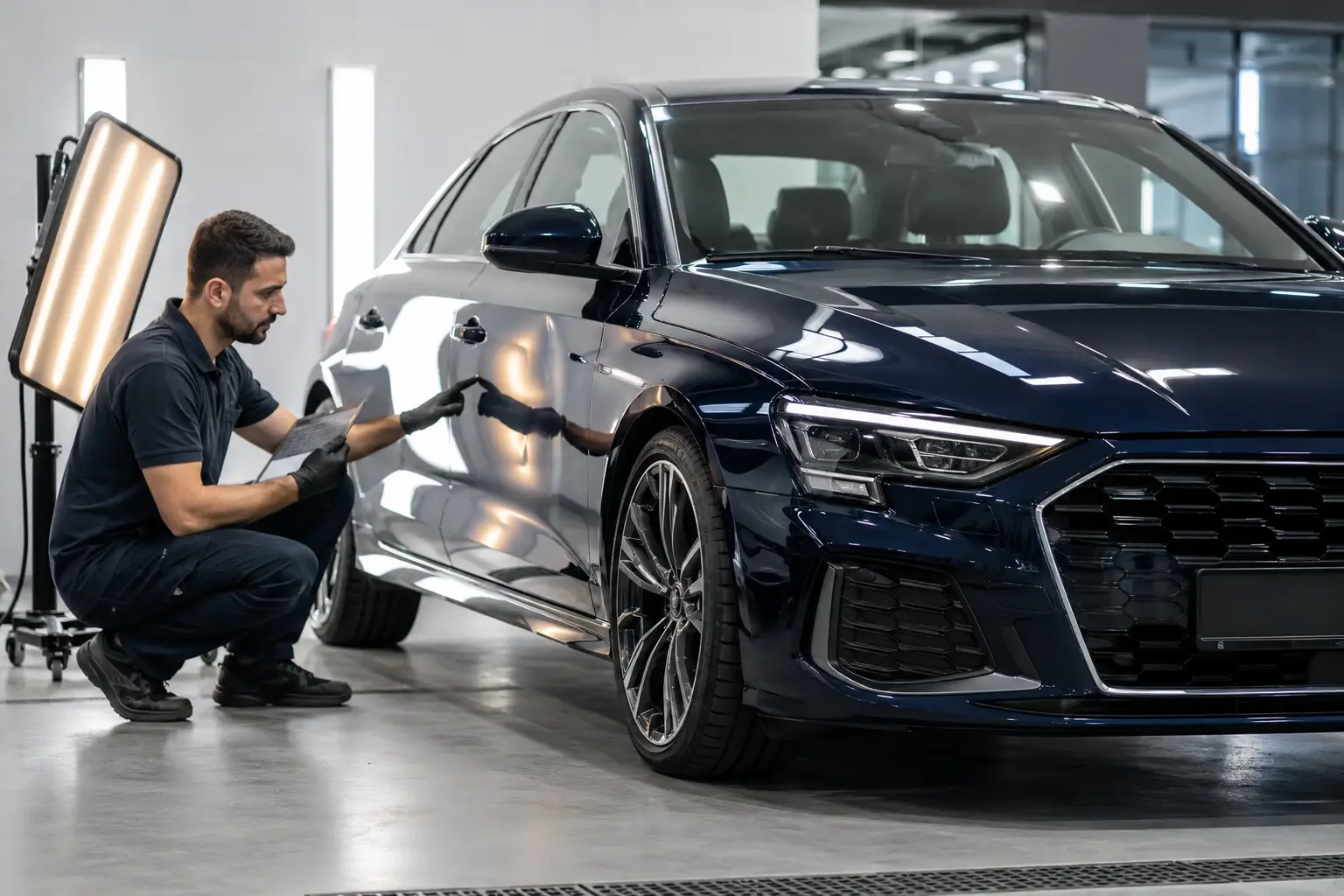
Send the VIN, model, model year and panel location. Take one photograph of the complete side or end of the car, one medium view showing the entire panel and several shallow-angle views where a straight reflection crosses the dent. Avoid digital filters, heavy flash and extreme close-ups that remove scale.
State how the damage happened, if known, and whether paint transferred, chipped, cracked or lifted. Mention prior body repair, ceramic coating, paint-protection film, vinyl wrap, repainting and filler. A coating or film may need its own removal and replacement decision even when the metal can be reshaped.
Report door, window, lock, mirror, light, tailgate, charging flap or parking-sensor behavior near the damaged area. A dent caused by a collision may look cosmetic while hiding intrusion, mount or wiring damage. Alignment, gaps and closing force belong in the first check.
This page owns minor panel deformation and dent-method selection. Collision structure, full repainting, wheel repair, glass, mechanical diagnosis and Audi upholstery are covered separately.
No single technique is best for every Audi panel. Paint condition, metal movement, access and the owner’s appearance priorities set the method.
These estimated Dubai ranges help you compare repair methods. The final quotation depends on dent size, location, paint condition, access, panel material and nearby sensors or trim. A free workshop inspection confirms the appropriate method.
| Dent service | Estimated price | Typical scope |
|---|---|---|
| Workshop inspection | Free | Panel, paint and access assessment at our Al Quoz 4 workshop. |
| Small paintless dent repair | AED 250–650 | One suitable shallow dent with intact paint and practical tool or glue access. |
| Bodyline or difficult PDR | AED 500–1,200+ | Controlled metal correction where location, tension or access makes the repair more involved. |
| Localized dent and paint repair | AED 700–1,800 | Preparation, shaping and localized refinishing where the coating cannot be preserved. |
| Full panel repair and paint | AED 1,200–3,000+ | Panel reshaping, preparation, suitable materials, refinishing and final appearance checks. |
| Plastic bumper dent repair | AED 450–1,500+ | Plastic reshaping or repair with paint where required. Tears, brackets and sensors are separate. |
| Multi-panel impact repair | AED 2,500–8,000+ | Assessment and repair of several affected panels. Structural, sensor and replacement work can increase cost. |
Send the Audi model and clear photos of the damage. We can advise whether PDR or refinishing is more likely and arrange a free workshop inspection or free pickup and delivery.
Audi Middle East says its body-repair methods include gentle paintwork processes, spot paint repair, plastic repair and reforming body components. Authorized centres control Audi-approved repairs, genuine parts, warranty decisions and official documentation. Auto Repair UAE remains independent.
| Situation | Independent workshop limits | Official or specialist service |
|---|---|---|
| Possible paint or corrosion warranty | Photograph untouched condition and measure without destructive preparation. | Audi partner decides eligibility and approved remedy. |
| Insurance claim | Document visible condition and proposed work without assuming authorization. | Insurer and chosen repairer confirm survey, parts and payment path. |
| Sensor or camera dependency | Record warnings and physical position before trim or panel work. | Use the required supported calibration and official programming process. |
| Structural concern | Stop treating the work as a cosmetic dent. | Send the vehicle for measured collision assessment using the manufacturer’s repair procedure. |
| Independent minor repair | Agree method, access, finish limits and verification. | Owner confirms warranty, lease and resale implications. |
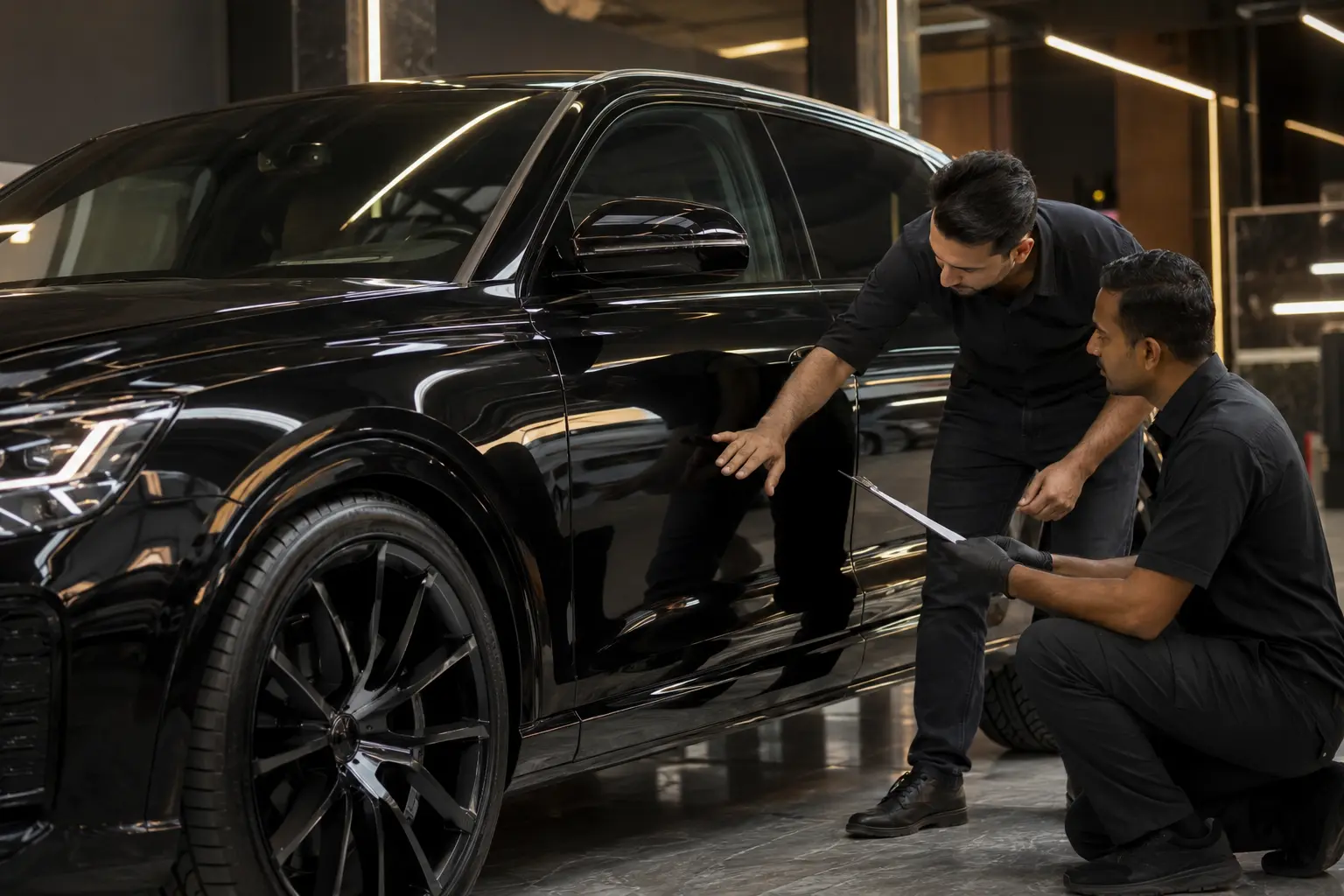
Original scenes show reflection-based assessment, crease mapping and a panel handover. They are independent workshop representations, not Audi authorization.
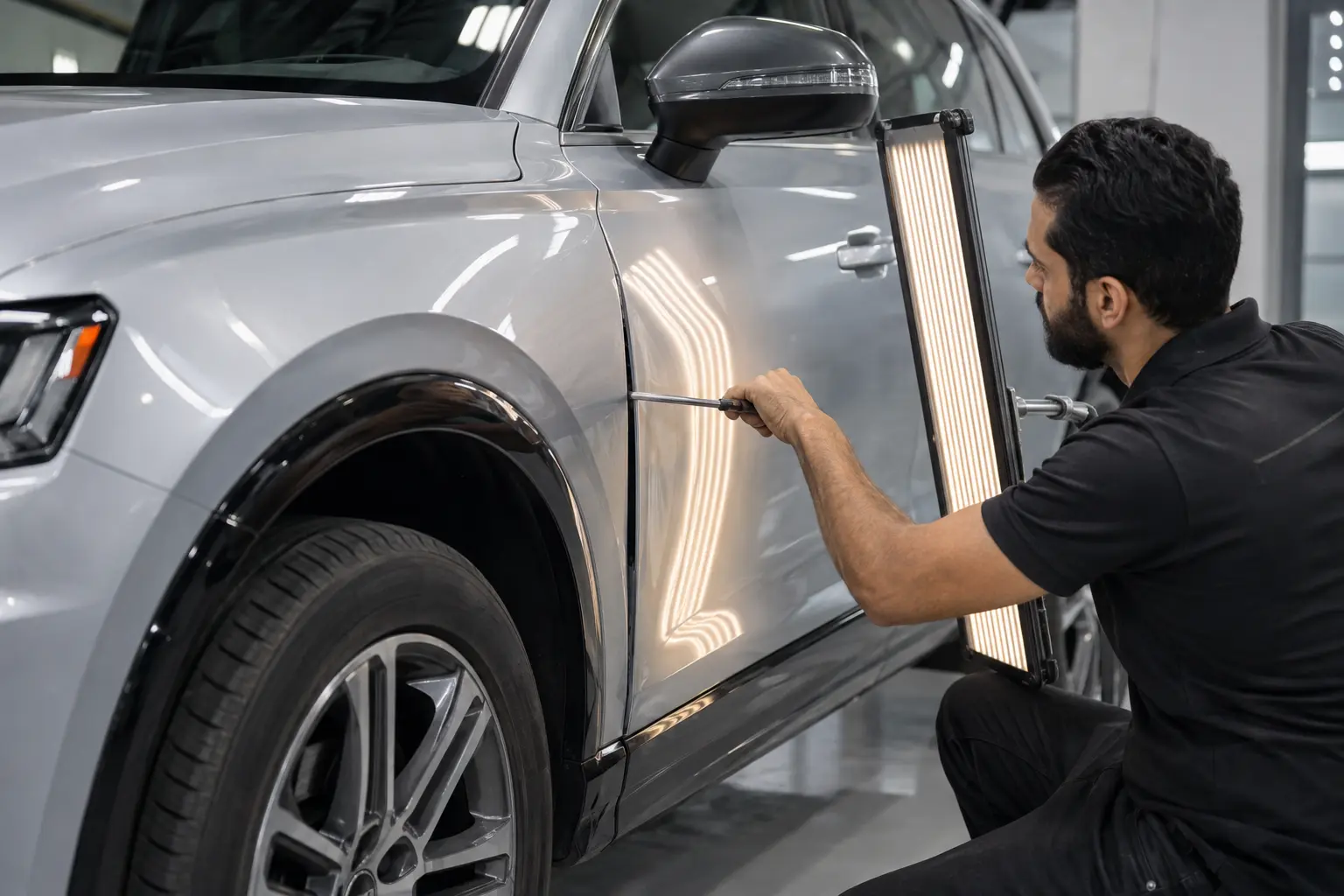
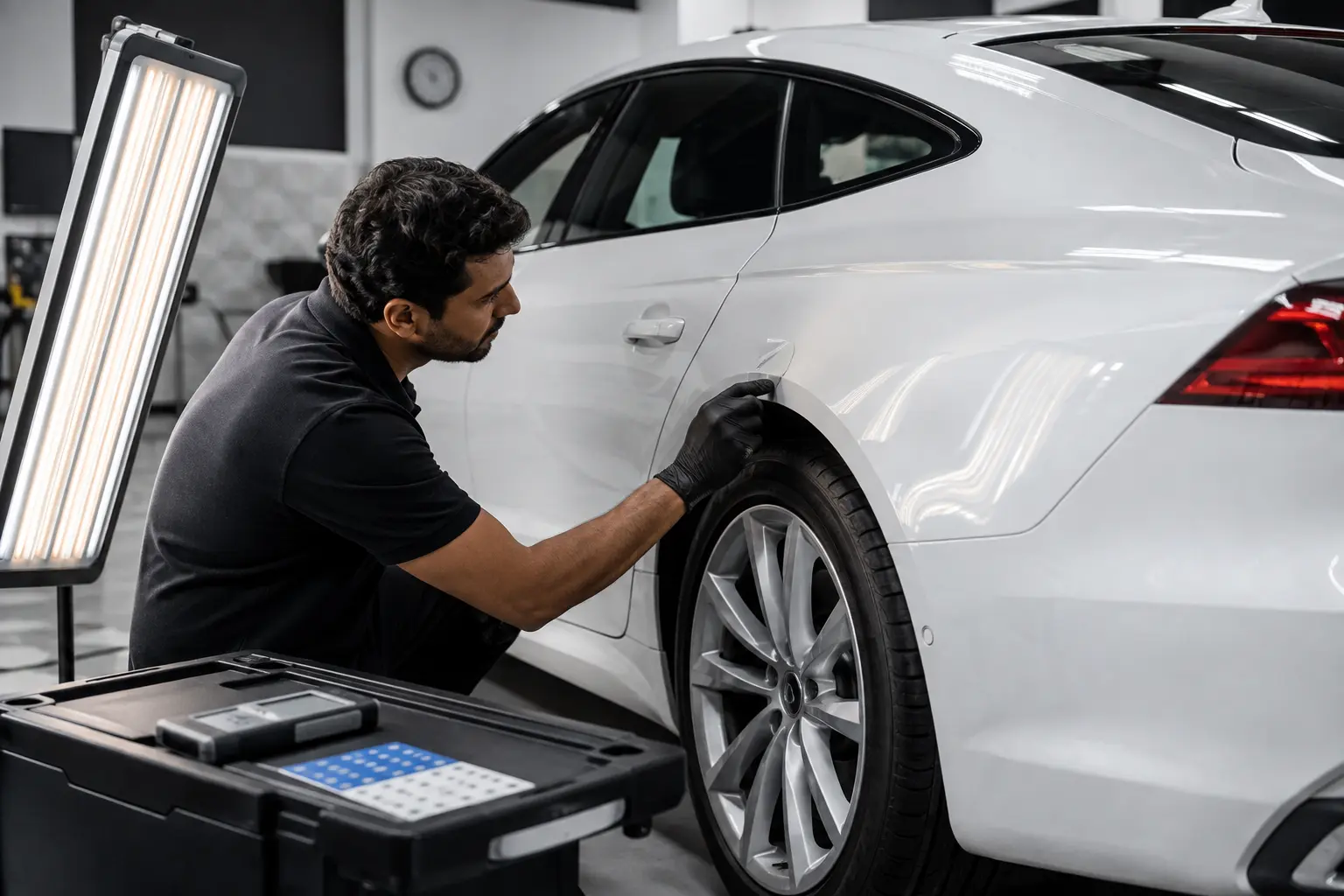
A paintless repair uses reflected lines to read microscopic high and low areas while the panel is gradually moved toward its original shape. The method can preserve factory paint, but only when paint, panel and access conditions support it.
Inspect chips, cracks, edge lifting, corrosion, repaint and filler. Refinished surfaces can respond differently to pushing, glue tabs or temperature and may fail without warning.
A broad shallow dent can still contain stretched metal; a small sharp impact can carry intense tension. Diameter alone is not a repair-time formula.
Braces, intrusion beams, double skins, adhesive, wiring and glass can block direct tool access. Trim removal should have its own protection and reassembly plan.
Exterior tabs avoid some dismantling but place load on the coating. Original paint, surface cleanliness, temperature and previous repair history affect suitability.
Damage crossing a sharp feature, flange or panel edge can require more time and may retain a trace even when the overall shape improves.
Confirm panel material and approved approach. Tool control, heat limits and work-hardening behavior cannot be assumed from a steel-panel routine.
Clean the area gently enough to reveal rather than alter the surface. Record chips, impact transfer, scratches, clear-coat marks, edge cracks, corrosion and film edges. Use a paint-thickness gauge where useful, understanding that a reading supports rather than proves previous repair.
A scratch can be transfer sitting on top, a mark in clear coat, a cut through color, or damage into primer or substrate. Polishing cannot replace missing paint, and repainting a panel is a larger intervention than removing transferred material. The estimate should name which condition is present.
If paint-protection film or vinyl crosses the dent, decide whether it can remain during assessment, must be removed for safe access, or should be replaced after repair. Adhesive age and previous coating matter. Do not promise the film will survive a process that requires stretching or heating it.
Color and texture after refinishing should be reviewed across adjoining panels and under useful light. Metallic orientation, panel angle and previous color variation can make a technically correct mix look different from one viewpoint.
Exterior sheet metal can hide restraint, electrical, water-management and driver-assistance components. The repair should not trade a visible dent for a damaged connector, water leak or warning light.
Window glass, regulator, side-impact beam, wiring, speaker, handle and side-airbag zone can affect access. Test window, lock and mirror operation before and after trim removal.
Liners, braces, bonded areas, fuel or charging hardware and rear-cabin trim may sit behind the surface. A quarter panel also connects to broader collision structure.
Inner frames, adhesives, latches, power struts, lights, cameras and wiring complicate access. Confirm closing, gaps and warning state before work.
Headliner, curtain airbags, antennas, sunroof equipment and adhesive-backed components make casual access inappropriate. Hail-type damage needs panel-wide mapping.
Plastic deformation may involve paint, tabs, absorbers, brackets, sensors and radar positioning. It is not treated as metal PDR.
Damage near a folded edge, hinge, striker or opening can affect fit and sealing. Check gaps, closing force and water management instead of judging appearance alone.
Do not proceed as minor dent work when gaps changed, a door binds, a light or sensor moved, glass contacts trim, the wheel or suspension was struck, a restraint warning appeared, or structural adhesive and seams are disturbed. These conditions need measured body and safety-system assessment.
Arrange transport if bodywork contacts a tire, a door cannot latch, glass is unstable, a sharp edge creates danger, a light is insecure, steering or braking changed, fluid is leaking, or a safety warning followed the impact.
Photograph the complete vehicle position and do not repeatedly operate a damaged window, tailgate, roof or door to demonstrate the problem.
These illustrative quotations show typical complete scopes rather than customer records. The final price depends on damage, access, paint condition and the selected repair method.
Door dent PDR
Assessment and paintless correction of one suitable shallow door dent with intact factory paint.
Illustrative total: AED 550
Fender dent and paint
Panel shaping, preparation, localized refinishing and final color and reflection checks.
Illustrative total: AED 1,450
Bumper dent repair
Plastic reshaping, preparation, paint repair and inspection of nearby mountings and trim.
Illustrative total: AED 1,250
Each stage should allow the technician to stop and ask for approval before the work changes.
Capture full panel, reflections, paint, gaps, functions and impact history.
Identify bracing, trim, glass, wiring, sensors, adhesives and panel material.
Agree PDR, spot finish, conventional repair, replacement or referral.
Protect paint, trim, electronics and adjacent panels while shape is corrected.
Review reflection, paint, texture, gaps, functions and remaining limitations.
Reflections, access and previous repair often become clear only after cleaning and in-person inspection. A useful estimate describes what is included and what finding would require a new decision.
State panel, dent count, access assumption, trim removal and expected appearance. Include the response if paint cracks or hidden filler is found.
List preparation area, substrate work, color, clear coat, blend area, removed trim and film or coating replacement.
Set a stop point for broken brackets, corroded metal, structural movement, wiring, sensors or previous repair that changes the chosen method.
Use linear reflection, broad soft light and normal viewing distance. Move the light and observer across the panel so lows, highs, waves and bodyline position remain visible. A single polished photograph can hide texture or a crown.
For painted work, compare color, metallic orientation, gloss and surface texture against adjoining panels without forcing an unrealistic expectation that aged finishes are uniform. Inspect edges, seals, trim and fasteners for paint lines or overspray.
Operate every item affected by access, including window, lock, handle, mirror, light, tailgate and sensor functions. Check panel gaps and closing force. If calibration or programming remains, the body repair is not fully complete until that dependency is documented.
The handover should identify method, removed trim, coating or film work, replaced pieces, retained original paint, function tests and remaining visual limitation. Before-and-after images should use comparable angles wherever practical.
A dent page should not become a catch-all for every impact or appearance issue.
Repair seat surfaces, headliner, leather, stitching and interior trim.
Review upholsteryUse the body-shop route when damage requires panel repair, refinishing, lamp work, or broader impact assessment.
Review body repairUse a paint-repair estimate where coating loss extends beyond dent correction.
Review car paintingPreserve impact-related sensor and restraint messages before repair.
Review diagnosticsAssess geometry when an impact involved a wheel, tire or suspension.
Review alignmentSend complete-panel and reflection photos for method triage.
Request an appointmentNo. Paint condition, metal stretch, sharpness, edge position, access, panel material and previous repair determine whether PDR is suitable.
That is its aim when the coating is original, intact and flexible. Repaint, filler, cracks, chips or film can change the risk.
One image rarely shows scale, bodylines, access or paint history. Send full-panel and shallow-angle reflection views for a useful first triage.
It may still be repairable, but concentrated tension and shape accuracy can increase time and affect the realistic finish expectation.
Possibly. Doors, roofs, hoods and quarter panels can hide braces, glass, wiring, airbags or sensors. Access should be agreed before removal.
Sometimes, but previous coatings and filler can crack or separate when moved. Their presence must be assessed and the risk stated first.
No. Auto Repair UAE is independent. Warranty, insurance authorization, official parts and Audi records remain with their respective providers.
Changed gaps, binding doors, unstable lights or glass, sensor warnings, tire contact, structural seams or altered steering require a broader assessment.
Send the Audi model and clear photos of the damaged area, then choose a workshop visit or pickup. We will confirm whether PDR, panel repair or refinishing is the appropriate next step.