Tires, wheels and alignment
Review pressure loss, irregular wear, vibration, wheel damage and geometry after a pothole or curb event. Record wheel size and tire specification, then protect lifting points before the car rises.
Review wheel alignmentBook an independent inspection for tire, brake, suspension, cabin cooling, 12-volt or visible body concerns. Send the exact model, warning message and current condition. We will explain whether the issue can be checked here or requires Tesla Service, an EV-qualified workshop or protected calibration.

A Tesla does not use the same routine-maintenance template as a combustion car. There is no engine oil, fuel filter or spark-plug service to sell. Tesla’s own UAE maintenance information focuses on condition-based items and specific checks such as tires, brakes, cabin filtration and other model-dependent work. The owner’s manual and vehicle information should guide the interval for the exact car.
Tell the advisor if the vehicle unlocks, wakes, selects drive, steers, rolls and holds charge. Include its Tesla family, generation, year, VIN, odometer, wheel size and whether the vehicle is GCC specification or imported. A refreshed Model 3, an earlier Model S and a current Model Y do not share every component or service procedure.
Describe the first event, not only the latest alert. A warning after tire replacement, collision work, a software update, deep discharge, third-party accessory installation, charging at a particular location or water exposure carries useful context. Avoid clearing messages or disconnecting the low-voltage supply solely to make the display look normal.
Auto Repair UAE is an independent workshop. It is not Tesla Service, a Tesla Collision Center or an authorized claim of access to remote diagnostics, official firmware, recalls, vehicle records or every high-voltage procedure.
The first assessment should determine whether the issue is an accessible chassis or low-voltage concern, a charging or thermal question, accident damage, a high-voltage risk, or an official software and coverage matter.
| Owner report | Evidence to preserve | First decision |
|---|---|---|
| Vehicle will not wake | Last charge level, storage duration, app status, access behavior and any low-voltage warning. | Can the low-voltage state be checked without unsafe energization or protected-system access? |
| Charging fails or stops | Location, connector, charger type, displayed message, state of charge, temperature and whether another charger was tried. | Is the fault external, inlet-related, thermal, low-voltage, software-controlled or appropriate for Tesla Service? |
| Range changed | Energy graph, recent routes, speed, climate use, tire pressure, ambient temperature, wheel changes and charging pattern. | Does the evidence indicate normal operating factors, tire drag, an accessible mechanical issue or an official battery-health question? |
| Steering or vibration concern | Road speed, surface, steering angle, braking effect, tire damage and recent wheel or suspension work. | Can tire, wheel, alignment, brake or suspension evidence explain the symptom before electronic assumptions? |
| Impact or underbody contact | Collision direction, photos, warning messages, fluid, odor, heat, scraping location and towing condition. | Does the vehicle require isolation, emergency response, a Tesla-approved collision destination or specialist recovery rather than workshop driving? |
Tesla’s owner information states that high-voltage components are not user-serviceable and warns against disassembling, removing or replacing high-voltage parts, cables or connectors. An independent workshop should accept high-voltage work only when trained personnel, model-specific information, rated protective equipment, isolation verification and a controlled work area are all confirmed.
Stop and seek the appropriate qualified or official service network if the vehicle has battery or thermal alerts, impact near the pack, exposed orange cabling, unusual heat, hissing, smoke, chemical odor, fluid near high-voltage parts or evidence of fire. Keep people away, avoid charging and follow emergency guidance rather than moving the car inside a general repair bay.
A vehicle that reaches zero displayed charge also needs a careful recovery plan. Do not repeatedly attempt to wake or move it. Share storage duration, last known percentage and current location so the receiving service can decide how low-voltage support, charging access and transport should be managed.
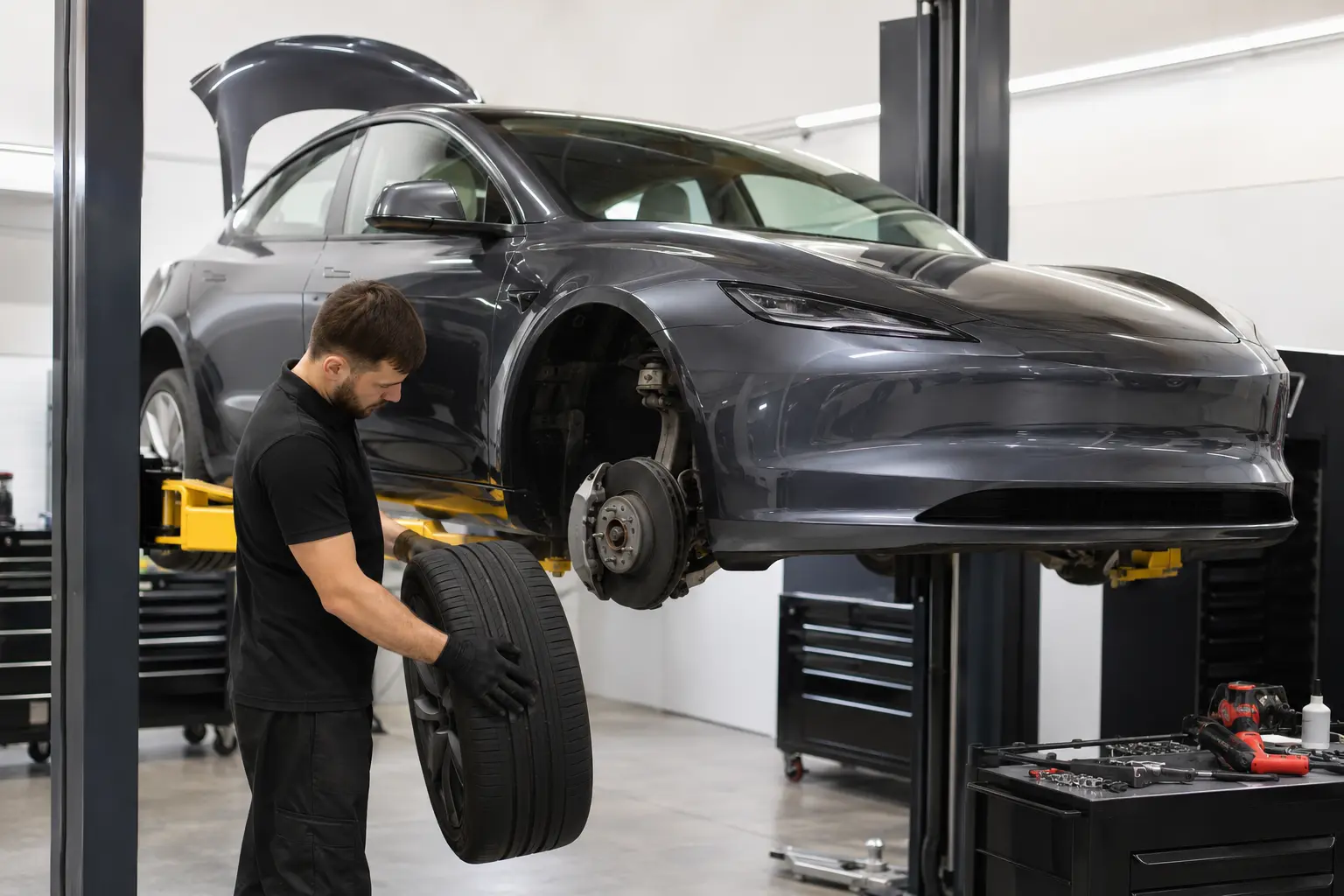
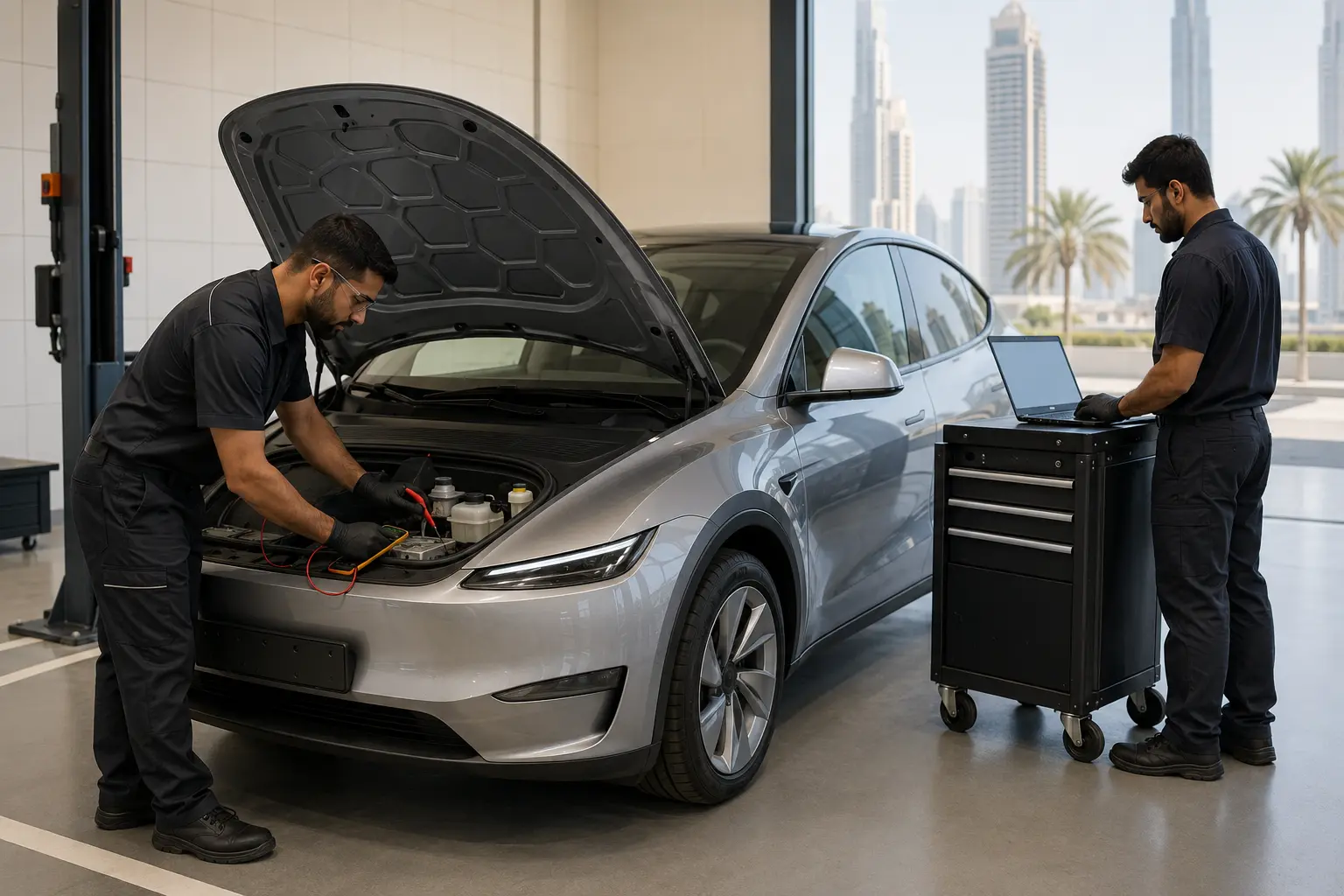
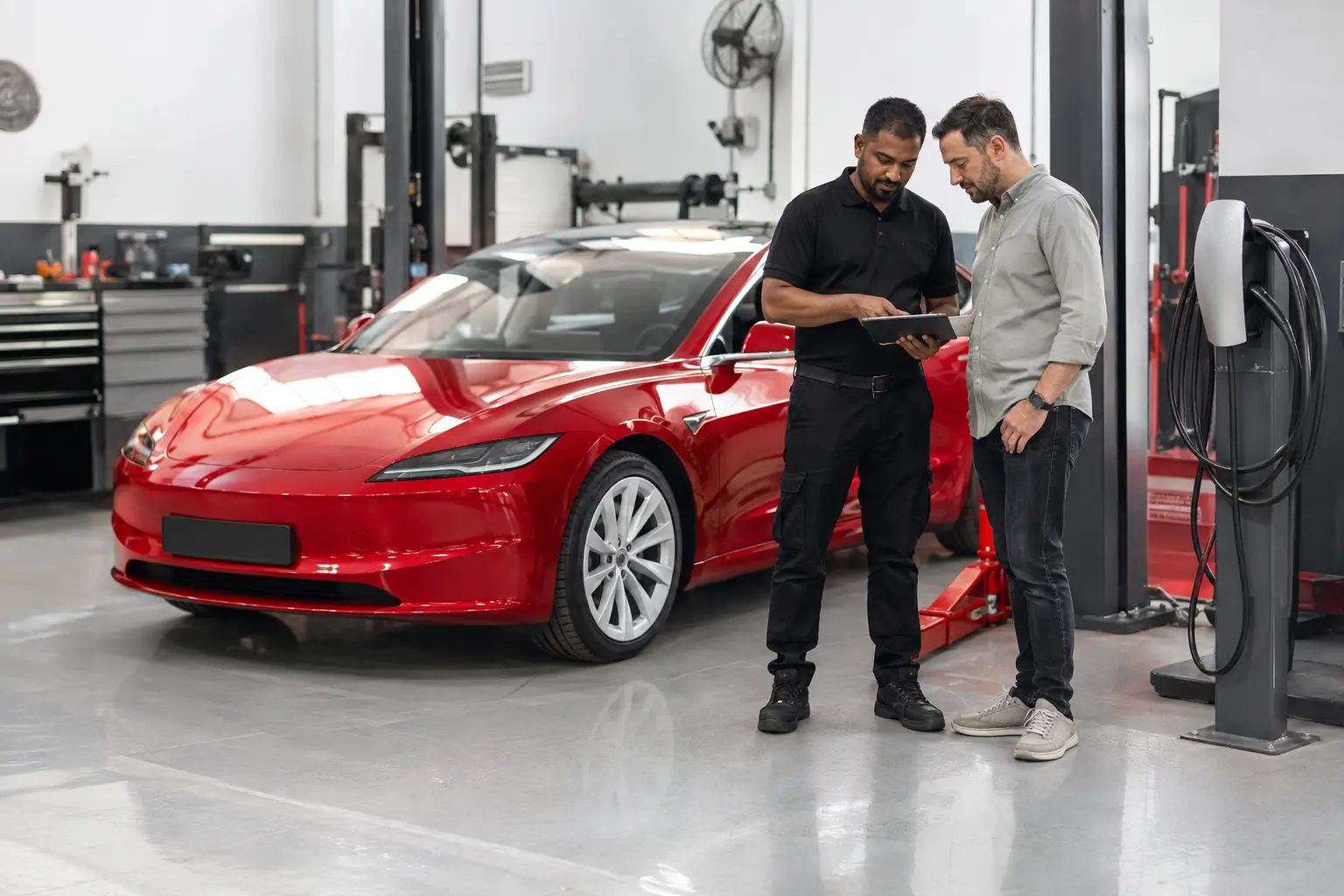
These workshop scenes show chassis inspection, low-voltage checks and an owner handover. They do not depict battery-pack repair or imply Tesla authorization.


Capability must be confirmed for the individual car. These categories explain the questions that can be assessed without promising every repair.
Review pressure loss, irregular wear, vibration, wheel damage and geometry after a pothole or curb event. Record wheel size and tire specification, then protect lifting points before the car rises.
Review wheel alignmentEV regenerative braking can change friction-brake use, but it does not remove the need to inspect corrosion, pad and disc condition, hoses, fluid, parking-brake behavior and abnormal noise.
Review brake repairCheck joints, bushings, dampers, links, wheel bearings, fasteners and geometry when the car develops clunks, pulling, changed ride height or tire wear.
Review suspension repairVent temperature, airflow, odor, filter loading and electronic commands can be checked during the agreed inspection. High-voltage compressor and thermal-system work requires an EV-qualified workshop.
Review AC diagnosisDoor, glass, trim, wiper, lighting and accessible low-voltage issues may be assessed after confirming the vehicle state. Software control can still make Tesla Service the correct destination.
Review diagnostic intakeWhen the category is unclear, send the alert photograph, VIN, model, charge state and current mobility so the advisor can accept or redirect the visit.
Request an assessmentA heavy electric vehicle with immediate torque can expose pressure, wear, wheel or alignment problems quickly. Record cold tire pressures, tread depth across each tire, age, sidewall damage, wheel runout and whether vibration follows a specific road speed. Do not blame the battery for increased energy use before checking underinflation, tire changes, dragging brakes and geometry.
Lift preparation is part of the repair. Identify the approved lifting locations for the model and production period, inspect the contact area and use suitable equipment. Battery-enclosure proximity makes casual pad placement unacceptable. After wheel work, document tightening, pressure settings and whether alignment or a controlled road check is still required.
Brake noise after washing or storage may differ from persistent scoring, binding or hydraulic concerns. Inspection should measure usable friction material and disc condition, confirm free movement and check fluid or hose evidence. The handover should distinguish an observation from a safety defect and explain how regenerative braking affected the test.
Correct pressure, inspect tires and wheels, check suspension play, confirm ride height and ask about collision or curb contact. Alignment values cannot repair a bent wheel or loose joint.
Match size, load, speed rating and vehicle requirements. Explain any change in rolling characteristics, noise or range expectations rather than calling every same-size tire equivalent.
Connect noise or vibration to measured wear, temperature, corrosion or movement. A visual glance through the wheel is not a full brake assessment.
Verify steering-center position, warning state, road feel and the original complaint where safe. Record any calibration or official-service need.
A charging complaint needs more than the sentence “it will not charge.” The following details help separate equipment, access, temperature, low-voltage, inlet, settings and vehicle-service possibilities.
Name the home, destination, public AC or DC location; connector or adapter; displayed power; starting percentage; stop point and any charger-side message. Trying another known-working charger may add evidence, but do not repeatedly reconnect damaged or hot equipment.
Weak cabin cooling, unusual fan operation and charging reduction can involve overlapping thermal questions. Record outside temperature, drive duration, parked condition and alerts. High-voltage thermal hardware must be handled by an EV-qualified workshop.
Note the current version, pending update and whether behavior changed after installation. Do not promise a firmware downgrade, feature activation, remote-data access or official configuration change from an independent workshop.
The workflow should protect the vehicle state, the people handling it and the owner’s official options.
Collect identity, charge state, screenshots, access status, event history and mobility.
Check impact, heat, odor, smoke, fluid, exposed cabling and unsafe underbody evidence.
Define tire, brake, suspension, physical, low-voltage or other supported inspection limits.
Connect observations and values to the owner’s original condition without clearing useful evidence.
State completed work, unresolved alerts and any Tesla Service or EV-specialist requirement.
Tell the recovery operator the exact model, if it unlocks, whether transport mode is available, whether it steers or rolls, and if any wheel is locked or the battery is depleted. Use the model-specific towing instructions and equipment. Dragging the vehicle or improvising underbody contact can cause additional damage.
After collision or suspected battery impact, keep the recovery and storage plan separate from routine workshop collection. A qualified service may need to advise isolation, loading and the safe holding location before movement begins.
Component selection begins with the VIN, production period, exact part identity and applicable service information. A part that fits physically may still depend on software configuration, calibration, security access or a different hardware revision. The estimate should state when installation cannot be completed or verified independently.
Keep touchscreen screenshots, photographs, measurements, tire details, alignment results, part documentation and invoices together. If the car later visits Tesla Service, a clear chronology helps the receiving team understand the original condition and independent actions without presenting them as official Tesla records.
Do not transfer app access, disclose account credentials or change ownership settings for workshop convenience. Use only the access the owner intentionally provides and return cards, keys and devices at handover. Personal data visible on the touchscreen should not be photographed unless it is necessary to the repair record and agreed with the owner.
No. This is an independent workshop. Official firmware, remote diagnostics, recall, warranty, Tesla service-history and protected vehicle operations should be handled through Tesla.
You can send details for Model S, Model 3, Model X or Model Y vehicles. We can confirm the booking after reviewing the generation, configuration, present condition, safe access and requested work.
No battery-pack capability is promised on this page. High-voltage work requires trained personnel, model-specific procedures, isolation equipment and a controlled environment, and official warranty questions belong with Tesla.
An appointment may cover tire, wheel, brake, bearing, steering, suspension and alignment evidence after the exact vehicle and safe lifting method are confirmed.
Send the full alert, charge percentage, charger and connector type, location, temperature, time charging stopped, recent software events and whether another known-working charger behaved differently.
No. Preserve the touchscreen message and its timing. Clearing alerts, disconnecting low voltage or repeatedly restarting can remove useful context without correcting the cause.
Call first. The recovery plan depends on model, access, transport mode, steering, locked wheels, charge state, collision damage and Tesla’s model-specific towing instructions.
The workshop repeats the relevant physical measurement or operating check where safe, confirms the vehicle state and documents any alert or procedure that still requires Tesla Service.
Send the VIN, model, remaining charge, full touchscreen message and a short account of what happened before the fault. From that information we can say whether the car is appropriate for an independent mechanical check or needs Tesla support.