Luxury car repair Dubai
Book luxury car repair in Dubai for maintenance, diagnostics, engine, transmission, suspension, brakes, AC and electrical faults. Start with a free inspection at our Al Quoz 4 workshop, or request free pickup and delivery.
Plan the likely workshop cost
These estimated Dubai ranges help set an initial budget for common work. The final amount depends on the vehicle, fitted equipment, access, parts choice and inspection results. Your written quotation will show the complete scope and VAT treatment before repair approval.
| Luxury car service | Estimated price | Typical inclusion |
|---|---|---|
| Workshop inspection | Free | Initial symptom review and visible-condition check at our Al Quoz 4 workshop. |
| Computer and fault diagnosis | AED 300–750 | Relevant scan, basic electrical checks and targeted testing for the reported concern. |
| Minor service | AED 750–1,800 | Suitable engine oil and filter, standard checks and service reset where applicable. |
| Brake repair | AED 1,200–3,500+ per axle | Suitable pads or pad-and-disc package, installation and final brake checks. |
| AC diagnosis and repair | AED 350–2,200+ | Performance diagnosis followed by the confirmed electrical, airflow or refrigerant repair. |
| Suspension repair | AED 650–4,500+ | Repair of the confirmed mechanical, air-suspension, sensor or control fault. |
| Battery replacement | AED 700–2,000 | Correctly specified battery, installation and charging-system verification. |
Want a closer luxury-car estimate?
Send the make, model and service or symptom. We will provide the closest useful range and arrange a free workshop inspection, free pickup and delivery, or a dedicated on-site assessment where suitable.
Protect the vehicle while preserving technical evidence
Careful handling is a system: suitable movement, surface protection, access planning, clean records and a final condition review. It is not a promise that every technical operation can be completed in-house.
Create a two-sided handover record
Photograph exterior panels, wheel surfaces, glazing, cabin displays and mileage with the owner or authorized representative. List keys, chargers, covers and removable accessories.
Repeat the record at collection so custody is transparent and any technical warning can be compared with arrival.
Choose lifting points deliberately
Long wheelbases, air suspension, carbon structures, side steps and underbody covers can affect safe lifting. The workshop should check vehicle information and equipment before positioning.
A premium appearance does not make ordinary lifting practices universally suitable. Ask how the specific chassis will be supported.
Protect sensitive surfaces
Fender covers, clean seat and steering protection and careful tool placement reduce avoidable contact. Existing film edges, wrap damage or ceramic coatings should be noted before access.
Where trim or fasteners must be removed, clarify replacement availability and the risk of age-related breakage.
Maintain battery stability
Long storage and numerous comfort modules can reduce low-voltage reserve. Use compatible support equipment only at approved points and record each discharged-battery incident or booster use.
If discharge repeats, request capacity, charging and sleep-current evidence rather than assuming the newest battery is healthy.
Preserve removed-part traceability
The invoice should identify part source and reference, and removed components should be available for review where practical and lawful. Photograph concealed findings before disposal.
A genuine-looking package or familiar logo does not replace supplier and fitment verification.
Verify with matched conditions
Final checks should address the original warning, temperature, road speed, suspension mode, braking load or parking duration where safely achievable.
Static code clearing is not sufficient proof for a fault that only appeared under a specific operating condition.
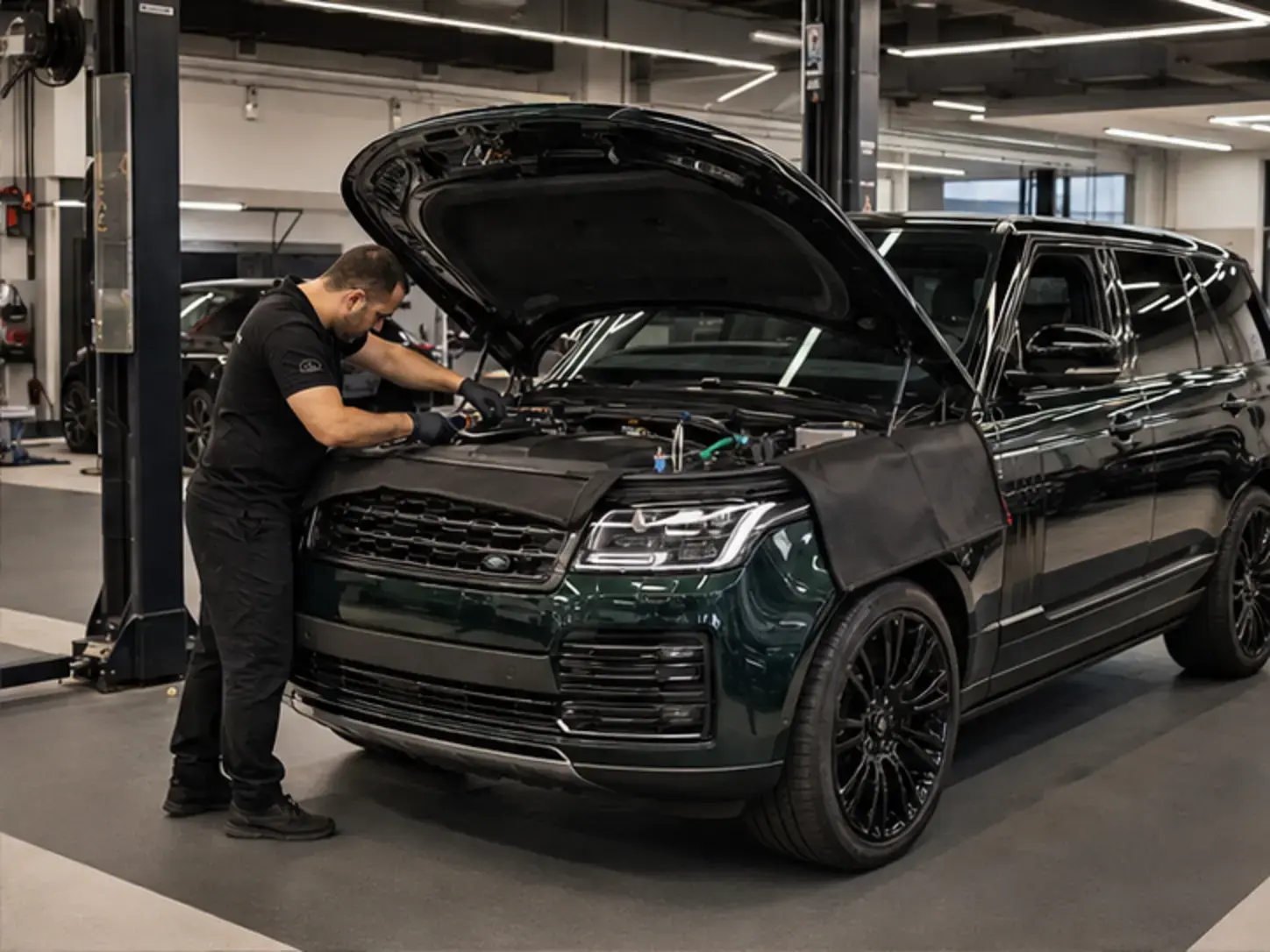
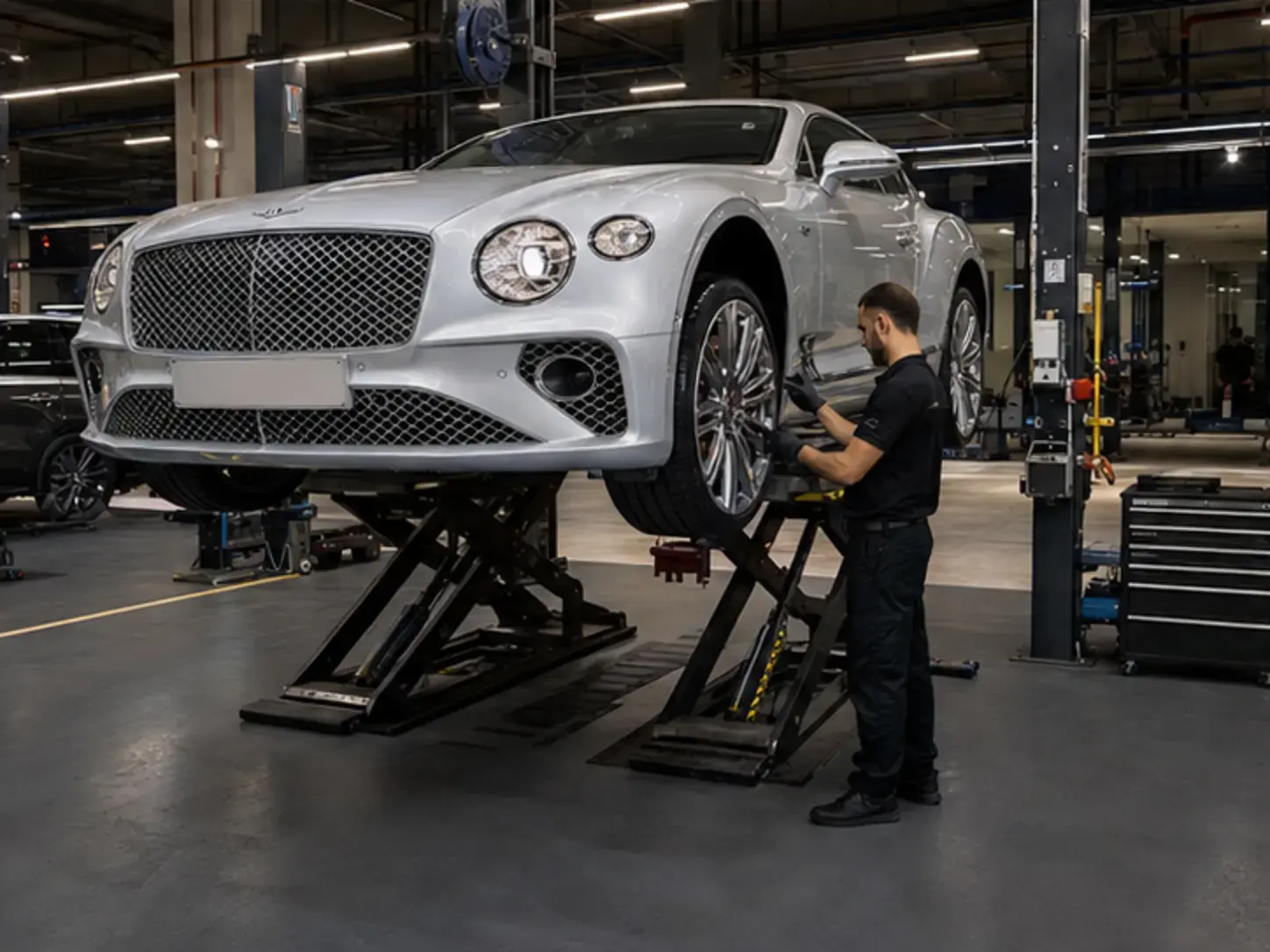
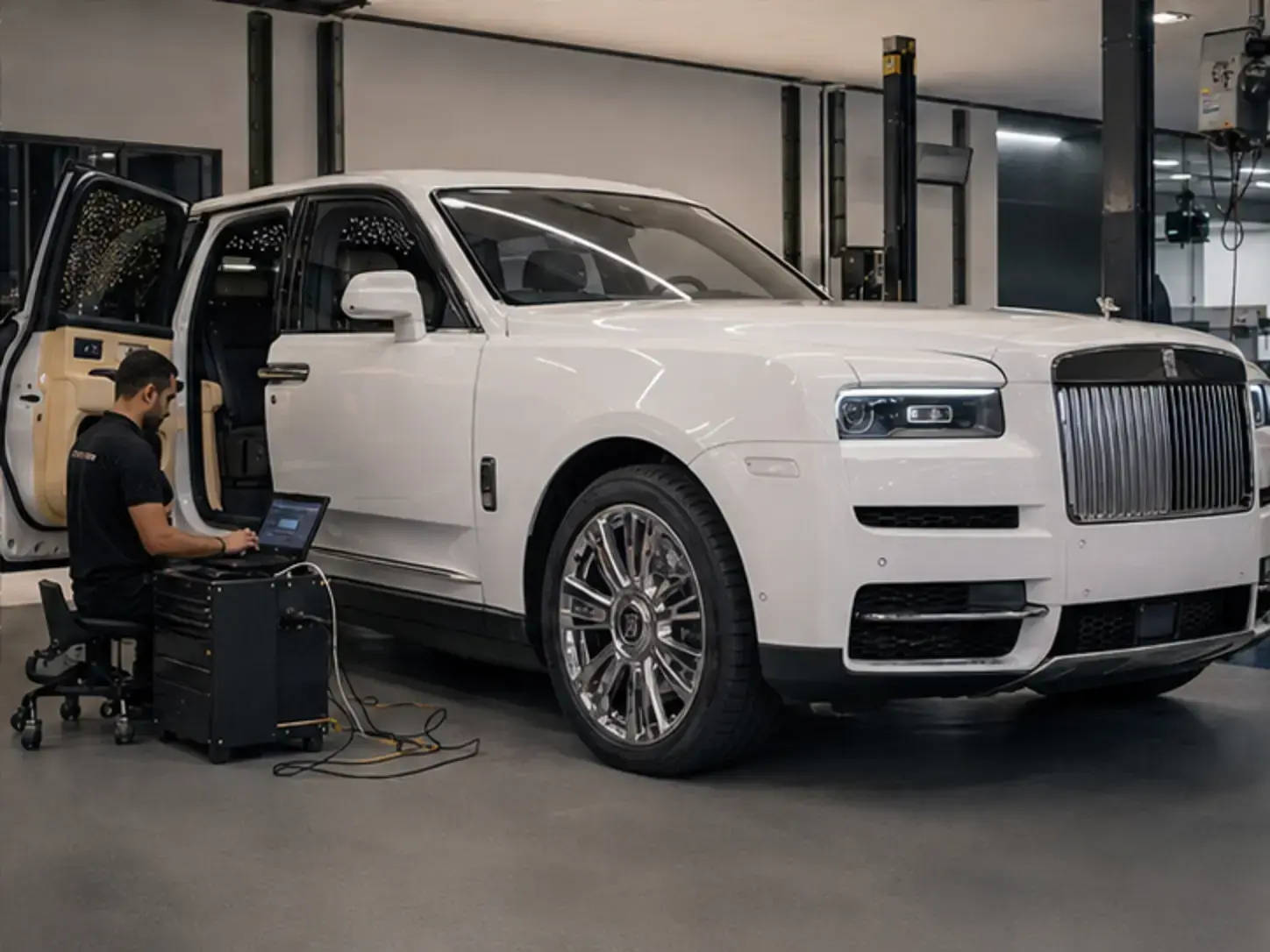
Show protection, access and verification
Each image uses a full workshop background and a complete modern vehicle. The sequence illustrates protected engine inspection, low-clearance chassis work and cabin or low-voltage verification.
Separate evidence, access and optional work
A premium vehicle can present safety, reliability, maintenance and cosmetic requests together. The estimate should make each category visible and allow the owner to authorize a defined scope.
| Request or finding | Information that supports it | Written clarification |
|---|---|---|
| Fluid trace under a parked car | Fluid identity, source area, cleaned recheck, level or pressure context, undertray condition and warning history. | Which leak is confirmed and what becomes visible only after access? |
| Ride height differs by corner | Level-ground measurements, elapsed time, selected mode, leakage, supply operation, sensors and mechanical hardware. | Is the proposal pneumatic, hydraulic, electrical or structural? |
| Brake vibration via the cabin | Tyre and wheel condition, disc and pad evidence, hub surfaces, bearings, joints and temperature history. | What measurement locates the cause before expensive parts are ordered? |
| Multiple controls reset after storage | Battery capacity, charging, grounds, support history, parked current, code chronology and returning faults. | Which functions remain faulty once low-voltage supply is stable? |
| Cabin temperature varies by zone | Vent temperatures, airflow, filters, leakage evidence, actuators, sensors and control commands. | Does the work address cooling capacity, air distribution or electronics? |
| Driver-assistance warning after impact | Tyre and wheel status, ride height, alignment references, sensor mounting and diagnostic information. | Is outside calibration required after mechanical condition is corrected? |
Choose the least intrusive reliable starting point
High component prices make disciplined diagnosis essential. A code, noise or visible stain should define a question, not a shopping list. Immediate safety and damage containment come before convenience or appearance.
The initial visit can identify condition and the next responsible test. It cannot honestly guarantee concealed access findings, restricted programming, special-order supply or a fixed completion time.
- Vehicle cannot move normally
- Explain immobile wheels, absent propulsion, collapsed suspension height, steering restriction, fluid loss and body-clearance concerns. Movement should be agreed before a recovery truck or workshop ramp is chosen.
- Engine or temperature warning is active
- Stop when guidance or severe symptoms require it. Record temperature, smoke, sound, fluid evidence, fan behavior and the event sequence without repeated road testing.
- Chassis feels different after impact
- Photograph tyres, wheels and ride stance. Provide speed, surface and steering or braking changes. Inspect road-contact hardware before geometry or electronic controls are blamed.
- Electrical faults appear after storage
- Describe parking duration, battery support and every affected function. Stable supply, grounds, network behavior and individual returning faults are separate diagnostic layers.
- Cabin comfort is the only concern
- List exact zones, fan levels, temperature readings where known, odors, sounds, seat functions and control responses. Keep comfort approval separate from unrelated mechanical work.
- Cosmetic repair overlaps disassembly
- Identify finish type, film, wrap, carbon or trim around the work area. Agree condition, removal method, fastener supply and refinishing responsibility before access.
Luxury repair costs in context
These illustrative jobs show typical complete scopes rather than customer records. The final recommendation depends on inspection, current parts availability and the exact equipment fitted to the vehicle.
Front brake refresh
OEM-equivalent front pads and discs, installation, hub preparation and final brake checks.
Illustrative total: AED 4,200Calipers, hoses and rear-axle work are excluded unless inspection confirms a need.
AC performance repair
System diagnosis, replacement of a suitable pressure sensor, refrigerant service and vent-temperature verification.
Illustrative total: AED 1,850Compressor, evaporator and condenser replacement are separate if required.
Front suspension repair
Two OEM-equivalent front control arms, installation, joint inspection and wheel alignment.
Illustrative total: AED 3,400Air-suspension units, active chassis components and seized hardware are separate.
Choose your luxury car
Use the dedicated brand page for model-specific services, workshop routes, estimated prices and booking guidance.
Ultra-luxury cars
German premium and performance
Audi, BMW, Mercedes-Benz, Porsche, Alpina, Wiesmann and Gumpert
Italian performance cars
Ferrari repair, Lamborghini repair, Maserati repair and Pagani repair
British luxury and performance
Jaguar, Land Rover, Range Rover, Lotus, McLaren and Noble
Luxury sedans and SUVs
Lexus repair, Genesis repair, Cadillac repair and Lincoln repair
Hypercars and specialist marques
Premium electric cars
High-voltage isolation, carbon-structure repair, advanced calibration, security programming and manufacturer-restricted software may require specialist capability. We confirm what can be inspected or completed before major work begins.
Route the verified system to focused information
This page coordinates custody and complex intake. Supporting service pages explain individual systems once the requested work and capability are clear.
Condition and diagnostic review
Begin with warning preservation, physical inspection and targeted measurements when fault ownership is unclear.
Open high-care diagnosisEngine and thermal concerns
Use for leakage, smoke, overheating, misfire or mechanical sound after safe movement is confirmed.
Read engine assessmentTransmission behavior
Engagement, shift, shudder or driveline vibration require temperature, mount, fluid, shaft and control evidence.
Review transmission pathBrake system
Changed feel, vibration and warnings are evaluated with wheel, tyre, hub, bearing and suspension condition.
See premium brake careSuspension and ride height
Height differences, knocks and uneven wear need mechanical and control checks before alignment is recommended.
Explore chassis serviceCabin climate
Airflow, vent temperatures, heat rejection, leakage, zones and actuators distinguish cooling from distribution faults.
Open climate-system guideControl custody from booking to collection
The process makes vehicle protection and technical authorization equally visible.
- 01
Review dossier and movement
Confirm identity, condition, clearance, warnings, requested work, transport and workshop capability.
- 02
Record handover and evidence
Document exterior, cabin, mileage and keys, then begin with agreed non-invasive tests.
- 03
Authorize access and parts
Connect findings to a written scope, source, risks, timing and escalation method.
- 04
Verify and repeat condition record
Test the original function, collect measurements and complete a final custody review at handover.
Put protection and technical scope together
Confirm the verified finding, diagnostic evidence, part source, access method, surface protection, fluids, consumables, labour, tax, coding, setup or calibration and final test. Agree whether removed components can be retained or inspected.
Avoid unverified dealer affiliation, universal model coverage, unsupported superlative claims, fixed turnaround and blanket warranty language. Every term should refer to the documented vehicle and the exact independent repair.
If the vehicle must stay for observation or await a specialist, record indoor or outdoor positioning, key custody, battery support, planned movement and the communication interval. Storage is not simply empty time; tyres, suspension height, low-voltage state and weather exposure may need deliberate management.
For finishes surrounding the work area, decide whether film, trim, carbon or delicate fasteners can remain in place. Where removal is necessary, clarify replacement supply and who owns refinishing or reapplication. These practical terms should be agreed before technical disassembly begins.
Set expectations before handover
These answers describe independent high-care coordination. Vehicle-specific capability follows dossier review.
Is this a manufacturer-authorized luxury workshop?
Neither manufacturer nor dealer approval is implied. The independent workshop confirms scope for each model and operation.
How is existing vehicle condition recorded?
Exterior, wheels, cabin warnings, mileage, keys and accessories should be photographed and noted at arrival and collection.
Can a low-clearance car arrive by road?
Share clearance, ride-height, wheel, tyre plus steering condition first so driving or suitable transport can be discussed.
Do you work on every luxury-car system?
No universal coverage is claimed. High voltage, protected programming, calibration, structures and unusual active systems may require referral.
Can you investigate intermittent warnings?
Yes, when the event history is preserved. Some conditions require observation, matched operating tests or staged diagnosis.
May I supply premium-brand parts?
Ask before purchase. Reference, source, authenticity or quality, condition, coding and fitment responsibility need agreement.
What should I include in the first message?
Send make, model, VIN, year, mileage, requested task, warnings, service record, modifications, clearance and condition photographs.
Where is the high-care booking coordinated?
Vehicle reviews use FCP’s high-care reception on Dubai’s fourth Al Quoz industrial block.
Can the car remain indoors while parts are sourced?
Storage position and timing must be verified for the individual booking. Ask about key custody, battery support, movement and progress communication.
How are optional cosmetic items handled?
Keep paint, trim, film and appearance work separate from verified safety or drivability repairs so each scope and responsibility stays clear.
Request luxury car repair
Send the make, model and main service or symptom, then choose a workshop visit or pickup. We can request technical or transport details later when they are needed for safe handling or parts matching.