
Change the engine oil at the time or mileage limit specified for your exact car, whichever comes first. Many modern vehicles use a schedule somewhere between 8,000 and 15,000 km or 6 to 12 months, but this is only a planning range. The correct interval depends on the model, engine, oil approval, market and driving conditions. Short journeys, long idling, towing, dusty roads and high engine load may activate a manufacturer’s severe-service schedule. A red oil-pressure warning, knocking noise, low oil level or visible leak needs immediate assessment instead of waiting for the routine interval.
Reviewed scope: This guide separates routine oil timing from oil-pressure faults and oil-selection questions. Vehicle-specific instructions always take priority.
Find the Oil Change Interval From Evidence
“Every 5,000 km” is easy to remember. “Full synthetic lasts longer” is easy to sell. Neither statement works for every engine. A responsible decision uses the manufacturer’s schedule, the required oil specification, the vehicle’s actual use and its condition since the last service.
| Your situation | What controls the interval | What to check now |
|---|---|---|
| Normal mixed driving with reliable records | Owner’s manual time and distance limits | Oil level, service reminder, date, mileage and leaks |
| Frequent short trips or long idling | Severe-service schedule when the manufacturer specifies one | Fuel smell, moisture signs, rising level and operating pattern |
| Unknown maintenance history | Establish a documented baseline instead of guessing | Engine identity, required approval, filter, level, leaks and stored records |
| Very low annual mileage | Keep the time limit as well as the distance limit | Repeated cold starts, moisture, battery condition and storage effects |
| Red oil warning or abnormal engine noise | Safety and diagnosis override the routine schedule | Stop safely and follow the owner’s manual |
If the schedule says 10,000 km or 12 months, the oil is due when either limit arrives. A vehicle driven only 4,000 km in a year does not earn an unlimited extension. A high-mileage driver may reach the distance limit several times before the annual date.
Engine Oil Change Interval Decision
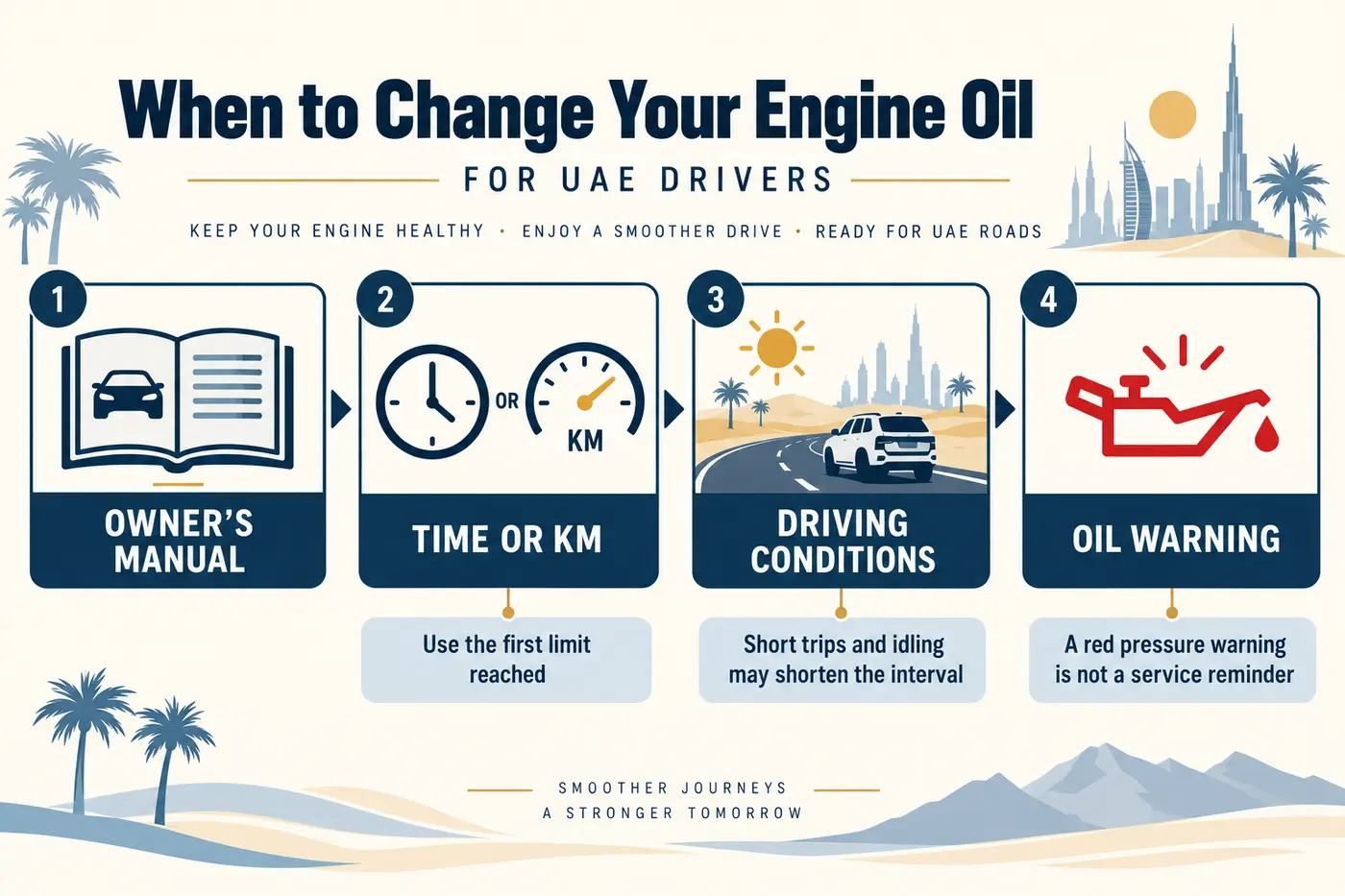
Start with the exact owner’s manual. Apply the first time or distance limit reached, then check whether the vehicle’s use meets the manufacturer’s severe-service conditions. Treat a red pressure warning as a fault, not as permission to drive until the next service.
This decision path is also shown in the infographic. The same information remains in HTML so it is accessible without the image.
Dubai Driving Can Change the Service Decision
Dubai heat does not automatically mean every car needs oil every 5,000 km. The manufacturer decides whether heat, dust, towing, short trips or idling require a severe-service interval for that vehicle.
Short trips matter because the engine may not stay warm long enough to evaporate moisture and fuel from the oil. Long idling adds operating hours without adding much odometer distance. Dust increases the need to inspect filtration. Towing, desert driving and repeated high engine load can raise oil temperature and oxidation.
Use the severe schedule only when the vehicle information connects your use to it. Otherwise, follow the normal schedule and inspect the oil level and vehicle condition between services.
Time and Mileage Answer Different Questions
Mileage represents engine operation and accumulated use. Time covers aging that continues while a vehicle is driven lightly or stored. Moisture, fuel dilution, repeated cold starts and chemical aging can matter before a low-mileage car reaches its distance limit.
Low annual mileage
Keep the calendar limit. Check whether frequent short trips prevent the engine from reaching full temperature. A low odometer reading does not prove the oil is suitable for several years.
High annual mileage
Use the mileage limit and track each service. Commercial or long-distance use can require several oil services in a year even when the calendar date seems recent.
Long storage
Check the date, battery, tires, fluids and visible leaks before returning the vehicle to regular use. Do not assume storage pauses every maintenance requirement.
Unknown records
Identify the engine and correct specification, then establish a documented baseline. Do not select oil from the model name alone.
An Oil-Pressure Warning Is Not a Service Reminder
An amber maintenance reminder normally indicates scheduled work. A red oil-can symbol or “low oil pressure” message can indicate that the engine is not receiving adequate lubrication. Move out of traffic, stop safely and switch the engine off. Follow the instructions in the owner’s manual.
Continuing to drive with inadequate pressure can damage bearings, camshafts, timing components and turbochargers quickly. A low level may be involved, but adding oil does not automatically resolve the cause. Oil can leave through a leak, burn inside the engine or become contaminated.
| What you notice | Possible meaning | Safe next step |
|---|---|---|
| Amber service reminder | Scheduled maintenance is approaching or due | Confirm the date, mileage and required scope |
| Red oil-pressure warning | Pressure may be too low for safe lubrication | Stop safely, switch off and follow the manual |
| Oil level below minimum | Leak, consumption or an incorrect previous fill may be involved | Use only the correct oil and investigate the loss |
| Knocking, tapping or turbo noise | Lubrication or mechanical damage may be present | Avoid continued driving and arrange diagnosis |
| Milky residue or rising oil level | Moisture, coolant or fuel contamination may be possible | Do not rely on a routine oil change alone |
Oil Specification Matters More Than Marketing Labels
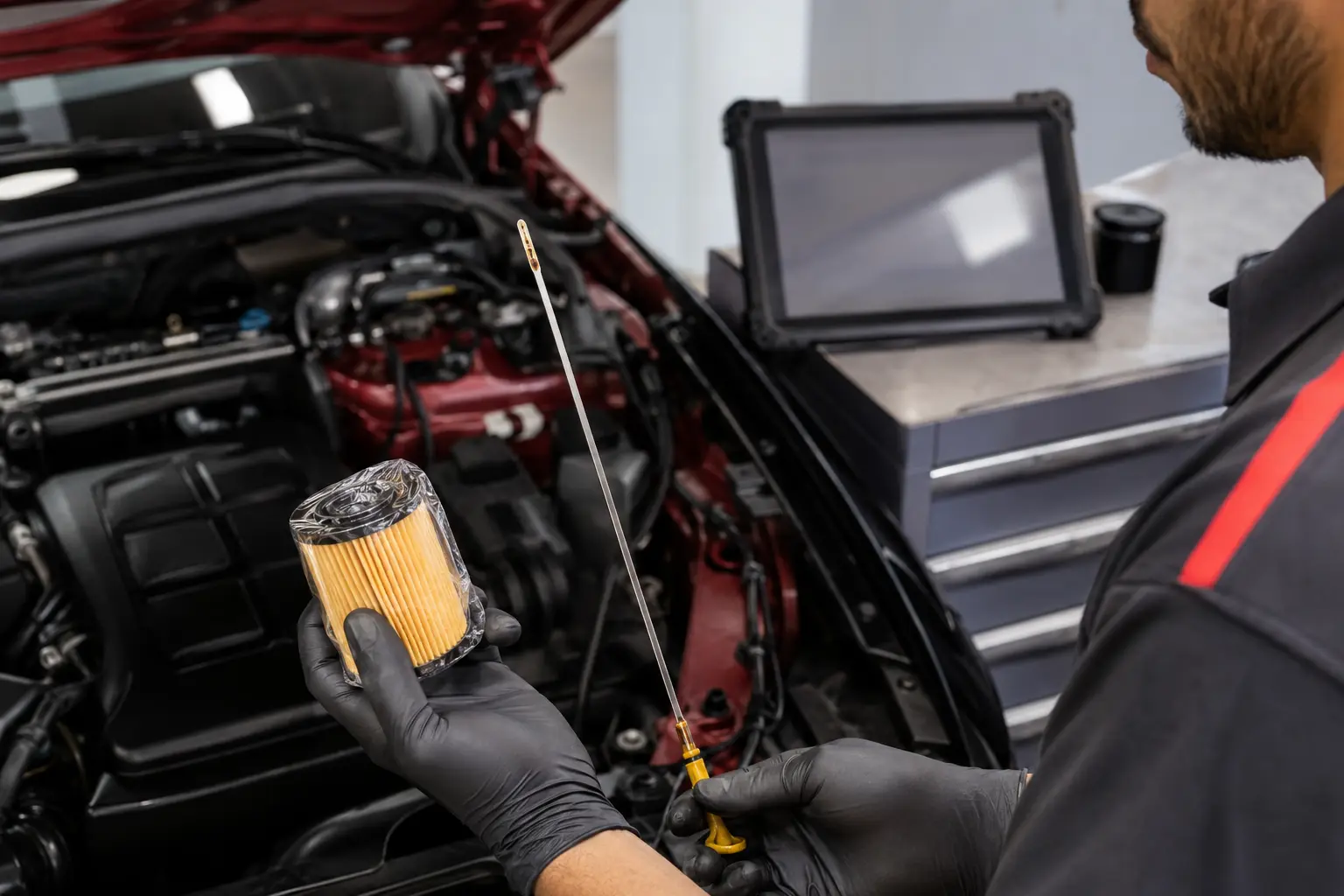
Viscosity such as 0W-20 or 5W-30 describes flow behavior, but it is not the complete instruction. The container may also need an API category, ILSAC, ACEA or manufacturer approval. That approval covers performance requirements relevant to the engine and emissions system.
Do not choose oil simply because it is synthetic, conventional or labeled for high mileage. An older engine may require a full-synthetic approved product. A newer engine may use a different viscosity and approval from another engine in the same model range. For viscosity, approvals and label interpretation, use our separate guide to choosing motor oil. This page owns the change-interval decision.
Diesel particulate filters and some turbocharged engines are particularly sensitive to oil chemistry. Use the owner’s manual, official service information or vehicle identification data to confirm the requirement.
What Oil Color Can and Cannot Tell You
Oil can become dark soon after a change because detergent holds soot and deposits in suspension. Dark color alone does not prove that oil is overdue. Clear-looking oil can still be old, below level, fuel-diluted or the wrong specification.
A dipstick check is still useful for level and obvious contamination. Park as the manufacturer directs, allow the specified waiting time and use the correct checking procedure. Some vehicles use an electronic level display rather than a physical dipstick.
Oil analysis can provide more information about viscosity, contamination and wear metals, but it is not normally necessary for a routine passenger-car service. It is more useful when investigating repeated contamination, unusual wear, fleet intervals or a high-value engine problem.
Signs That Need Diagnosis, Not Just Fresh Oil
- Oil level repeatedly falls between services
- Blue exhaust smoke or an oil-burning smell
- Oil or coolant contamination
- Knocking, tapping or timing noise
- Overheating or cooling-system loss
- Misfires, rough running or fuel dilution
- Leaks around the engine, filter or drain point
- A warning that returns after an oil change
Fresh oil may protect the engine while the cause is investigated, but it does not repair worn seals, blocked ventilation, a leaking housing, fuel-system faults, coolant contamination or low mechanical oil pressure. Ask for a diagnosis when a symptom exists.
If the engine warning is involved, use the check engine light decision guide. For the complete maintenance schedule beyond engine oil, see how often to service a car in the UAE.
What a Correct Oil Change Should Include
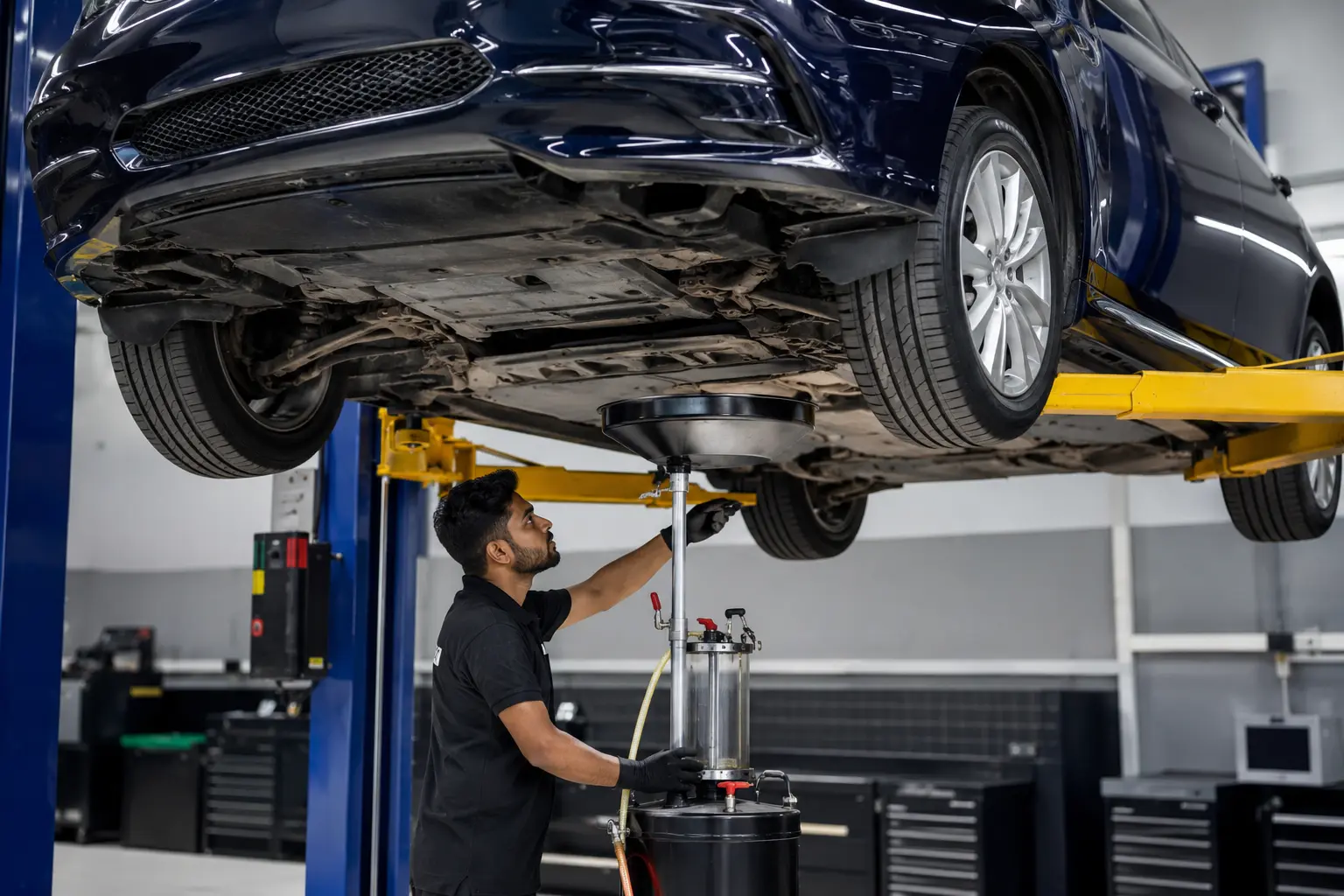
A proper service begins by confirming the engine, oil approval, viscosity, quantity and filter. The technician should inspect the drain point, filter housing and visible leak areas before and after the service.
- Confirm the vehicle identification and engine.
- Verify the required oil approval and quantity.
- Inspect the level and visible condition before draining.
- Replace the filter and required sealing hardware.
- Fill and confirm the level using the correct procedure.
- Inspect for leaks after running the engine as required.
- Reset the maintenance display only after completion.
- Record the oil, quantity, filter, date and mileage.

Engine Oil Change Prices in Dubai
These are our planning ranges. The price changes with oil quantity, manufacturer approval, filter type, access, underbody removal and the checks included. The exact model and engine must be confirmed before quoting.
| Service scope | Price range | Typical inclusion |
|---|---|---|
| Basic oil and filter service | AED 150 to 300 | Suitable oil quantity, filter, labor and basic level confirmation for eligible vehicles |
| Full-synthetic oil service | AED 250 to 650 | Approved full-synthetic oil, filter, sealing hardware, level check and reset |
| High-capacity or specialist engine | AED 600 to 1,200+ | Larger oil quantity, model-specific approval, specialist filter or added access work |
| Leak or warning diagnosis | Quoted after checks | Separate testing because a routine oil service may not correct the fault |
Ask whether VAT, disposal, sealing hardware, the service reset and an inspection report are included. Spark plugs, air filters, engine flushes, additives and repairs are not included unless they are named in the approved estimate.
For workshop availability, see our car oil change service in Dubai.
When Not to Buy a Flush, Additive or Early Oil Change
Do not approve an engine flush automatically. A flush may be unsuitable for some high-mileage, sludged or poorly maintained engines. First inspect the service history, oil condition and symptoms. An additive cannot replace an oil approval required by the engine.
An early oil change can be sensible after confirmed contamination, severe operation, incorrect oil, repairs that exposed the lubrication system or a manufacturer instruction. It is not automatically necessary because the oil looks dark or because a generic sticker uses a shorter interval than the manual.
Do not pay twice for recent work. Check the invoice for the oil approval, quantity, filter and mileage. If those details are missing, establish a documented baseline at the next appropriate service rather than assuming the worst.
DIY Checks and Workshop Tests
Checks an owner can make
- Review the manual and last invoice
- Check the service date and mileage
- Inspect the oil level by the correct procedure
- Look for fresh spots under the vehicle
- Record warning messages and unusual sounds
Checks for a workshop
- Confirm engine and oil approval
- Inspect filter housing and drain point
- Diagnose pressure or warning faults
- Check for coolant or fuel contamination
- Trace consumption and external leaks
Do not work beneath a vehicle supported only by a jack, open a hot cooling system or continue running an engine with a red pressure warning. Used oil should be collected and disposed of responsibly.
Oil Consumption Between Services
Some engines use a measurable amount of oil between scheduled changes, but “normal” consumption is model-specific. Check the owner information before accepting a general statement that any amount is normal. The important questions are how quickly the level falls, whether the rate has changed and whether smoke, leaks, misfires or warning messages appear with it.
Record the odometer reading and the amount added each time. A single top-up without mileage data tells a technician very little. A simple log can show whether the rate is stable, worsening or connected to highway driving, long idling or heavy engine load.
| Pattern | What it may suggest | Useful check |
|---|---|---|
| Fresh spots under the parked car | External leak from a seal, housing, plug, cooler or line | Clean and inspect the engine and underbody to locate the source |
| Blue smoke after startup | Oil may enter the combustion chamber after the engine sits | Check the pattern, engine design and related ventilation or sealing systems |
| Blue smoke under acceleration | Internal wear, turbocharger or ventilation faults may be involved | Inspect before assuming thicker oil or an additive is the solution |
| Level rises or oil smells strongly of fuel | Fuel dilution may be increasing the sump level | Investigate driving pattern, misfire, injection and operating temperature |
| Milky contamination | Moisture or coolant may be present | Separate short-trip condensation from a cooling-system or sealing fault |
Changing to thicker oil without manufacturer approval can create new lubrication or emissions problems. A stop-leak product may hide symptoms without correcting the failed part. Diagnose the cause before changing specification.
Common Oil Change Misdiagnoses
Several symptoms are routinely blamed on old oil even when another system is responsible. Recognizing these limits prevents unnecessary servicing and delayed repairs.
Engine noise means the oil is old
Noise can come from low pressure, incorrect level, timing components, bearings, injectors, accessories or another mechanical fault. Fresh oil cannot safely be used as the only test.
Dark oil means it has failed
Color changes with engine design, detergency and contamination. Dark oil can still be within its interval, while clear oil can be the wrong product or below level.
Smoke means an oil change is due
Smoke color and operating condition matter. Oil burning, rich fueling, coolant entry and condensation require different checks. Replacing oil alone does not identify the source.
A reset proves the service was completed
A dashboard counter can be reset without replacing the correct oil or filter. The invoice should name the specification, quantity, parts, date and mileage.
Another common mistake is treating an oil-level warning and an oil-pressure warning as the same message. Level refers to the quantity detected or measured. Pressure refers to the lubrication system’s ability to circulate oil at the required pressure. Read the exact message and follow the vehicle instructions.
What Can Make Fresh Oil Fail Early
An oil change is only as reliable as the parts and procedure around it. The wrong approval, insufficient quantity, overfilling, a poor-quality filter, a damaged sealing ring or an incorrectly fitted housing can create problems immediately after service.
Fuel dilution can return when an injector, misfire, repeated short-trip pattern or emissions-system issue remains unresolved. Coolant contamination can return when a cooler, gasket or another sealing fault is still present. Excessive engine wear can darken or consume the new oil quickly.
- Incorrect oil approval or viscosity
- Wrong quantity or level-setting procedure
- Filter, housing or sealing failure
- Unrepaired fuel dilution
- Coolant entering the lubrication system
- Blocked or faulty crankcase ventilation
- External leak not identified during service
- Internal wear or turbocharger problem
After the service, confirm that the warning lights are out, the level is correct and no fresh leak appears. If the vehicle uses an electronic level display, follow the temperature and waiting conditions required for an accurate reading.
Planning an Oil Change Before a Long Trip
Do not schedule an oil change only because a road trip is approaching if the oil is well within its approved interval. First check the due date, remaining mileage, oil level and trip distance. An early service may be sensible when the trip will cross the scheduled limit, the history is uncertain or the vehicle has shown consumption or leakage.
Allow enough time after service to confirm the level and check for leaks. Servicing the vehicle immediately before departure without any verification drive can leave no time to correct a loose shield, sealing problem or incorrect level.
A long-trip check should also cover coolant, tires, brakes, battery, lights, wipers and the spare or mobility kit. These are separate from the oil change and should not be assumed complete unless they are listed in the inspection scope.
Model, Engine and Year Differences Matter
A model badge is not enough to select oil. One vehicle line may use petrol, diesel, hybrid and performance engines with different capacities and approvals. A mid-cycle engine update can change the requirement even when the body looks identical.
Bring the registration card or VIN, model year, engine information, odometer reading and previous invoice. Note any oil use, leak, warning, smoke, overheating or unusual noise. These details prevent the common mistake of selecting a product from the model name alone.
Imported vehicles deserve an additional market check. Confirm whether the engine hardware, emissions system, software and maintenance documentation match the GCC version before applying a local assumption.
Engine Oil Change Questions
Should I change oil by mileage or time?
Use whichever manufacturer limit arrives first. Low mileage does not cancel the calendar limit, and high mileage can trigger several services within one year.
Can full-synthetic oil extend the interval?
Only when the vehicle manufacturer permits the longer interval and the oil carries the required approval. Synthetic construction alone does not authorize a different schedule.
Does Dubai heat mean oil must be changed every 5,000 km?
No. Heat and dust affect operating conditions, but the exact interval still comes from the vehicle schedule and its severe-use definition.
Should the oil filter be changed with the oil?
Follow the vehicle schedule, but most routine oil services replace the filter with the oil. The correct filter and sealing parts matter as much as the replacement itself.
What if I do not know which oil was used last time?
Identify the engine and required approval, check the level and condition, and establish a documented baseline. Do not select oil by color or viscosity alone.
Can I drive with the red oil-pressure light?
Continuing can cause rapid engine damage. Stop safely, switch off and follow the manual. Arrange recovery when the warning remains, the level is extremely low or abnormal noise is present.
Is dark engine oil automatically bad?
No. Detergent can darken oil quickly. Use the schedule, level, specification, operating history and diagnostic evidence instead of color alone.
How do I know whether my driving counts as severe use?
Compare your short trips, idling, towing, dusty-road use and engine load with the severe-service definition in the official maintenance information for your vehicle.
Confirm the Oil Specification Before Service
Send the model, year, engine, VIN or registration details, current mileage and last service record. Our Al Quoz 4 workshop can confirm the oil approval, quantity, filter and visible checks before the work is approved.
Technical Sources
Use the owner’s manual or official service information for the final interval, capacity and oil approval for a specific vehicle.