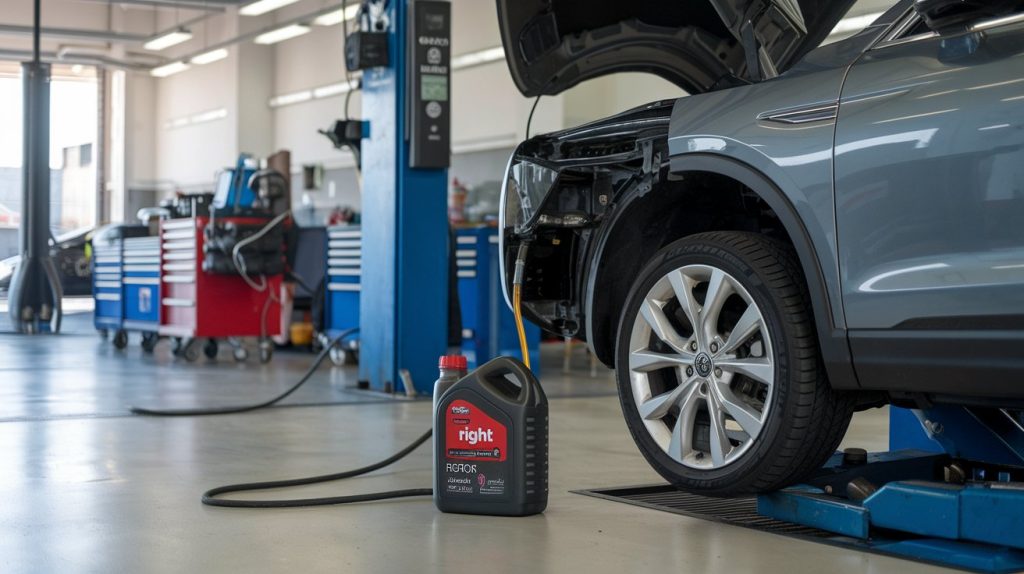
Which Engine Oil Is Right for Your Car?
Choose engine oil by matching two things: the viscosity grade your engine allows, such as 0W-20 or 5W-30, and its required performance specification or manufacturer approval. Then compare suitable products by oil type, quantity and price. Engine oil and motor oil are two names for the same lubricant. Neither a familiar brand nor “full synthetic” on the bottle proves that it suits your car.
Dubai heat and high mileage do not automatically justify thicker oil. Check the requirement for your engine, model year and market before changing grade.
What Engine Oil Does Inside Your Engine
Engine oil forms a lubricating film between moving parts to reduce friction and wear. It also carries heat away from lubricated components, helps keep contaminants suspended for filtration, and contains additives that help control deposits and corrosion. It works alongside the cooling system; it cannot fix overheating caused by a cooling-system fault.
The oil must flow through narrow passages and reach bearings, camshafts and, where fitted, turbocharger bearings. That is why “thicker means more protection” is too simple. The correct oil must provide the required protection while flowing as the engine was designed to use it.
Engine oil is different from transmission fluid, brake fluid and coolant. A hybrid with a combustion engine still needs the specified engine oil. A battery-electric car has no combustion-engine oil service, although other fluids may require maintenance.
Your Engine Oil Buying Checklist
- Confirm the engine, model year and market, using the VIN when needed.
- Write down the required manufacturer specification and permitted viscosity.
- Match any required API, ILSAC or ACEA category as well.
- Check the exact product name, approval wording and current data sheet.
- Confirm the service-fill quantity, filter and next service deadline.
- If an oil-pressure warning is active, stop safely and switch off before considering an oil purchase.
An Oil-Pressure Warning Requires a Safe Stop
If the oil-pressure warning appears while the engine is running, pull over as soon as it is safe and switch the engine off. Do not drive to the workshop for a routine oil change or repeatedly restart the engine to test the light. Follow the vehicle’s warning instructions and arrange assistance or recovery when the cause is unresolved.
Oil level is the amount in the engine. Oil pressure concerns its circulation under pressure. A correct level does not prove that pressure is safe. An unresolved pressure warning needs assessment before further driving, even when the oil level is correct.
| What you see | What it means for your decision | Next step |
|---|---|---|
| Oil-pressure warning while running | Lubrication pressure may be inadequate; this is not a routine service reminder. | Stop safely, switch off and arrange assessment. |
| Low-oil-level message | The quantity needs checking using the specified procedure. | Follow the manual’s stop and top-up instructions. Investigate repeated loss. |
| Oil service due reminder | Scheduled maintenance is due or approaching. | Check the service record and book the required work. |
| Dark oil without other symptoms | Color alone does not establish the remaining service life. | Use the schedule, service history and condition checks. |
Read the message and handbook rather than relying on dashboard color alone. New knocking, a large oil leak or overheating also calls for assessment before further driving. If the cause is unclear, arrange engine diagnosis rather than treating an oil change as the repair.
How to Find the Correct Engine Oil for Your Car
- Identify your engine. The same model can have different gasoline, diesel, turbocharged or hybrid engines. Registration year alone may not identify the engine or applicable service information.
- Check the manual and current service information. Record the viscosity options, oil specification and any conditions attached to them. An oil-cap label can be a useful clue, but often does not show the full approval requirement.
- Match all required specifications. A manufacturer code, an industry performance category and a viscosity grade answer different questions. One does not automatically replace the others.
- Resolve uncertainty before buying. For an imported car, engine replacement or missing manual, have the vehicle identity and current application checked. Another owner’s recommendation is not enough.
Take a photo of the manual’s oil page and both sides of the container. If the previous invoice names only “synthetic oil,” ask for the exact product and specification. This makes the next purchase verifiable.
Engine Oil Grades and Viscosity Explained
Viscosity means resistance to flow. Oil generally becomes thinner as it heats up and thicker as it cools. A multigrade engine oil, such as 5W-30, is classified for both low-temperature starting and high-temperature operation. Its grade describes viscosity, not its overall quality or compatibility with every engine.
- 5W
- The low-temperature grade. W means winter. This describes starting and pumping performance in standardized cold tests.
- 30
- The high-temperature viscosity grade. It is not an outside-temperature limit of 30°C.
- The rest of the label
- Performance categories and manufacturer approvals tell you more about the oil’s intended use. Check these as well as viscosity.
What 5W-30 actually tells you
The W refers to winter testing. The first part identifies a low-temperature viscosity grade; the second identifies the high-temperature viscosity grade. These numbers are not outside-temperature limits. A 30 grade does not mean “for weather up to 30°C,” and the W does not make an oil unsuitable for summer.
Two 5W-30 products can meet different performance specifications. Matching the large number on the front of the bottle is only one check.
5W-30 vs 5W-40 vs 0W-20
| Comparison | What changes | What it means when buying |
|---|---|---|
| 5W-30 and 5W-40 | Both have a 5W cold-temperature grade. The 40 grade falls in a higher high-temperature viscosity range than the 30 grade. | Do not switch to 5W-40 unless your engine permits it with the required specifications. |
| 0W-20 and 5W-30 | Both the cold-temperature grade and the high-temperature grade differ. | They are not automatically interchangeable. Use the grade required or permitted for the exact engine. |
| Two different 5W-30 oils | The viscosity grade matches, but the formulation, performance categories and approvals may differ. | Read the back label and product data sheet before deciding either is suitable. |
For example: if your manual specifies 0W-20 with a particular oil standard, a more expensive 5W-40 is not an automatic upgrade. If the manual permits two grades under stated conditions, choose within those conditions and retain the required performance specification.
What API, ACEA and manufacturer approvals mean
API is the American Petroleum Institute. Its engine-oil service categories describe performance requirements. ILSAC is the International Lubricants Standardization and Approval Committee, which defines passenger-car oil standards. ACEA is the European Automobile Manufacturers’ Association; its oil sequences cover different engine and emissions-system requirements. These names identify standards, not oil brands.
A vehicle maker may also require its own oil specification. A BMW, Mercedes-Benz, Audi or Porsche can have different requirements across engines and model years, even when two cars use the same viscosity grade. Match the complete specification for your car rather than choosing by badge alone.
Check the product data sheet for the exact product and regional formulation. “Approved,” “meets requirements” and “recommended for” may represent different claims. When formal manufacturer approval is required, verify it through the maker’s approved-product information rather than treating a seller’s compatibility statement as approval.
Fully Synthetic vs Semi-Synthetic vs Mineral Engine Oil
Engine oil contains base oils and an additive package. Mineral or conventional oil uses refined mineral base oils. Semi-synthetic oil combines mineral and synthetic base oils. Fully synthetic products use synthetic base stocks with additives selected for their intended performance. The complete formulation matters, so the product still needs to meet your engine’s requirements.
| Oil type | What it offers | How to decide |
|---|---|---|
| Fully synthetic | Formulated for demanding performance requirements, including temperature stability and deposit control, depending on the product. | Use when required. Compare compatible products instead of assuming every synthetic oil fits. |
| Semi-synthetic | A blend of mineral and synthetic base stocks. Often positioned between mineral and fully synthetic products. | Consider only if the exact product meets all requirements. It is not a substitute for a required fully synthetic specification. |
| Mineral or conventional | Uses refined mineral base oils with additives. It can suit applications whose requirements the product meets. | Do not select it solely because the car is older or has low annual mileage. |
Is high-mileage oil a separate oil type?
“High mileage” describes the product’s intended use, rather than a single viscosity grade or base-oil category. Such oils may use additives intended to help with aging seals, but they do not repair mechanical damage or establish the cause of a leak. Check compatibility and investigate repeated oil loss before changing products.
Similarly, “racing oil” does not mean the best oil for everyday driving. Its intended operating conditions and service schedule may differ from those of a road car.
For diesel engines with a particulate filter, and gasoline engines with applicable exhaust aftertreatment, the oil’s additive chemistry matters as well as viscosity. Use the required category; a higher category number is not a universal upgrade.
Which Engine Oil Is Best for UAE Heat?
Choose among the grades permitted for the application and conditions in the manufacturer’s instructions. There is no universal Dubai recommendation to change every car to 5W-40 or 10W-40. If your engine requires another grade, local weather alone is not a reason to override it.
Heat, extended idling, towing, short trips and dust may affect maintenance requirements where the manufacturer defines a severe-service schedule. They do not create a new oil specification. An imported car needs the correct application and market guidance checked, rather than a guess based on the climate where it was previously driven.
If overheating or an oil warning is the concern, investigate the fault. Changing viscosity is not a substitute for diagnosis.
When Should You Change Engine Oil in the UAE?
Follow the applicable time and mileage limits and the manufacturer’s instructions for the service indicator. A “synthetic,” “blend” or “high-performance” label cannot provide a universal change interval. Where both a calendar limit and a distance limit are specified, use whichever comes first.
Keep the oil quantity and service interval separate too. Buying a larger bottle does not mean the engine needs its full contents. Service-fill quantity can differ from a dry-engine capacity, and the final level must be checked by the vehicle’s specified method.
For time limits, mileage and Dubai driving conditions, read our guide to when to change engine oil.
How to Top Up Engine Oil and Change Brands
For a routine top-up without a pressure warning, check the level exactly as the manual directs. Some vehicles use a dipstick; others use an electronic measurement with specific temperature and waiting requirements. Do not add oil from a single uncertain reading or exceed the maximum level.
- The correct product is available. Use the required specification and follow the manual’s quantity and checking instructions.
- Only another brand is available. Check the complete specification, not just the viscosity. Use any emergency alternatives only within the manual’s limits.
- The existing oil is unknown. Look for the service record. If compatibility cannot be established, ask for application-specific advice rather than guessing.
- The wrong oil may already have been added. Record the product, amount and whether the engine has run. Seek advice before further use; the required response depends on the mismatch and symptoms.
A top-up does not renew the full oil charge or reset its service deadline. If the level falls repeatedly, record how much is added and over what distance, then arrange a check for leakage or consumption. Do not mask the pattern by repeatedly choosing thicker oil.
How to Compare Engine Oil Prices and Brands
Once compatible products have been identified, compare the same pack size and exact formulation. A bottle price, a price per liter and a complete oil-and-filter service are different purchases. Check the unit, quantity and tax treatment before comparing totals.
Ask a workshop quote to identify the oil product, approval, fill quantity, filter, labor and any additional work. A premium label alone does not justify a higher price, and a low price is not good value if the oil fails the required specification.
Do not buy extra additives, a flush or a viscosity change simply because the car has crossed a mileage threshold. Ask what finding supports the recommendation and whether the manufacturer permits it. A healthy engine already using the correct oil does not need a product change just because another brand is advertised more heavily.
Your Next Engine Oil Purchase
Keep a short record of the engine identity, required approval, permitted grade, exact product, quantity, filter, service date and mileage. Manufacturer requirements come first; brand and price come after compatibility. A pressure warning always takes priority over shopping or routine maintenance.
Further reading: API’s engine oil label guide and Shell UAE’s engine oil types. Always use your vehicle’s current manual for the exact requirements.
Need Help Choosing Engine Oil in Dubai?
Send your model, year, engine details and current oil label if available. We can check the requirement and arrange an oil and filter service in Al Quoz 4. Tell us about any warning or repeated oil loss before setting off.
Engine Oil Questions
Are engine oil and motor oil the same?
Yes. Both terms refer to the lubricant used inside a combustion engine. The name on the bottle does not determine compatibility; the viscosity grade and required specifications do.
Can two oils with the same viscosity be different?
Yes. Two 5W-30 oils can carry different industry categories and manufacturer approvals. Match every requirement listed for your engine before choosing either product.
Does an oil-pressure light mean I need an oil change?
It means you must stop safely and switch off if it appears while the engine is running. Do not assume fresh oil will fix it. Follow the manual and arrange assessment or recovery before further driving when the cause is unresolved.
Should I switch to thicker oil after 100,000 km?
Mileage alone does not justify a change. Use a permitted grade and investigate leaks, consumption or pressure concerns separately. A high-mileage product must still meet the required specification.
Can I use 0W-20 in Dubai?
Use it when it is the specified or permitted grade for your exact engine and the product meets the required performance specifications. Dubai heat alone does not make 0W-20 unsuitable or authorize replacing it with a thicker grade.
Can I change oil brands at the next service?
A different brand can be suitable if the exact product meets all required specifications. Keep its full product name on the service record so future top-ups can be checked.
Does full synthetic oil allow a longer interval?
Only follow a longer interval when the vehicle’s applicable service instructions allow it with that oil and use pattern. The words “full synthetic” alone do not authorize an extension.