Warning-light decisions and measured diagnosis
The lamp appears, the car still moves, and the expensive question arrives immediately: can you drive, or is the engine damaging itself? A check engine light in Dubai can be caused by a loose fuel-cap seal, a misfire, an air or fuel-control fault, an emissions-system problem, or damaged wiring. The light alone does not name the failed part.
That distinction prevents two bad decisions: paying for a guessed sensor, or continuing to drive through an active misfire that can overheat the catalytic converter.
Can You Drive With the Check Engine Light On
| What you see or feel | What it may mean | What to do now |
|---|---|---|
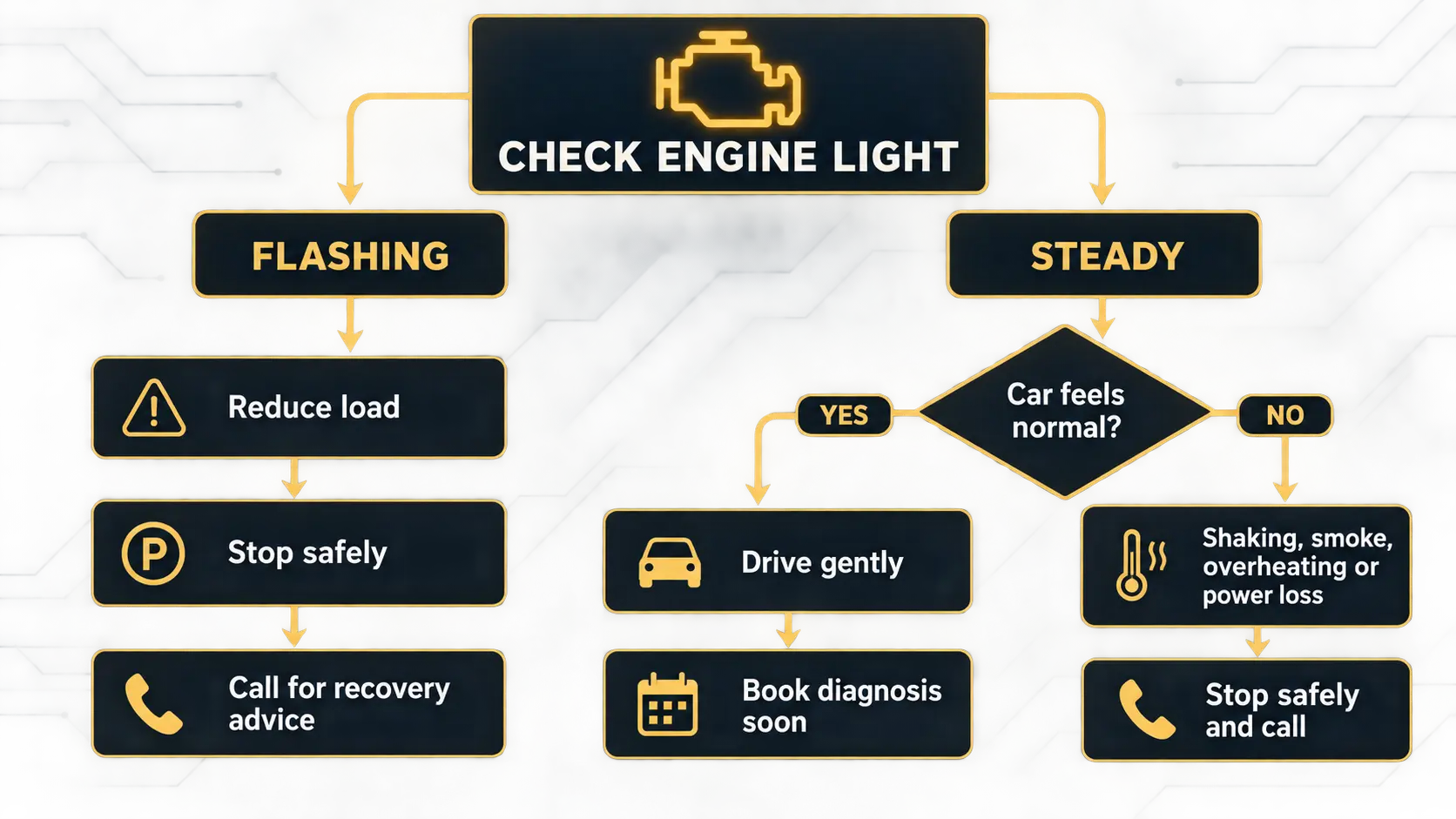
| Flashing light and rough running | An active misfire or combustion fault may be sending unburned fuel into the exhaust. | Ease off, stop in a safe place, switch off, and arrange inspection or recovery. |
| Steady light and normal driving | A stored emissions, sensor, circuit, or intermittent fault is possible. | Check for other warnings, avoid hard driving, and book a diagnostic test soon. |
| Steady light with weak acceleration | The vehicle may have reduced engine output to protect a system. | Avoid high load and fast roads. Have the fault read and tested. |
| Light plus oil-pressure or temperature warning | Engine lubrication or overheating risk may exist. | Stop as soon as it is safe. Do not keep driving to “see if it clears.” |
| Light appears after refueling | A cap or evaporative-system seal may be involved on vehicles that use one. | Secure the cap, keep the code data, and arrange a scan if the warning remains. |
Five Likely Check Engine Light Causes
Search results often turn this into a shopping list. Real diagnosis is less tidy. The computer records a condition, such as a cylinder misfire or lean mixture. Several parts, connections, or mechanical faults can create the same condition.
Use the five groups below to understand the test path. Do not use them as a reason to order a part before measurements are taken.
1. Ignition or combustion misfire
Spark plugs, ignition coils, injectors, air leaks, fuel pressure, wiring, or cylinder compression can cause a misfire. The cylinder number helps narrow testing, but it does not prove which item failed.
2. Air and fuel measurement
Airflow meters, pressure sensors, throttle control, oxygen-sensor feedback, vacuum leaks, and fuel delivery affect mixture control. Fuel trims and live data must be read together.
3. Evaporative emissions leak
A loose cap is possible where fitted, but purge valves, vent valves, hoses, seals, and leak-detection hardware also matter. A smoke or pressure test may be needed.
4. Oxygen sensor or catalyst concern
A catalyst-efficiency code does not automatically condemn the converter. Exhaust leaks, oil use, mixture faults, misfires, and sensor response should be checked first.
5. Wiring, voltage, or control fault
Low battery voltage, poor grounds, heat-damaged wiring, loose connectors, communication faults, and software conditions can produce intermittent warnings.
What Dubai conditions change
Heat, dust, long idling, and short urban trips can expose marginal cooling, intake, battery, and electrical conditions. They influence the test conditions, but they do not prove the cause.
Clues That Change the First Diagnostic Test
- Only on cold start: look at startup misfire counts, fuel pressure retention, air leaks, and temperature inputs.
- Only after the engine is hot: reproduce the operating temperature and inspect heat-sensitive sensors, coils, wiring, pressure, and mechanical condition.
- Only under acceleration: review boost or airflow, ignition load, fuel supply, knock control, and exhaust restriction.
- After a battery replacement: confirm system voltage, terminals, stored low-voltage events, adaptations, and any disturbed connectors.
- After refueling: check the cap and evaporative controls, but also record whether the engine became hard to start or ran rough.
- After recent repairs: compare the old codes, replaced parts, connectors, calibration steps, and the verification that was performed.
A Fault-Code Scan Is Not the Repair
A basic code reader can tell you that the system detected a condition. It cannot always tell you why. For example, an oxygen sensor may report excess oxygen because an intake leak made the mixture lean. Replacing the sensor would leave the leak untouched.
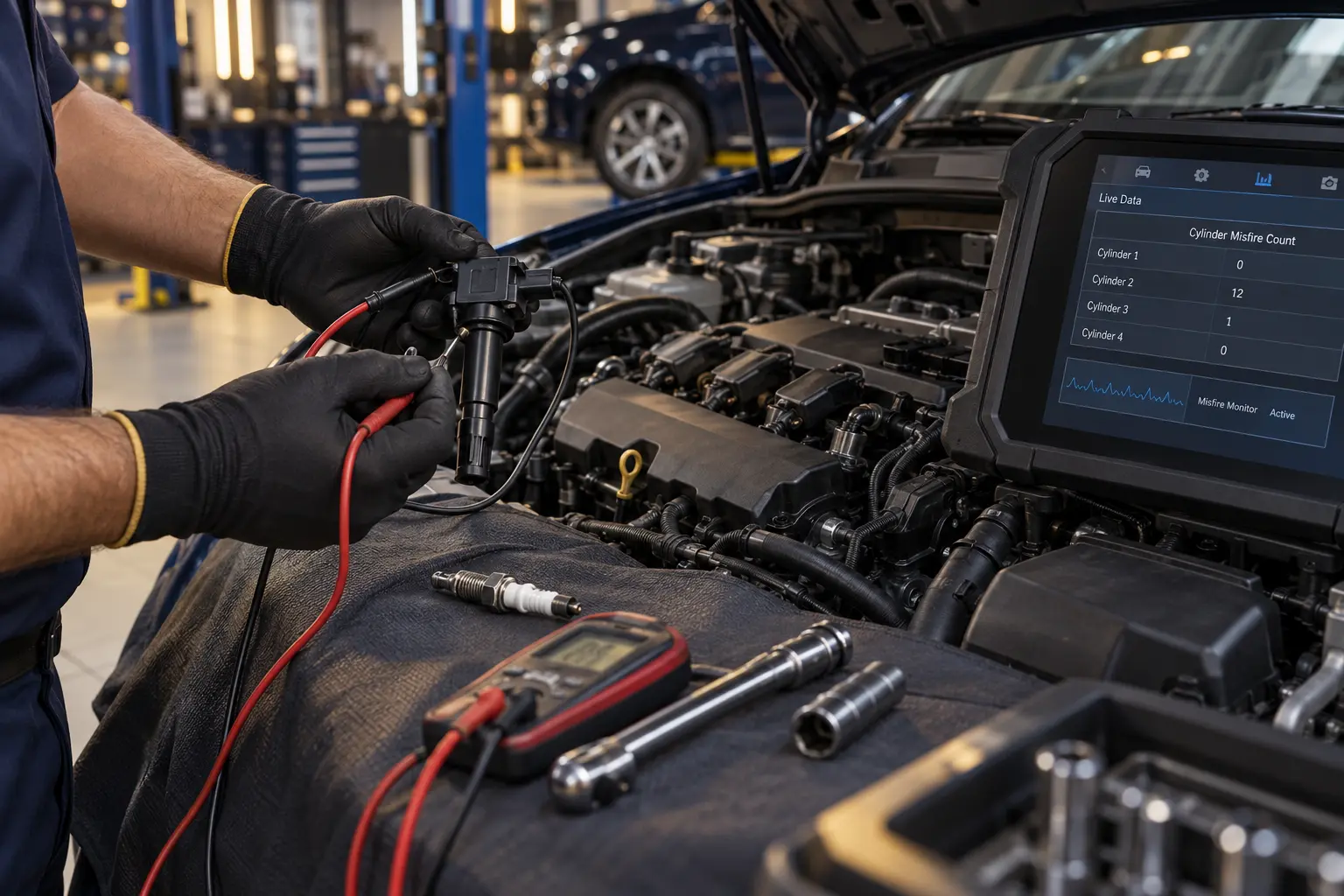
A useful engine diagnostic test records confirmed, pending, and history codes, saves freeze-frame conditions, reviews relevant live data, and follows the manufacturer’s test route. Electrical measurements, smoke testing, fuel-pressure testing, component activation, compression testing, or a controlled road test may follow.
What a Proper Check Engine Diagnosis Includes
- Record the complaint. Note when the light appeared, whether it flashes, and what the driver feels, hears, or smells.
- Scan relevant control modules. Save codes, status, event mileage, and freeze-frame data before clearing anything.
- Check basic condition. Inspect battery voltage, grounds, fluid warnings, intake parts, hoses, connectors, and visible damage.
- Follow the code’s test route. Use measurements that can confirm a component, circuit, leak, or mechanical cause.
- Verify the repair. Recheck data, reproduce the original operating condition, and complete a suitable drive cycle when safe.
How to Read a Diagnostic Trouble Code Without Guessing
A code has a family, a detected condition, and a status. Generic powertrain codes often begin with P0, while manufacturer-specific or enhanced codes may use other prefixes and require model-aware data. The description is a clue about what the control unit noticed. It is not a statement that one named part must be changed.
| Code group | What it generally covers | Useful next evidence |
|---|---|---|
| P0300 or cylinder-specific misfire codes | Random, multiple, or identified-cylinder combustion misses | Misfire counters, plugs, coils, injectors, fuel pressure, air leaks, compression, and wiring |
| Lean or rich mixture codes | Fuel correction has reached a limit or sensor feedback is outside the expected pattern | Short- and long-term fuel trims, airflow, pressure, oxygen feedback, intake and exhaust leaks |
| Oxygen-sensor circuit codes | Heater, signal, response, or plausibility concern in the sensor circuit | Supply, ground, wiring, connector condition, response graph, and upstream engine condition |
| Catalyst-efficiency codes | Upstream and downstream sensor behavior suggests reduced converter oxygen-storage performance | Misfire history, mixture control, oil use, exhaust leaks, sensor response, and temperature evidence |
| EVAP leak or flow codes | Fuel-vapor system cannot hold pressure or does not flow as expected | Cap seal where fitted, smoke test, purge and vent operation, hoses, tank pressure data |
| Communication or voltage codes | A module message, network, power supply, or voltage event fell outside its expected condition | Battery and charging state, grounds, network health, event timing, connectors, and related modules |
Code status matters too. A pending code means the system detected a condition but may not yet have completed the threshold needed to illuminate the lamp. A confirmed code has met the strategy for storage. A history or permanent code can remain after the immediate problem changes, depending on the vehicle and monitor. The technician should compare status with freeze-frame data and present symptoms.
Why online code definitions can mislead
A short internet definition removes the operating context and manufacturer test sequence. The same code number may need different steps across engines, years, and control software. Advice that says “replace sensor one” skips checks for circuit supply, exhaust leakage, mixture error, and whether the sensor is reacting correctly to another fault.
Diagnostic Tests and What Each One Proves
Live-data review
Shows what the control unit sees while the engine runs. Fuel trims, temperatures, airflow, pressures, oxygen response, misfire counts, and command values can reveal patterns. Bad data still needs electrical or physical confirmation.
Smoke testing
Introduces controlled test vapor to locate leaks in an intake or evaporative system. It can expose a split hose or seal that is difficult to see. The system must be isolated and tested using the correct method.
Electrical testing
Measures voltage, ground quality, resistance where appropriate, signal behavior, and circuit integrity. A visual connector check cannot prove that a circuit carries current correctly under load.
Fuel-pressure testing
Compares actual fuel delivery with the required value under the condition that creates the symptom. A static idle reading may not reveal pressure loss during acceleration or a hot restart.
Compression and leak testing
Checks whether the cylinder can seal and produce pressure. It helps separate a mechanical misfire from ignition or injection causes when other evidence points inward.
Controlled road test
Reproduces the complaint while data is recorded. It should be performed only when the vehicle is safe and the technician can monitor the relevant parameters without distraction.
Petrol, Hybrid, and Turbocharged Vehicles Need Different Context
A conventional petrol engine, a turbocharged performance car, and a hybrid may show the same dashboard symbol but require different precautions and data. Turbo engines add boost control, charge-air leaks, wastegate or actuator behavior, and higher load demands to the test route. A warning that appears only under boost should not be assessed only at idle.
Hybrid vehicles can start and stop the combustion engine automatically. A rough restart, high-voltage system message, or low 12V supply may change which module first recorded the event. Do not touch orange high-voltage cables or attempt traction-battery diagnosis with a generic code reader. High-voltage work requires vehicle-specific procedures and trained personnel.
Modified vehicles add another layer. Intake, exhaust, boost, fueling, or software changes may alter expected airflow and emissions behavior. Tell the technician exactly what was changed and provide the calibration information if available. Hiding a modification turns useful diagnosis into a longer guessing exercise.
Aftermarket Scanners and Free Code Reads
A small OBD reader is useful for recording a generic powertrain code and checking whether the light is on. It can help an owner describe the issue before booking. Its limits matter. Many readers cannot access manufacturer modules, run bidirectional tests, graph data clearly, interpret enhanced codes, or guide electrical and mechanical checks.
A free code read can be worthwhile when the car behaves normally and you need initial direction. It is not enough when the light flashes, the engine runs poorly, the fault returns after previous repairs, or an expensive component is being recommended. In those cases, pay for testing that answers why the code set.
Preparing the Car for a Diagnostic Appointment
If the car can be driven safely, avoid changing the conditions that produced the warning. Do not clear codes, disconnect the battery, add unrequested fuel additives, swap parts, or wash an engine bay with an electrical concern. Bring every key, recent invoices, and any scan report. If the warning follows a repair, bring the old estimate and parts list too.
For a cold-start problem, ask whether the workshop wants the vehicle delivered the evening before so it can be tested from ambient temperature. For a hot-running concern, describe the drive time and traffic conditions needed to reproduce it. Intermittent faults are easier to find when the appointment preserves the original pattern.
If the car is not safe to drive, send a dashboard photo and short video of the engine sound without standing near traffic or moving parts. Arrange recovery. Do not repeatedly restart an overheating, oil-pressure, heavy-misfire, or fuel-leak condition to create better evidence.
Check Engine Light Diagnosis Cost in Dubai
The warning lamp cannot determine the repair price. Start with a scoped diagnosis, then price the confirmed repair. These Dubai planning ranges were checked against multiple published workshop listings in September 2026. They are comparison figures, not a final quote. The model, system access, fault history, testing time, mobile call-out, secure manufacturer access, programming, and VAT treatment can change the total.
| Diagnostic scope | Price from | What is included | What is not included |
|---|---|---|---|
| Initial fault-code scan | AED 50 to 150 | Code reading, warning review, and initial direction | Extended circuit, pressure, smoke, or mechanical testing |
| Standard engine diagnosis | AED 150 to 400 | Codes, freeze-frame, live data, visual checks, and focused testing | Parts and repair labor |
| Intermittent or multi-system fault | AED 300 to 700+ | Longer reproduction, electrical tests, data logging, or related module checks | Major dismantling, secure manufacturer access, programming, or internal engine inspection unless approved |
Ask what evidence supports the recommended part and what will be checked after installation. A cheap scan can be useful for triage. It is not the same service as finding a heat-sensitive circuit, measuring fuel pressure, or proving a mechanical misfire.

When to Authorize a Repair or Ask for More Evidence
Authorize the repair when the fault is repeatable, the measured result is outside specification, related causes were checked, and the estimate explains parts, labor, and verification.
Ask for more evidence when the recommendation is based only on a code description, several expensive parts are listed “to try,” or nobody can explain why the warning appeared only under one condition.
Do not buy a scanner for one active fault if you will still need professional tests. A reader is worthwhile when you will use it repeatedly and understand that a code is a direction, not a verdict.
Common Misdiagnoses That Waste Money
Replacing the named sensor
The sensor may be reporting an air leak, exhaust leak, wiring fault, or mixture problem elsewhere.
Calling every misfire a coil
A plug, injector, compression issue, connector, or fuel condition can produce the same cylinder code.
Condemning the catalyst first
Misfires, oil consumption, mixture faults, and exhaust leaks should be resolved before an expensive converter decision.
What Happens After the Cause Is Confirmed
The next step depends on the evidence. A damaged hose or connector may be repaired during the same visit. An ignition fault may need one coil, a set of plugs, wiring repair, or an injector test. A catalyst recommendation should come only after upstream causes such as misfire, mixture error, oil consumption, and exhaust leakage have been considered.
Some repairs also require adaptation, calibration, or a drive cycle before all monitors can run again. The lamp turning off immediately is not the only proof. The original symptom should be gone, relevant data should return to an expected range, and no confirmed or pending fault should return under the same conditions.
Questions to ask before authorizing work
- Which code and operating condition led to this test?
- What measurement or physical finding confirms the failed item?
- Were wiring, supply voltage, leaks, and related causes checked?
- Does the estimate include required seals, fluids, programming, and verification?
- What will be rechecked if the warning returns?
Why the Light Can Disappear and Return
The control unit does not judge every system continuously. Each monitor needs certain conditions before it runs. Vehicle speed, coolant temperature, fuel level, ambient temperature, engine load, and the time since startup can all affect when a test is completed. That is why a warning may disappear for several trips and return during the same type of acceleration, hot restart, or refueling event.
An intermittent lamp is still evidence. Record the route, outside temperature, fuel level, speed, and whether the engine was cold or fully warm. Do not assume the problem repaired itself. A loose terminal, cracked hose, sticking valve, weak ignition component, or temperature-sensitive connection may behave normally during a short workshop visit.
Related Checks and Repair Routes
For a booking focused on fault codes, live data, and circuit testing, see our car inspection and computer diagnostic service in Dubai. If testing confirms an internal mechanical fault, review the engine repair inspection and repair options. A slow crank or low-voltage history should be separated with the 12V battery tester guide.
Check Engine Light Questions
Will the check engine light turn off after tightening the fuel cap?
It may, but not immediately. On vehicles with a sealed-cap system, the monitor may need further driving before it reruns. A damaged seal, hose, valve, or another fault can produce a similar warning.
Can I drive with a steady check engine light?
If the vehicle behaves normally and has no overheating, oil-pressure warning, smoke, strong smell, or major power loss, a careful trip for diagnosis may be reasonable. Stop if the condition changes.
Why did the light return after a sensor was replaced?
The sensor may have reported another problem, its circuit may still be faulty, or the original repair may not have been verified under the condition that set the code.
Can low battery voltage trigger warning codes?
Yes. Low system voltage can interrupt control modules and create communication or plausibility faults. The battery, charging system, terminals, and fault timing should be compared.
Does a cleared light mean the problem is fixed?
No. Clearing removes stored information and turns the lamp off until the monitor detects the condition again. Repair requires finding and correcting the cause.
Should I stop for a flashing check engine light?
Reduce engine load and stop safely. If the engine shakes, smells of fuel, loses power, smokes, or overheats, do not continue driving. Arrange inspection or recovery.
Book Check Engine Diagnosis in Al Quoz 4
Tell us whether the light is steady or flashing and what the vehicle is doing. We can start with fault data, then test the system indicated by the evidence.