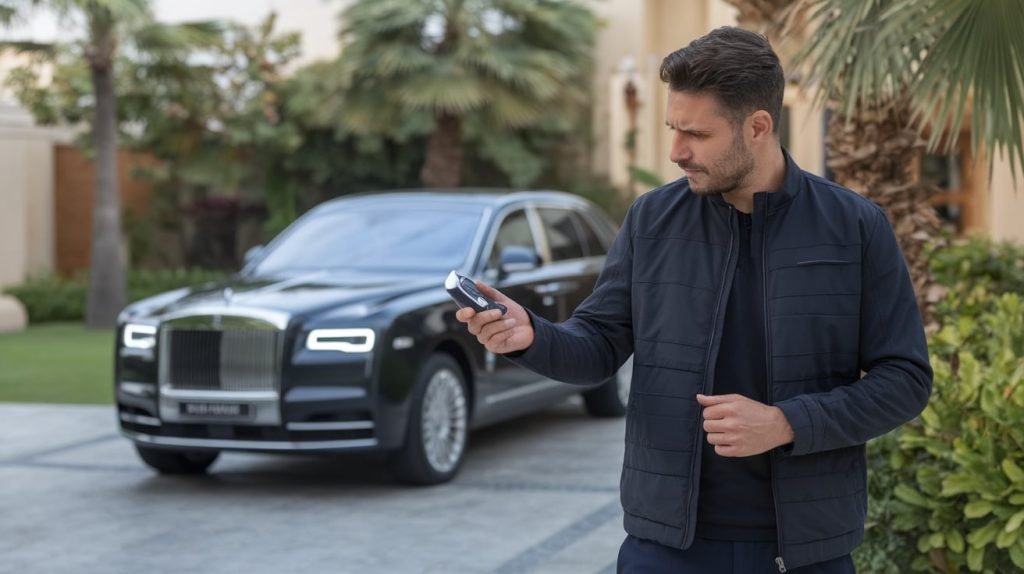
You press unlock. Nothing happens. You move closer, press harder, then try the button five more times as if determination might improve radio frequency. It doesn’t. Now you’re wondering whether the key fob is not working, the car has stopped listening, or the small coin battery has chosen the worst possible morning to quit.
A car key fob not working can come from a discharged coin battery, damaged switches, poor battery contact, lost synchronization, a receiver or antenna fault, a weak vehicle battery, or a door-lock problem. The fastest clue is the spare key. If it works, concentrate on the failed remote. If both keys fail, look at the vehicle side before buying another fob.
Key fob not working checks to try first
- Try the spare key. This single comparison can separate a remote fault from a vehicle-side fault.
- Move close to the car. Operation only at short range usually points toward a weak coin battery, poor contact, or reduced transmitter output.
- Try another parking location. A temporary local signal problem should change when the car is moved. A hardware fault usually follows the car.
- Check what still works. Test lock, unlock, trunk release, passive entry, and starting. Do not treat them as one function.
- Look for damage. A cracked case, soft button, liquid mark, or loose battery cover gives the diagnosis a direction.
- Check the dashboard. Record low-key-battery, key-not-detected, immobilizer, or vehicle-battery messages before they disappear.
- Consider the 12V vehicle battery. If both keys fail alongside other electrical problems, the car’s power supply matters.
- Use the emergency procedure. Check the owner’s manual for mechanical entry and the backup key-reading position.
What your key fob symptoms mean
| Symptom | Likely area | First check | Next step |
|---|---|---|---|
| Key works only near the car | Coin battery, contacts, or transmitter | Install the correct battery | Retest range and signal |
| One key fails but the spare works | Affected remote | Battery, case, switches, signal | Repair or program only after testing |
| Both keys fail | Vehicle battery, receiver, antenna, fuse, or module | Vehicle voltage and central locking | Scan and test the car |
| Doors unlock but engine will not start | Transponder or start authorization | Backup key-reading position | Immobilizer diagnosis |
| Engine starts but buttons fail | Remote transmitter, synchronization, or receiver | Test remote output | Repair or resynchronize |
| Only one door fails | Actuator, latch, wiring, or local module | Interior locking switch | Door diagnosis, not a new key |
| Failure after coin-battery replacement | Wrong battery, polarity, contact, or synchronization | Reopen and inspect the battery | Follow the model procedure |
Is the key fob or the car causing the problem
If the spare works, the failed key becomes the main suspect. That does not mean it needs replacement. A battery, bent contact, worn switch, cracked solder joint, damaged casing, or lost remote synchronization may be repairable.
If both keys stop working together, buying a third key is poor math. Check whether the car’s interior lock switch works, whether the 12V vehicle battery is healthy, and whether the receiver, antenna, fuse, or access-control module has stored faults.
Key fob battery replacement
Weak battery clues
Reduced range, delayed response, several button presses, intermittent operation, or a dashboard battery message support a coin-battery check.
Correct battery
Read the code on the installed battery and confirm it through the vehicle instructions. Diameter alone is not enough. Thickness, voltage, and polarity matter.
Correct installation
Place the battery in the indicated orientation, keep the contacts clean, avoid bending clips, and close the case without trapping the seal.
A branded car does not need a coin cell carrying the car maker’s logo. It needs the correct battery specification from a dependable manufacturer. Cheap cells can arrive partly discharged, but a high price does not prove freshness either. Check the date and seller.
Key fob not working after battery replacement
- Confirm the battery code and voltage.
- Check positive and negative orientation.
- Remove any protective film or sticker.
- Make sure both battery contacts touch firmly.
- Inspect for a bent clip or displaced rubber button pad.
- Close the case completely.
- Try the spare key.
- Follow the vehicle-specific synchronization process.
- Check the vehicle’s 12V battery if both keys fail.

Can you unlock and start the car with a dead key fob
Often, yes. Many fobs contain a mechanical key blade for emergency entry. The door cylinder may be visible or hidden behind a handle cover. The removal method differs by model, so forcing the cover is a quick way to turn a battery problem into paint and trim damage.
Push-button-start vehicles may have a backup reading location near the steering column, start button, center console, cupholder, or another marked point. The passive transponder may work even when the remote battery is dead. Check the owner’s manual for the exact position and procedure.
If the mechanical key will not turn, both keys are unrecognized, the car battery is flat, or access is unsafe, mobile assistance makes more sense than experimenting beside the road.
Key fob programming and synchronization
These terms get mixed together. Synchronization may restore remote locking communication for an existing key. Programming registers a compatible key or transponder with the vehicle’s security system. Some synchronization procedures are available to owners. Security programming may require diagnostic access, proof of ownership, security data, and every key that must remain authorized.
Synchronization may help
The existing remote is compatible, still transmits, and has lost its locking connection after a battery or power event.
Programming may help
A compatible replacement key must be registered, a security component was replaced, or the vehicle no longer authorizes an existing key.
Programming will not help
The battery is dead, buttons are broken, contacts are corroded, the circuit board is cracked, or the car’s receiver or door actuator has failed.
A used key is not automatically reusable. Some transponders become locked to the first vehicle. Frequency, part number, key generation, passive-entry support, blade, and security data must all match. “It looks identical” is not a compatibility test.
Repair, reprogram, or replace the key fob
| Option | Choose it when | Do not choose it when |
|---|---|---|
| Battery replacement | Range has dropped and the battery is weak | The case or circuit has physical damage |
| Case or button repair | Electronics work but the shell or switches are worn | The board is cracked or heavily corroded |
| Circuit repair | A repairable contact, switch, or solder fault is confirmed | The repair cannot provide dependable operation |
| Resynchronization | The compatible remote lost its locking connection | The remote does not transmit |
| Programming | A compatible key is not registered correctly | A hardware or receiver fault is present |
| Replacement key | The key is lost, incompatible, or damaged beyond repair | A battery or switch repair would solve it |
| Vehicle-side repair | Both remotes fail or a receiver, wiring, actuator, or module fault is confirmed | Only one remote is defective |
Key fob repair cost in Dubai
These are Auto Repair UAE estimate ranges. Price changes with the make, model, year, key type, security system, parts availability, access method, and whether every working key has been lost.
| Service | Estimated price | Scope note |
|---|---|---|
| Key-fob battery replacement | AED 40 to AED 120 | Correct coin battery and function check |
| Remote inspection and signal test | AED 100 to AED 250 | Battery, switches, casing, and transmission check |
| Button or casing repair | AED 150 to AED 450 | Depends on shell, blade, and switch condition |
| Key-fob circuit repair | AED 250 to AED 750 | Only when board damage is repairable |
| Remote synchronization | AED 200 to AED 500 | For a compatible existing remote |
| Key programming | AED 450 to AED 1,500 | Security access and model determine labor |
| Replacement remote and programming | AED 800 to AED 3,500+ | Remote, blade, transponder, and programming vary |
| Receiver or antenna diagnosis | AED 250 to AED 750 | Vehicle scan and directed electrical tests |
| Door-lock actuator repair | AED 450 to AED 2,000+ | Door design and parts determine the total |
Ask whether the estimate includes the remote, emergency blade cutting, transponder, programming, mobile visit, and tax. A cheap key with half its functions missing is not a bargain. It is a second appointment.
What technicians check during diagnosis
- Confirm the symptom. Entry, locking, trunk release, passive entry, starting, or immobilizer authorization.
- Compare both keys. One working spare changes the entire diagnostic direction.
- Check both batteries. Test the coin cell and the car’s 12V supply.
- Test remote output. Confirm whether each button produces a signal.
- Scan the vehicle. Read access, body, immobilizer, antenna, and communication faults.
- Inspect the locks. Check actuators, latches, wiring, mechanical entry, and the interior switch.
The goal is simple: identify which side stopped communicating before selling a part.

Key fob problems by situation
Works only near the car
Start with the coin battery, contacts, transmitter output, and receiver sensitivity. A short range is evidence, not proof of one component.
Spare works normally
The main key needs battery, switch, circuit, casing, signal, and synchronization checks. The car has already demonstrated that it can respond.
Neither key works
Check the vehicle battery, central locking, fuses, receiver, antenna, and access-control faults before ordering keys.
Unlocks but will not start
Investigate transponder recognition, immobilizer authorization, steering lock, start-button inputs, and vehicle voltage.
Starts but buttons fail
The passive transponder and remote-locking transmitter are separate functions. Test the remote signal and receiver path.
Only one door fails
The remote probably sent the command. Inspect that door’s actuator, latch, wiring, and local control before blaming the key.
Problems often blamed on the key fob
A weak vehicle battery can disrupt several systems at once. If both keys fail alongside slow cranking or electrical resets, use our battery tester tool guide for 12V battery checks. If the mechanical key, cylinder, or one door is the issue, the relevant next step is car lock diagnosis and repair options.
If the engine does not crank but key authorization appears normal, read our guide to starter motor diagnosis and replacement decisions. These symptoms overlap, but the repairs should not.
Original, used, and aftermarket key fobs
| Choice | Possible benefit | What must be confirmed |
|---|---|---|
| Original new key | Known application path and full intended functions | Part number, order requirements, programming, lead time |
| Aftermarket new key | Lower cost or faster availability | Frequency, transponder, passive entry, blade, programming support |
| Used original key | Original housing and electronics at a lower purchase price | Whether its transponder can be reset and registered to another car |
| Repaired original key | Keeps the existing programmed key when damage is serviceable | Circuit condition, casing, reliability, and repair scope |
Original does not automatically mean compatible. Aftermarket does not automatically mean unsuitable. The exact system decides. The seller should identify what will and will not work before you pay.

How to protect the remote and spare key
- Do not leave the remote on a dashboard or beside liquids.
- Replace a cracked casing before dust or moisture reaches the board.
- Do not hang heavy objects from an ignition key.
- Keep a working spare and test it occasionally.
- Learn where the mechanical blade and backup reading point are located.
- Store the spare away from the vehicle.
- Replace the coin battery when operating range begins to fall.
- Use theft-resistant storage when passive entry is fitted.
That spare key sitting in a drawer is only helpful if its battery, blade, and programming still work. Test it before the main key fails. Boring advice? Yes. Useful at midnight? Very.
Key fob repair near me in Dubai
If you are searching for key fob repair near me in Dubai, describe what the key and car are doing before booking. Tell the technician whether the spare works, whether the engine starts, whether the remote works only at close range, and whether one door or every door is affected.
Auto Repair UAE can inspect the remote and vehicle-side system at our Al Quoz 4 workshop. Mobile support is available when access or starting is not possible. The repair may involve a battery, casing, switch, circuit, synchronization, programming, receiver, vehicle battery, or door-lock component. Testing decides which one.
Separate remote locking, passive entry, and starting authorization
A modern key can perform three separate jobs, and each job can fail independently. The buttons transmit a radio command for locking. Passive entry uses antennas to detect an authorized key near the door. Starting authorization uses a transponder or secure communication path that may still work when the coin battery is discharged.
Buttons fail but the engine starts
Test the coin battery, button switches, transmitter output, synchronization, and vehicle receiver. The immobilizer side has already authorized the key.
Doors open but starting fails
Check the backup reading position, transponder recognition, steering lock, start-button inputs, vehicle voltage, and security faults.
Passive entry fails at one door
Compare other doors and the spare key. A local antenna, handle sensor, latch, wiring, or door module may be responsible.
This separation prevents unnecessary programming. A remote that still starts the car may need a battery, switch, casing, circuit repair, or synchronization. A key that unlocks the doors but is not authorized to start needs security-system diagnosis. Describe each function separately when requesting a quote.
What changes when every key is lost
An all-keys-lost situation is different from repairing a remote that remains available. The technician may need proof of ownership, the VIN, vehicle identification, security access, emergency blade cutting, key ordering, immobilizer programming, and deletion of missing keys from the authorized-key list. Access method and model-specific security rules affect both time and cost.
| Situation | What should be included in the plan | Cost risk to clarify |
|---|---|---|
| One working key remains | Compatibility check, new key preparation, programming, and function test | Whether every key must be present during programming |
| Every key is lost | Access, ownership verification, blade cutting, security programming, and lost-key deletion | Mobile attendance, security data, towing, and ordered parts |
| Key is locked inside | Damage-controlled access based on the vehicle design | Whether opening the car solves the starting problem |
| Key was stolen | New key, removal of the missing key’s authorization where supported, and security review | Whether mechanical blade access or other credentials also require attention |
Ask how many keys will work when the job is finished and whether the missing key will remain authorized. Also confirm whether remote locking, passive entry, trunk release, emergency blade, and engine starting are included. “Key programmed” does not always mean every intended feature has been tested.
How part number and frequency affect compatibility
Two remotes can share the same casing and button layout while using a different frequency, transponder generation, passive-entry system, emergency blade, or vehicle-market configuration. Compatibility should be checked from the VIN, original part number, diagnostic information, and supplier data. Appearance alone is not enough.
- Part number: Confirm supersessions and model-year application.
- Frequency and market: A remote intended for another region may not communicate correctly.
- Transponder: Some used transponders cannot be registered to another vehicle.
- Passive entry: A basic remote may lock the doors but lack proximity functions.
- Blade: Confirm blade type, cutting method, and emergency-entry operation.
- Key count: Ask whether existing keys must be present and whether missing keys will be removed.
Used keys deserve extra caution. A used original housing may be suitable for parts, but its security chip may be locked or incompatible. Before paying, obtain a written statement of which functions are expected to work and what happens if programming is unsuccessful.
What a complete key fob estimate should include
Compare the complete working-key cost, not the advertised remote price. A cheap listing may exclude the coin battery, emergency blade, blade cutting, transponder, passive-entry electronics, security access, programming, mobile visit, or VAT. Those exclusions can turn one purchase into several appointments.
| Estimate item | Question to ask | Why it matters |
|---|---|---|
| Remote hardware | Is it original new, aftermarket new, repaired, or used? | Compatibility and reuse limits differ |
| Functions | Will locking, passive entry, trunk release, starting, and emergency entry work? | Some quotes cover only basic authorization |
| Programming | Does the price include security access, synchronization, and all required keys? | Programming scope varies by vehicle |
| Blade | Are the emergency blade and cutting included? | An electronic key can still be incomplete |
| Mobile service | Is attendance, access, or recovery charged separately? | All-keys-lost jobs may require work at the vehicle |
| Tax and warranty | Is VAT included, and what hardware or labor is covered? | The final payable amount and remedy must be clear |
If the diagnosis shows a failed door actuator, vehicle receiver, antenna, wiring circuit, or weak 12V battery, do not approve a replacement key as a trial. The estimate should name the failed side and the test that supports it.
Checks to complete before accepting a programmed key
- Test every supplied key. Confirm each existing and new key still works.
- Test every button. Check lock, unlock, trunk, panic, and any model-specific function.
- Check passive entry. Try each equipped door and the normal starting position.
- Verify the emergency blade. Confirm the blade fits and operates the intended lock.
- Start the vehicle repeatedly. Test normal and backup key-reading procedures.
- Check dashboard messages. Confirm key-not-detected or immobilizer warnings are resolved.
- Confirm missing-key status. Ask whether lost or stolen keys remain authorized.
- Review the invoice. Match hardware, part number, programming, cutting, VAT, and warranty to the estimate.
Do not leave after one successful unlock. Walk around the vehicle and test the functions that matter. A programming session is complete only when the agreed keys operate the agreed features and the vehicle no longer stores a relevant active fault.
Key takeaway
When a key fob is not working, compare the spare first. One failed remote directs attention toward its coin battery, contacts, buttons, circuit, or synchronization. Two failed remotes direct attention toward the vehicle battery, receiver, antenna, fuses, locks, or access-control system. Do not buy a replacement until the faulty side is identified.
Book key fob diagnosis in Al Quoz 4
Tell us whether the key unlocks the doors, starts the engine, or works only at close range. We can check the remote battery, signal output, synchronization, vehicle receiver, immobilizer, and door-lock system before recommending repair or replacement.
Key fob not working FAQs
Why is my key fob not working?
Common causes include a discharged coin battery, poor battery contact, damaged buttons, circuit damage, lost synchronization, an incompatible key, a weak vehicle battery, receiver faults, or a door-lock problem.
Why does the key fob work only near the car?
A weak coin battery is common, but poor contacts, reduced transmitter output, or receiver sensitivity can produce the same pattern. Replace the correct battery and compare the spare key.
Why is the key fob not working after a battery replacement?
Check the battery code, polarity, protective film, contact pressure, case assembly, and model-specific synchronization process. If both keys fail, test the vehicle side.
Can I start the car with a dead key-fob battery?
Many vehicles provide a backup transponder-reading position and a mechanical emergency key. The method varies, so follow the owner’s manual rather than guessing.
Does changing the battery require reprogramming?
Usually not, but some remotes require resynchronization. Programming and synchronization are different. Use the vehicle-specific procedure.
How do I know whether the key or receiver is faulty?
Compare a working spare, test remote output, check the vehicle battery, and scan the access system. If neither key works, the vehicle side needs attention.
Can a used key fob be programmed to my car?
Sometimes. Compatibility depends on frequency, part number, transponder type, key generation, passive-entry support, and whether the used transponder can be reset.
Should I repair or replace a damaged remote?
Repair makes sense when the casing, switch, contact, or circuit fault can be corrected reliably. Replace a lost, incompatible, badly corroded, or structurally damaged key.
Can a weak vehicle battery stop both remotes from working?
Yes. Low vehicle voltage can affect receivers, locks, security modules, and starting authorization. Test the car battery when several electrical symptoms appear together.
Sources and owner guidance
- Ford vehicle support and owner resources
- BMW owner manuals and remote-control instructions
- Mercedes-Benz owner manuals and emergency key procedures
Use the manual for the exact vehicle model and year. Emergency entry, battery replacement, synchronization, and backup starting procedures vary.