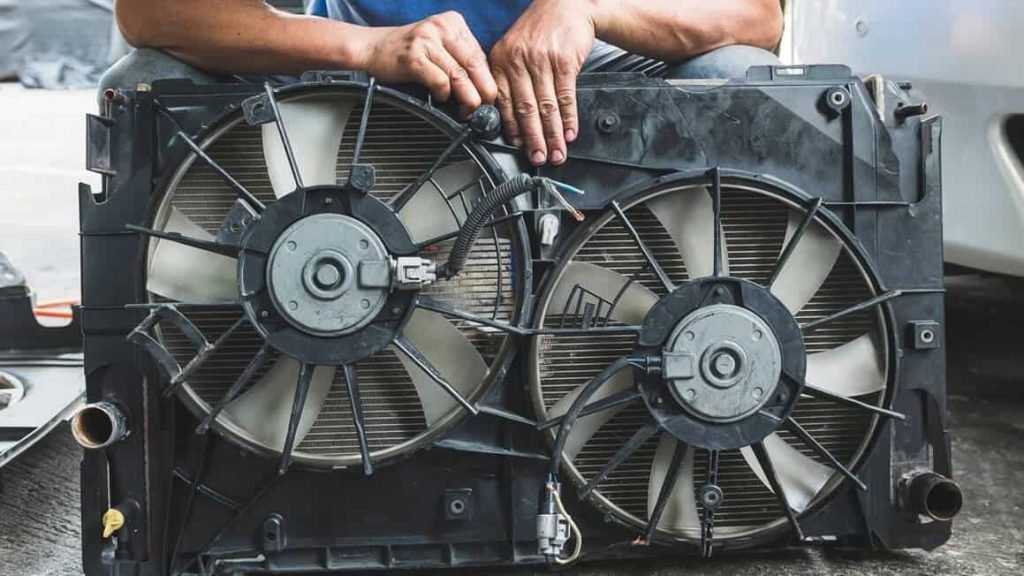
Radiator fan replacement is needed only after testing confirms that the fan assembly, motor, or an inseparable control component has failed. An engine that overheats at idle but cools while moving does point toward lost fan airflow, yet a fuse, relay, wiring fault, temperature sensor, fan control module, blocked radiator, low coolant, or thermostat can create a similar complaint. Stop driving if the temperature enters the warning zone, coolant escapes, or steam appears. Diagnosis should come before parts.
What the radiator fan does
The radiator transfers engine heat into the air. At road speed, air passes through the condenser and radiator without much help. At idle, in queues, or during slow parking maneuvers, natural airflow drops. The cooling fan pulls or pushes air through the heat exchangers so coolant temperature and air-conditioning pressure stay within the control strategy.
Many vehicles use one or two electric fans. The engine control module may command low, medium, or high speed based on coolant temperature, air-conditioning demand, vehicle speed, ambient conditions, and refrigerant pressure. Some systems use relays and resistors. Others place an electronic module inside the fan assembly.
A mechanical fan driven through a viscous clutch works differently. It reacts to air temperature behind the radiator and engine speed. The correct test depends on the fitted system, so a generic “fan is bad” diagnosis is not enough.
Can you drive with a radiator fan fault
Stop the engine
- The temperature warning is red.
- Steam or coolant is escaping.
- The gauge keeps rising after AC is switched off.
- The engine runs roughly after overheating.
- A fan blade is broken or touching the shroud.
Arrange prompt inspection
- Temperature rises only in traffic.
- AC becomes warm while stationary.
- The fan is noisy, slow, or intermittent.
- A fan-related diagnostic code returns.
- The fan stays on long after normal shutdown.
A short period of normal gauge movement does not prove the fault is harmless. Temperature displays on some vehicles are damped and may stay near the middle across a range. Scan data and measured temperatures provide more information than the dashboard alone.
Symptoms of a failed radiator fan
Overheating at idle
The gauge rises in traffic, then falls when the vehicle gains speed. That pattern suggests insufficient airflow at low speed, but it does not identify the failed component.
AC cools while moving
The condenser also needs airflow. Vent temperature may increase at a stop and improve on the road. Refrigerant charge, compressor control, and condenser condition must still be checked.
Fan noise or vibration
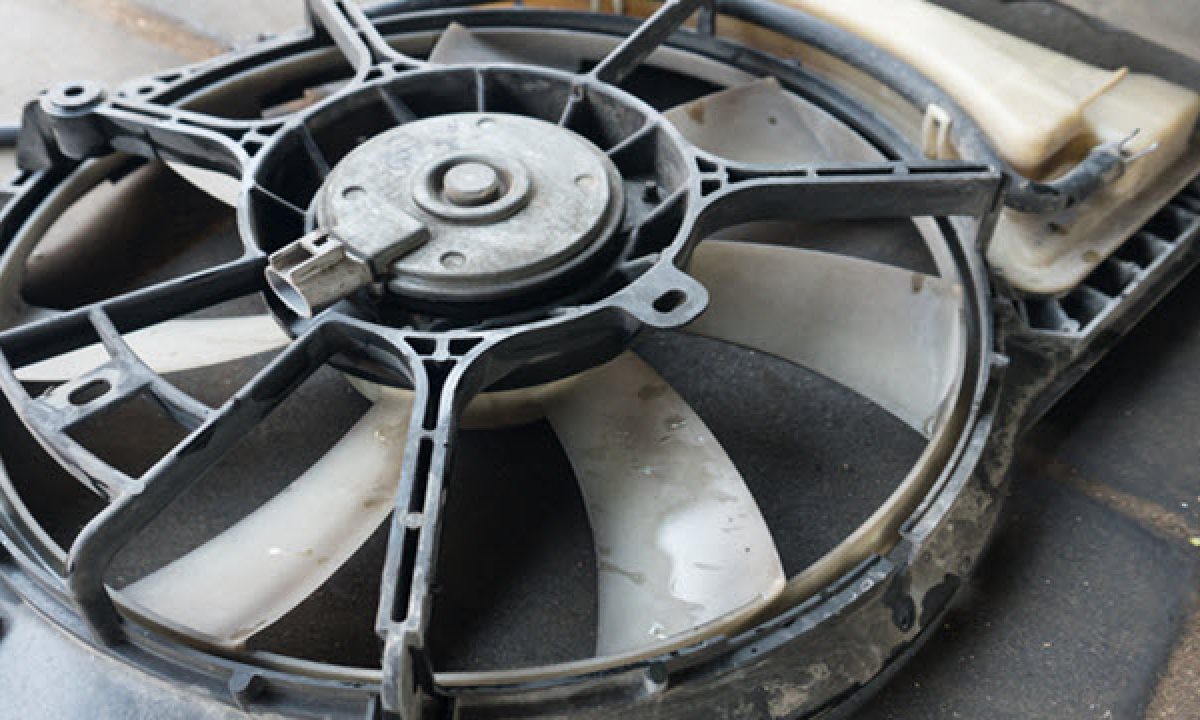
Worn bearings, a loose shroud, debris, damaged blades, or motor wear can create rubbing, grinding, or pulsing noise. A damaged blade can unbalance the assembly.
Fan never stops
A fan running at full speed can reflect a control strategy responding to missing sensor data, excessive temperature, high AC pressure, a stuck relay, or a module fault. It does not always mean the motor is defective.
Other clues include a blown fuse, stored cooling-fan circuit codes, loss of one fan speed, repeated battery drain, or a burning smell near the fan connector. Treat a melted connector as a circuit problem that needs load testing, not just a reason to install another motor.
What else can look like fan failure
A cooling complaint should be separated into airflow, coolant circulation, heat transfer, pressure control, and engine-condition problems.
- Low coolant: An external leak or trapped air can stop proper circulation and sensor contact.
- Thermostat fault: A thermostat stuck closed restricts radiator flow even when the fan works.
- Water pump problem: A damaged impeller, drive issue, or leak can reduce circulation.
- Blocked radiator: Internal deposits or external debris reduce heat transfer.
- Pressure-cap fault: Incorrect system pressure changes coolant behavior.
- Sensor or wiring fault: The controller may not receive or act on temperature information.
- Head-gasket or combustion leak: Gas entering the cooling system can cause pressure and overheating.
- AC system fault: Warm air at idle can come from refrigerant or compressor problems rather than fan airflow alone.
The guide to bad thermostat symptoms helps separate a circulation restriction from a fan-control problem.

How technicians test a radiator fan system
A useful diagnosis follows the circuit from the complaint to the commanded output. It should not begin by bridging random terminals or applying battery voltage without a wiring diagram. Modern fan modules can be damaged by the wrong test.
- Confirm the complaint. Record whether the problem occurs at idle, with AC demand, after a hot soak, or at a particular temperature.
- Inspect the cooling system. Check coolant level only when safe, look for leaks, assess the radiator and condenser faces, and inspect the fan blades and shroud.
- Scan every relevant module. Read trouble codes, coolant temperature, AC pressure, fan command, and available feedback values.
- Command the fan. A bidirectional scan test can request fan speeds on supported vehicles. Command without response narrows the fault but does not yet condemn the motor.
- Check power and ground under load. A voltmeter reading without load can hide resistance in a connector or wire.
- Test control signals. Relay, pulse-width, or communication-based systems need the matching procedure and waveform interpretation.
- Measure current draw. Excessive draw may indicate a binding motor. Low draw with poor speed can also show internal wear or supply loss.
- Verify the repaired system. Repeat the original conditions and confirm commanded operation, stable temperature, and AC behavior.
Fan motor, module, relay, or complete assembly
The correct replacement scope depends on how the vehicle was designed and what failed.
Motor only
A separate motor can be sensible when the blade, shroud, wiring, and control parts are serviceable and the manufacturer or parts catalog supports motor replacement.
Complete fan assembly
An assembly may include the motor, blades, shroud, resistor, and module. It can reduce compatibility risks when several components are worn or the controller is integrated.
Relay, fuse, resistor, or wiring
These are circuit repairs, not fan replacement. A blown fuse must have a cause. Installing a larger fuse is unsafe. A burned connector should be repaired with the correct terminal capacity and routing.

Radiator fan replacement cost in Dubai
These Auto Repair UAE planning ranges cover common passenger-vehicle work. The final price changes with vehicle model, fan count, module integration, access, parts choice, programming needs, coolant or AC work, and damage to wiring or connectors.
| Service | Indicative price | Typical scope |
|---|---|---|
| Cooling fan diagnosis | AED 180 to 350 | Inspection, scan data, command test, and circuit checks |
| Fan relay, fuse, or minor wiring repair | AED 180 to 650 | Confirmed circuit repair, excluding major harness work |
| Single fan motor replacement | AED 450 to 1,200 | Motor and labor where the motor is separately serviceable |
| Complete fan assembly replacement | AED 850 to 2,500 | Fan, shroud, and integrated components as supplied |
| Dual-fan or module-controlled assembly | AED 1,400 to 4,000 | Vehicle-dependent assembly, diagnosis, installation, and testing |
| Connector or harness repair | AED 250 to 1,200 | Price changes with heat damage and harness access |
Prices vary by model, condition, parts source, and access. Confirm VAT, diagnostic charges, coolant, AC refrigerant handling, and programming on the written estimate. Genuine, OEM, and aftermarket parts can differ in connector quality, motor control, noise, and service life. The chosen part must match the vehicle identification and original fan-control specification.
Repair or replacement decision table
| Finding | Likely action | Why |
|---|---|---|
| Fan command present, power and ground pass, motor does not run | Motor or assembly replacement | The motor has the required supply but fails to respond |
| No power at the fan and relay output is absent | Trace fuse, relay, command, and wiring | A new fan would receive the same missing supply |
| One speed works and another does not | Test resistor, relay stages, module, and wiring | The motor may still be capable of operation |
| Broken blade or damaged shroud | Replace affected assembly parts | Imbalance and contact can damage the motor or radiator |
| Fan works, but coolant still overheats | Test circulation and heat-transfer faults | The fan is not the root cause |
| Fan runs continuously with implausible sensor data | Diagnose sensor and control input | Full-speed operation may be a protective fallback |
What radiator fan replacement includes
The work commonly requires battery isolation where specified, removal of intake ducts or covers, disconnection of the fan circuit, release of the shroud, transfer of serviceable parts, installation with proper clearance, and functional testing. Some vehicles need front-end components moved for access. Others allow the fan to lift out from the engine bay.
The quote should say whether it includes the fan motor, complete shroud, integrated module, relays, wiring repair, coolant top-up, AC work, scan diagnosis, and verification. If the condenser or refrigerant circuit must be disturbed, refrigerant recovery and recharge require separate equipment and scope.
After installation, cables and hoses must stay clear of the blades. The shroud must sit correctly so air is drawn through the heat exchangers rather than around them. Fasteners, clips, connectors, and seals should return to their intended locations.

Evidence to request after the repair
Before findings
Ask for the stored codes, relevant scan values, failed electrical test, visible damage, or motor response that justified the part.
Part identification
The invoice should identify the installed fan, motor, module, relay, or wiring repair and state the parts category.
Functional verification
The fan should respond to commanded stages or operating conditions. Temperature and AC behavior should be checked under the complaint conditions.
Related cooling status
Coolant level, leaks, hose routing, radiator condition, and any remaining codes should be reported rather than hidden behind the new part.
When radiator fan replacement will not solve overheating
A working fan cannot compensate for every cooling-system defect. If coolant cannot circulate, the radiator cannot transfer enough heat, or combustion pressure enters the system, the engine may still overheat with the fan at full speed.
Overheating at highway speed
Natural airflow is already high on the road. A fan fault becomes less likely as the sole cause. Check coolant flow, radiator restriction, thermostat opening, water-pump operation, airflow blockage, engine load, and combustion leakage.
Heater output changes with engine speed
Intermittent cabin heat can point toward low coolant, trapped air, or weak circulation. Confirm the system is full and leak-free when cold before focusing on the fan.
Coolant disappears
A fan does not consume coolant. Search for external leakage, pressure-cap problems, heater-core leakage, internal engine leakage, or previous overheat damage. Topping up repeatedly without locating the loss delays the real repair.
The temperature reading is implausible
A sensor circuit can report a false value or trigger a protective fan strategy. Compare scan data with a cold-soak expectation and other temperature evidence. Replacing the fan will not correct a false input.
Questions to ask before authorizing replacement
- Which test proves the fan or assembly has failed?
- Did the scan tool command each available fan speed?
- Were power and ground tested under load?
- Is the control module part of the fan assembly?
- Does the estimate include diagnosis, installation, and verification?
- Will coolant or AC refrigerant need to be removed?
- Has the radiator face been checked for external blockage?
- Were thermostat, coolant level, and circulation considered?
- What part category and part number will be installed?
- What operating condition will be repeated after repair?
These questions are not an attempt to tell a technician how to work. They connect the customer’s complaint to the proposed part and the final proof.
What to record before visiting the workshop
Operating conditions
Write down whether the problem happens with the AC on or off, at idle or while moving, from a cold start or after a hot soak. Note the temperature display, warning messages, weather, traffic conditions, and any coolant smell. A short video can capture fan noise, but keep hands, clothing, and the phone away from moving belts and blades.
Recent repair history
Bring recent cooling-system invoices. A thermostat, radiator, water pump, coolant flush, AC condenser, battery, or front-end accident repair can change the diagnostic path. Mention any jump-start, wiring work, or fuse replacement that occurred before the symptom.
Codes and safe handling
Do not clear codes before inspection unless required to move the vehicle safely. Stored and pending codes may help explain an intermittent fan. Do not open a hot reservoir to show the coolant level. Let the system cool fully.
How Dubai conditions affect fan use
Heat and electrical load
High ambient temperature, long idle periods, parking maneuvers, and AC demand can keep an electric cooling fan busy. That does not mean every loud fan is failing. Many systems command high speed when condenser pressure rises or when the controller needs more airflow.
Heat can expose weak electrical connections because resistance increases temperature at the terminal. A discolored connector, softened plastic, or repeated fuse failure deserves a voltage-drop and current test. Replacing only the motor can leave the cause in place.
Sand and idle time
Sand and road debris can collect between the condenser and radiator or across the front surface. Cleaning must protect delicate fins and electrical parts. High-pressure spraying at close distance can fold fins and reduce airflow. Inspect the heat exchangers when fan demand seems higher than before.
Idle time matters as much as distance. A vehicle used for school pickup, delivery work, or repeated short trips may spend much of its operating time with little natural airflow. Its fan can cycle more often than the fan on a car that covers the same distance on an open highway.
Hot soak and storage
After parking a hot vehicle, heat can move from the engine into nearby components even though combustion has stopped. Some control systems run the fan or an electric coolant pump during this heat-soak period. Ask whether the behavior matches the vehicle strategy before treating after-run noise as a fault.
Long storage creates another pattern. Dust, debris, corrosion at a connector, or an animal-damaged wire may stop a fan that worked before parking. A command test and circuit inspection can separate storage-related electrical damage from normal motor wear.
Preventing another cooling fan problem
- Investigate coolant loss instead of topping up indefinitely.
- Use the coolant specification required for the vehicle.
- Keep the radiator and condenser faces free from obstructing debris.
- Repair loose undertrays or covers that can contact wiring.
- Check fan operation after front-end collision repair.
- Do not install a fuse with a higher rating.
- Address fan noise before a blade or bearing fails completely.
- Keep connectors locked and routed away from heat and moving parts.
- Scan a returning temperature warning rather than clearing it repeatedly.
- Verify the original complaint after any cooling-system repair.
Cooling-system maintenance cannot prevent every electrical motor failure, but it can stop low coolant, blockage, leaks, and poor connections from being mistaken for one.
Comparing parts choices
A price comparison should use complete, compatible parts rather than brand labels alone. Confirm whether the quote supplies a bare motor or the full fan and shroud. Check whether the controller is integrated and whether coding or adaptation is required.
| Parts choice | Check before approval | Possible tradeoff |
|---|---|---|
| Genuine | Correct supersession and complete included components | Higher purchase cost |
| OEM supply | Manufacturer, connector, control strategy, and specification match | Packaging and included hardware may differ |
| Aftermarket | Motor output, module compatibility, fit, noise, and support | Quality and control behavior vary by supplier |
| Used assembly | Donor compatibility, damage, connector heat, bearing noise, and test result | Unknown service history |
The cheapest part becomes expensive if it cannot produce the required airflow, communicates incorrectly, or requires repeated labor. The most expensive box is unnecessary when a relay or connector is the confirmed fault. Diagnosis gives the comparison meaning.
Why the original symptom must be repeated after repair
A fan spinning in the workshop does not finish the diagnosis. The repair must be checked under the condition that first exposed the problem. If the temperature rose with the AC on while the car idled, the post-repair check should include controlled idle, AC demand, fan command, coolant temperature, and condenser pressure where available. If the complaint appeared after a hot soak, the technician should review behavior after the engine has reached operating temperature and been restarted.
The test should stop if temperature, pressure, leakage, or noise moves outside a safe range. Verification is not permission to overheat the engine again. Scan data can show whether the fan enters the requested stages and whether the temperature stabilizes before a warning.
What a successful repair looks like
- The replacement fan responds to supported commands.
- Electrical current and supply remain within the expected diagnostic procedure.
- No blade, shroud, hose, or cable contact is present.
- Coolant temperature stabilizes under the tested condition.
- AC vent behavior no longer changes because of missing condenser airflow.
- Relevant fault codes do not return after the verification cycle.
- There is no new coolant or refrigerant leak from access work.
If the fan operates but the temperature still rises, the repair has exposed a second fault or the original diagnosis was incomplete. Continue with circulation, thermostat, radiator, sensor, pressure, or engine testing instead of assuming another fan is needed.
Key takeaway
Radiator fan replacement should follow proof that the motor or assembly cannot perform under command. Overheating at idle and warm AC at a stop are useful patterns, but they can also involve relays, modules, wiring, sensors, coolant level, radiator restriction, thermostat operation, or circulation. Stop the engine during a temperature warning or coolant release. For a non-emergency fault, request scan data, loaded circuit tests, a clear parts scope, and verification under the original conditions.
Book radiator fan diagnosis in Al Quoz 4
Tell us when the temperature rises, whether the AC is on, and what warning appears. We can test fan command, electrical supply, cooling-system condition, and the replacement scope.
Radiator fan replacement questions
Why does my car overheat only in traffic?
Low-speed overheating often points toward insufficient airflow, but confirm fan command, electrical supply, radiator condition, coolant level, and circulation before replacing parts.
Can a bad radiator fan make the AC warm?
Yes. The condenser needs airflow while the vehicle is stationary. Refrigerant charge, compressor operation, pressure sensors, and condenser condition can cause similar symptoms.
Should the fan run whenever the AC is on?
Operation varies by vehicle and conditions. Some systems cycle or modulate fan speed according to refrigerant pressure and control strategy. Use model-specific data.
Why does the fan keep running after shutdown?
Some vehicles use after-run cooling. Excess temperature, a sensor fault, stuck relay, or module problem can also cause extended operation. Compare behavior with manufacturer information and scan data.
Can I test the fan by connecting it to the battery?
Do not do this without the correct wiring information. Integrated modules and controlled circuits can be damaged by direct power at the wrong terminals.
Does a blown fan fuse mean the motor is bad?
Not always. A binding motor can draw excess current, but wiring shorts, damaged connectors, or other loads may blow the fuse. Find the cause before replacing it.
How long does radiator fan replacement take?
Access differs widely. Some assemblies lift out after covers are removed. Others require front-end or refrigerant-system work. Confirm scope after vehicle identification and inspection.
Does radiator fan replacement require coolant?
Not on every design. Coolant may need to be drained if hoses, the radiator, or other cooling parts must be moved. The estimate should state this.
Where can I get radiator fan testing near me?
Auto Repair UAE is in Al Quoz 4, Dubai. Share the vehicle, warning, temperature behavior, and AC symptoms before arrival. Arrange recovery if the engine is overheating.