Small parking dents
Shallow door, fender, or quarter-panel dents with intact paint and usable rear access.
Dent assessment · repair · refinishing
Repair door dings, creases, parking dents, tailgate damage, bedside dents, and larger panel damage. We assess whether paintless dent repair or conventional body and paint work will produce the right result.
01
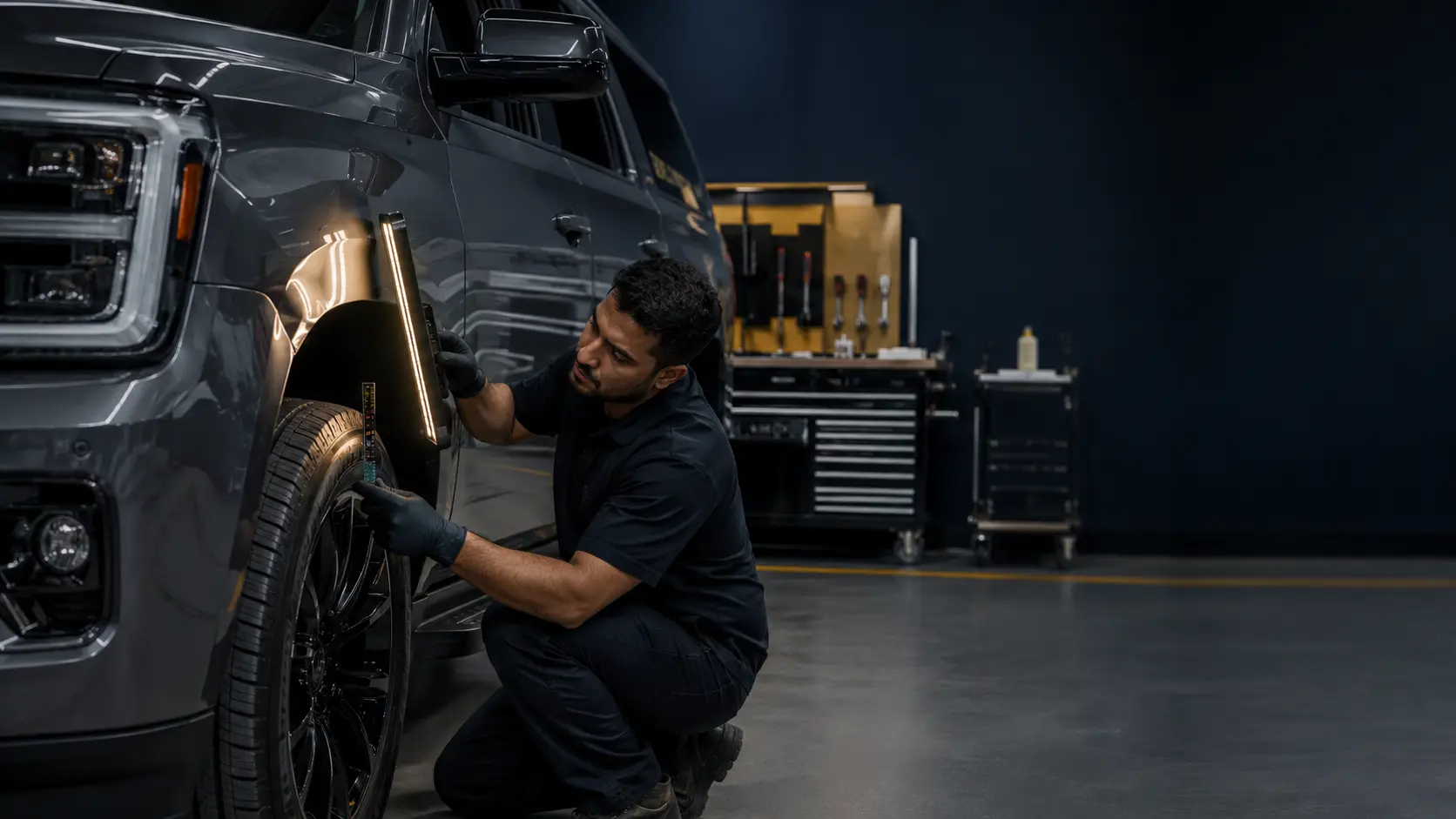
Assess the panel first
A shallow door ding with intact paint may be suitable for paintless dent repair. A sharp crease, stretched metal, cracked paint, damaged body line, torn edge, or inaccessible reinforcement can require conventional metal work and refinishing. Aluminum, steel, plastic, and composite parts also respond differently.
Send photos from straight on and from an angle so the reflection shows the dent shape. Include the full panel and a closer view. Photos help with the first discussion, but an inspection confirms depth, access, paint condition, previous filler, corrosion, panel material, and whether nearby trim must be removed.
Shallow door, fender, or quarter-panel dents with intact paint and usable rear access.
Sharper damage that needs careful shaping and may require paint repair.
Stretched metal, edge damage, cracked paint, previous repair, or several affected areas.
02
Damage location changes the repair
GMC SUVs, pickups, crossovers, and vans have different panel sizes, reinforcements, access points, trim, cameras, sensors, and body lines. A Yukon door dent is not approached like a Sierra bedside crease or a Savana sliding-door dent. The location controls access and the amount of dismantling required.
We inspect adjacent gaps, hinges, latches, lamps, moldings, seals, and mounting points when the impact could have moved more than the visible skin. A dent beside a wheel opening may also need tire-clearance, liner, suspension, or alignment checks if the impact was strong.

Parking dents, edge damage, handle-area dents, and wheel-arch distortion.
Creases, falling-object damage, broad shallow dents, and body-line changes.
Pickup and SUV cargo-area dents, corners, rails, lamps, and latch alignment.
Plastic deformation, metal dents, scuffs, cracked paint, and mounting damage.
03
Choose by damage, not habit
Paintless dent repair reshapes suitable metal without repainting the panel. It can preserve the original finish and reduce repair time when the paint is sound, the metal has not stretched too far, and tools can reach the back of the dent or controlled pulling can be used safely.
Conventional repair is used when paint has cracked, metal is stretched, an edge is damaged, filler is already present, or the panel requires welding, preparation, primer, color, and clear coat. The aim is not to force every dent into one method. The aim is to choose the method that produces a stable shape and acceptable finish.
04
Panel-based fitted estimates
These market-based ranges help with budgeting. The final price changes with dent size, depth, sharpness, location, body line, access, panel material, paint damage, trim removal, previous repair, color, blending, and VAT treatment. Several dents on one panel may be priced as a combined repair rather than separate jobs.
A written estimate identifies the panel, method, preparation, paintwork, dismantling, assembly, polishing, and known exclusions. Paintless work and conventional repair should not be compared only by price because the damage must be suitable for the chosen method.
Estimated per suitable shallow dent with intact paint and practical access.
Estimated for more controlled shaping, difficult access, or a defined body line.
Estimated per panel for repair, preparation, paint, clear coat, and finishing.
Estimated complete scope for several areas, paint blending, assembly, and checks.
05
Know what changes the result
The same visible dent size can require different work on two vehicles. A shallow center-panel dent may be accessible and repairable without paint. A smaller dent at a folded edge can be harder because the metal is stronger, access is limited, and paint stress is concentrated.
Previous filler or repainting also changes the decision. Pulling or reshaping a previously repaired area can crack the finish or separate old materials. We check the surface and explain when preserving the current paint is not a reliable option.
06
Panel size and construction
We repair dents on GMC Yukon, Yukon XL, Sierra, Canyon, Terrain, Acadia, Savana, and other supported models. Yukon and Yukon XL have large doors, quarter panels, hoods, and tailgates where broad reflections can reveal small shape changes. Sierra and Canyon bedsides, tailgates, cab panels, and wheel arches can combine strong body lines with limited rear access.
Terrain and Acadia dents often involve doors, fenders, quarter panels, liftgates, and bumper corners. Savana vans have large side panels and doors that require control across a wide surface. Model year, trim, side steps, moldings, cameras, parking sensors, and previous modifications can change dismantling and access.
Doors, hood, roof, quarter panels, liftgate, fenders, bumper corners, and trim areas.
Bedside panels, tailgate, cab, fenders, hood, wheel arches, steps, and bumper damage.
Crossover and van doors, side panels, liftgates, sliding doors, fenders, and bumpers.
07
Controlled repair sequence
Start with the model, year, damaged panel, and photos. We confirm whether a workshop inspection is required and arrange pickup when needed. The inspection identifies the dent type, paint condition, access, previous repair, panel material, and connected damage. You receive a written estimate before work begins.
Trim may be removed for access and protection. The panel is reshaped gradually or repaired through conventional metal work. If painting is required, the surface is prepared, primed, colored, cleared, and polished. Reassembled parts, gaps, handles, lamps, windows, locks, and sensor areas are checked according to the repair.
Inspect dent shape, paint, material, access, and connected damage.
Select paintless repair, conventional repair, or replacement.
Reshape, prepare, refinish, and assemble the affected area.
Review reflection, color, gaps, operation, and finish before handover.
08
Inspect under changing light
A repaired panel should look stable from several angles, not only straight on. Reflections across the surface reveal waves, high spots, low spots, and changes around body lines. Door, hood, tailgate, and lamp gaps should remain consistent. Handles, windows, locks, seals, trim, and nearby sensors should operate correctly after assembly.
When paintwork is included, color and metallic orientation must be checked under suitable lighting. Texture, gloss, edges, dust, overspray, masking lines, and polishing marks also affect the result. Some deep damage or previous repair can limit the achievable finish. Any known limitation should be discussed before approval rather than discovered at handover.
Check the panel from several angles for waves, highs, lows, and body-line accuracy.
Review color match, gloss, texture, blend area, edges, dust, and polishing.
Confirm gaps, trim, handles, locks, windows, lamps, seals, and sensors.
09
Typical repair budgets
These are realistic planning estimates, not confirmed customer records. Final prices depend on inspection, repair method, paint condition, and vehicle condition.
Typical job estimate
Medium door dent with intact paint, trim protection, controlled paintless reshaping, and reflection inspection.
AED 550 to 950Typical job estimate
Bedside metal correction, preparation, refinishing, polishing, lamp-area check, and panel-gap inspection.
AED 1,600 to 2,800Typical job estimate
Fender repair, surface preparation, color application, clear coat, assembly, and final finish review.
AED 950 to 1,65010
A dent can hide other damage
A parking dent is usually cosmetic, but a stronger impact can affect door intrusion beams, hinges, latches, lamp mounts, bumper supports, wheel liners, tire clearance, suspension, and alignment. If a door does not close correctly, a tire rubs, a lamp is loose, glass is damaged, or a warning appears, the vehicle needs a broader inspection.
Do not keep driving when loose trim could detach, visibility is reduced, a door or hood cannot latch, fluid is leaking, a wheel is rubbing, steering has changed, or safety warnings are active. Arrange pickup so the vehicle can be assessed without increasing damage.
The panel shape and finish are affected, while gaps, mounting, operation, and connected systems remain normal.
Changed gaps, broken mounts, warning lights, rubbing, leaks, unsafe closures, or structural concerns need wider inspection.
11
Al Quoz 4 body repair
Our workshop is in Al Quoz 4, Dubai. We serve GMC owners across Dubai and support vehicles coming from Abu Dhabi, Sharjah, and Ajman. Free pickup and delivery can be arranged. A dedicated on-site inspection van is available by arrangement when a mobile assessment is suitable.
Send the GMC model, year, damaged panel, vehicle location, and photos. Tell us if the paint is cracked, a door or tailgate has moved, a lamp is loose, or the wheel area was hit. We will arrange the suitable inspection and prepare a written repair estimate.
Direct answers
Photos support the first review, but exact pricing may require inspection of depth, access, paint, previous repair, panel material, and connected damage.
It is controlled reshaping of suitable metal while preserving the existing paint. It depends on paint condition, metal stretch, dent position, and tool access.
The metal may still be reshaped, but cracked paint normally requires preparation and refinishing. The complete method is confirmed after inspection.
Yes. Sierra and Canyon bedside, tailgate, wheel-arch, and cab dents can be assessed for paintless or conventional repair.
Blending may be needed when refinishing a panel and matching the adjacent finish. Color, panel position, and damage determine the paint plan.
Yes. Free pickup and delivery can be arranged. Share the model, location, damaged area, and whether the vehicle is safe to move.
Timing depends on dent complexity, access, dismantling, paintwork, curing, parts, and workshop capacity. The expected schedule is discussed after inspection.
Yes. Several dents can be inspected and quoted as one scope. Combined work may be more practical when trim removal or panel refinishing overlaps.
Start with the damaged panel
Send the model, year, panel location, and photos. We will arrange an assessment and recommend the suitable repair method.