
A car that feels sluggish when accelerating may have an airflow, ignition, fuel-delivery or control fault, transmission slip, or resistance from brakes or tires. Notice whether it hesitates before responding, lacks power under load, or revs without gaining speed. That pattern determines what needs testing.
Which sluggish acceleration pattern matches your car?
Compare pedal response, engine speed and road speed. These clues help separate an engine problem from transmission slip or rolling resistance. Observe normal behavior; do not make repeated hard-acceleration runs to test it.
| Pattern | What the driver experiences | First diagnostic direction |
|---|---|---|
| Hesitation | A pause, stumble or delayed response immediately after pressing the accelerator | Airflow, throttle, ignition, fueling, electrical supply and engagement data |
| Low engine power | The engine responds but cannot build expected speed, especially under load | Fuel delivery, ignition under load, boost, exhaust restriction, cooling and reduced-power control |
| Transmission or clutch slip | Engine speed rises without a matching increase in road speed | Gearbox or clutch operation, fluid and temperature data where applicable, and mechanical evidence |
| Rolling resistance | The whole car feels held back even though the engine sounds normal | Tire pressure, brake drag, wheel temperature, alignment and bearing condition |
A brief RPM rise during an automatic downshift or some CVT operation can be normal. A new, persistent flare with poor road-speed response needs assessment. Describe the change from your car’s usual behavior.
Common causes of sluggish acceleration
The table is a diagnostic guide, not a remote diagnosis. More than one fault can exist, and the correct order of tests depends on the vehicle, its history and the exact conditions in which the symptom appears.
| Area | Possible pattern | Useful checks |
|---|---|---|
| Air intake and throttle | Flat response, unstable idle or hesitation after the pedal is pressed. | Inspect the intake path, filter condition, hoses, throttle operation and relevant live sensor readings. |
| Ignition | Misfire, shaking at idle or loss of pull under load. | Check stored and pending faults, misfire data, plugs, coils, wiring and whether service parts match the vehicle specification. |
| Fuel delivery | Hesitation, difficult starting, stalling or reduced power at higher demand. | Verify fuel quality history where relevant, pressure or delivery data, injector operation and electrical supply before replacing components. |
| Sensors and control | Check-engine light, inconsistent response or reduced-power mode. | Compare fault codes with live data, wiring integrity, power supply and expected values. A code may describe a circuit or condition, not the failed part. |
| Turbo or boost | Normal low-load driving but weak pull when more power is requested. | Inspect charge-air hoses, leaks, boost control, actuator operation and measured versus requested pressure on equipped engines. |
| Exhaust restriction | Power fades as engine speed rises, sometimes with heat, smell or rattling. | Assess exhaust condition and pressure or temperature evidence where appropriate rather than condemning a catalyst from one symptom. |
| Transmission or clutch | Delayed engagement, flare in engine speed, harsh shifts or poor transfer of power. | Review fluid condition where serviceable, fault data, adaptation or slip information, road-test behavior and mechanical evidence. |
| Brakes, tires and alignment | The car feels heavy, pulls, vibrates or does not coast as expected. | Check tire pressures and condition, wheel alignment indicators, brake drag, temperatures and wheel or bearing condition. |
| Electrical supply | Multiple warnings, inconsistent throttle or steering assistance and faults after starting. | Test battery condition, charging voltage, grounds and power feeds because low or unstable voltage can affect several control systems. |
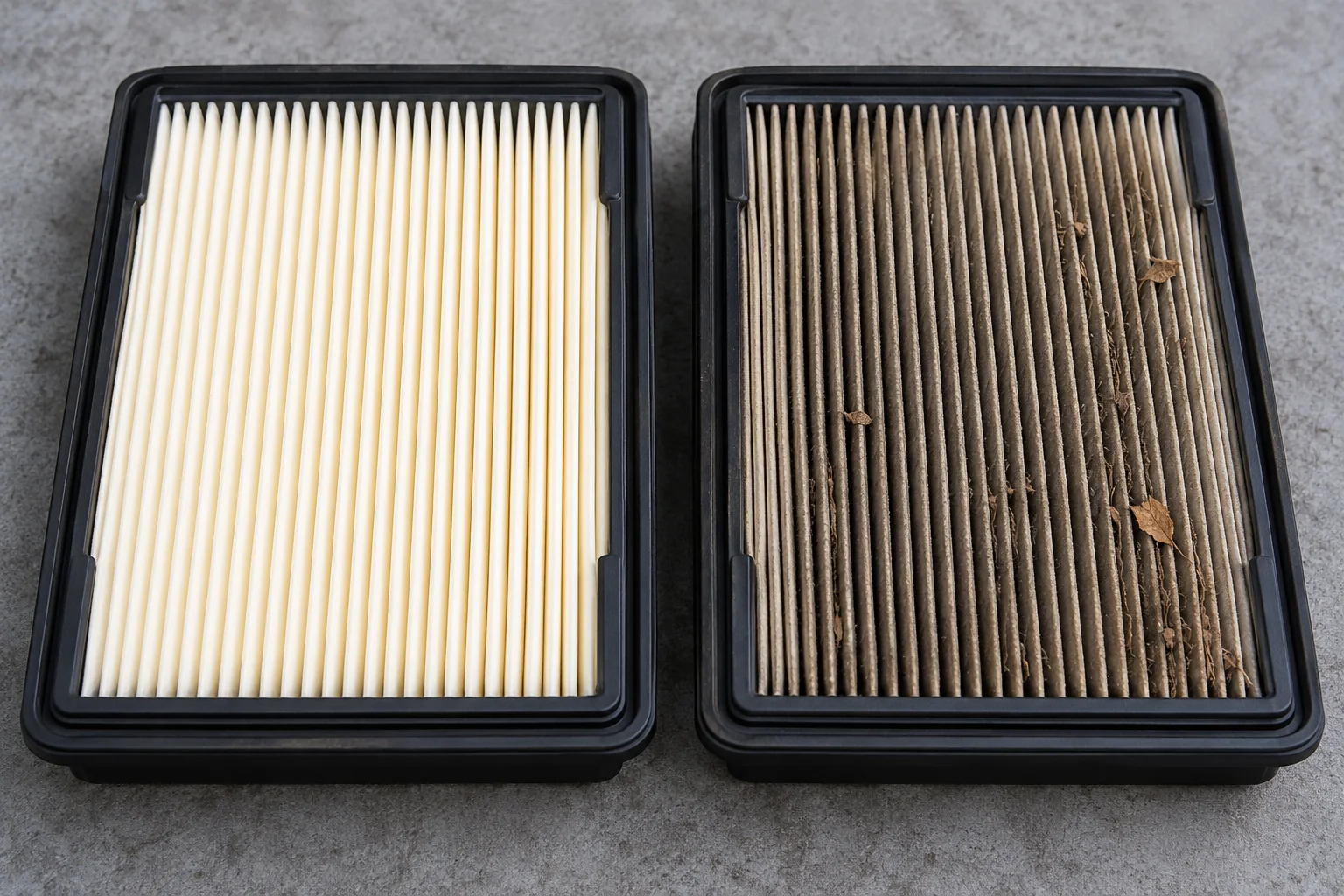
Check before buying a replacement
A heavily restricted filter can limit airflow, but hesitation can also come from a leak, ignition fault, fuel problem or incorrect sensor data. Inspect the filter, housing and air path together.
For an airflow-related code, our mass air flow sensor guide explains the checks before cleaning or replacement. A warning-light label is not a parts verdict.
What the onset pattern can reveal
Only when the engine is cold
Record how long the condition lasts and whether the idle is unstable. Temperature-related sensor input, air or fuel control and ignition performance may need review, but the correct tests depend on data captured during the cold condition.
Only after a long drive
Heat can expose an intermittent electrical, fuel-delivery, cooling or transmission problem. Note the outside temperature, coolant reading, traffic conditions and whether stopping or restarting temporarily changes the response.
Immediately after recent work
Share exactly what was repaired and which parts were disturbed. A loose connector, intake hose, incorrect setting or unrelated new fault is possible. The timing is useful evidence, but it does not by itself prove who or what caused the problem.
After refueling
Keep the receipt and record the station, fuel grade, remaining tank level and how soon the symptoms began. Fuel quality or an evaporative-system issue may be considered, while ignition, sensor and other faults still need to be ruled out.
With the AC switched on
A small load change can be normal, but severe hesitation, stalling or a new noise is not something to dismiss as “just the AC.” The workshop may need to compare engine response, idle control, charging condition and compressor load with the system on and off.
After a warning light disappears
Intermittent faults can remain stored even when the dashboard returns to normal. Avoid disconnecting the battery or clearing codes before inspection unless safety requires it, because freeze-frame and event information can help reconstruct the failure.
Safe checks before your appointment
- Park securely and switch off. On a hybrid, confirm it is fully off, not silently in READY mode.
- Check the driver’s footwell. Look for a loose object, displaced mat or stacked mats near the pedals. Use one correctly fitted mat, secured as the manual directs, clear of pedal movement. Do not adjust it while driving.
- Check cold tire pressure against the vehicle label, where safe. Do not touch a wheel or brake to check whether it is hot.
- Save the warning and timeline. Photograph the display while parked and record recent fuel, battery or repair work. Do not clear codes.
- Avoid trial fixes. Do not add cleaners, unplug sensors, pour in unknown transmission fluid or swap parts before diagnosis.
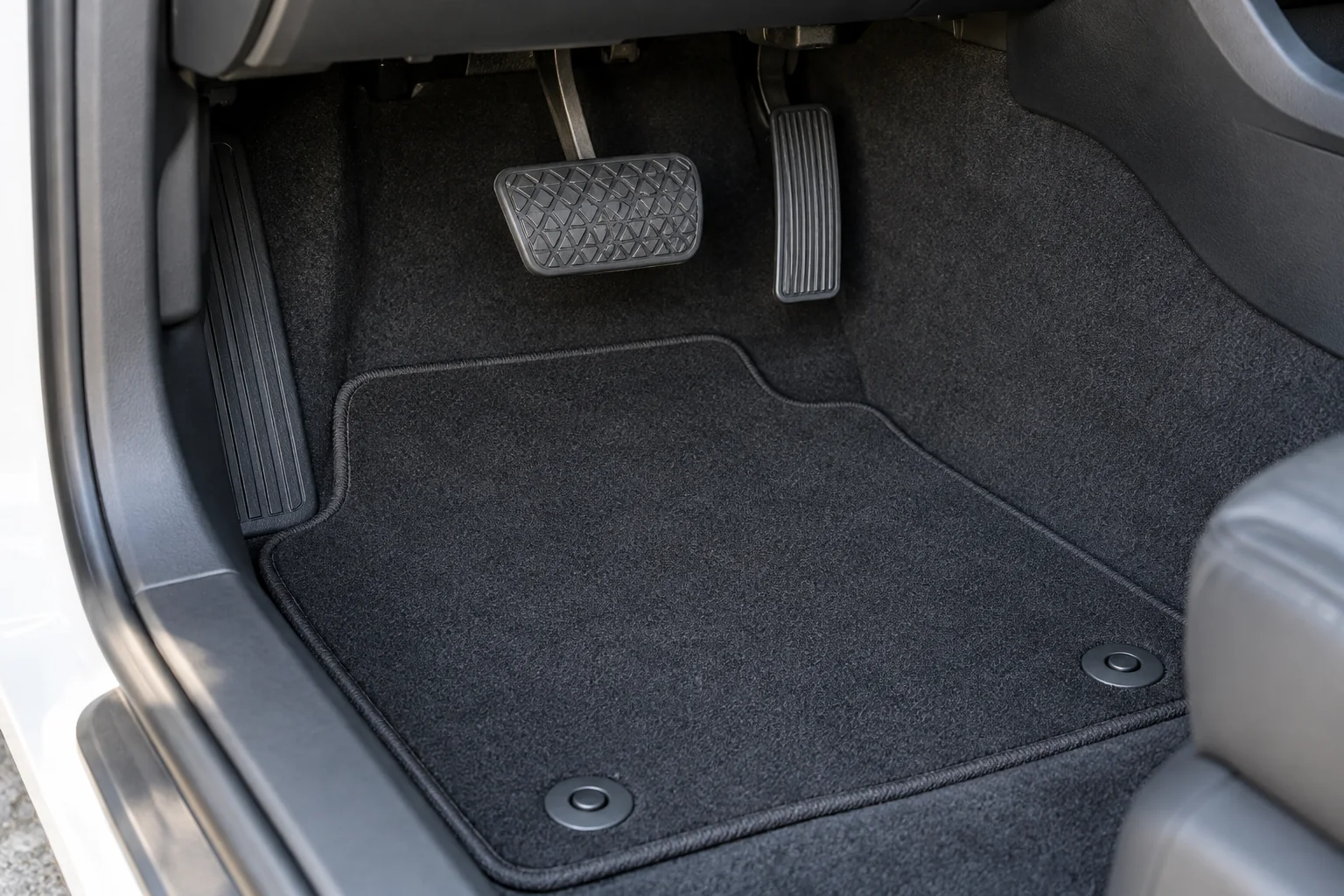
If a pedal sticks or does not return normally, do not drive until the cause is resolved. A clear footwell does not rule out an engine, transmission or brake fault. Keep hands away from hot components, belts, fans and orange high-voltage cables.
How a workshop diagnoses sluggish acceleration
Good diagnosis connects the customer’s description with repeatable evidence. The sequence may change when there is a safety concern or an obvious mechanical defect, but it should still explain why the proposed repair follows from the findings.
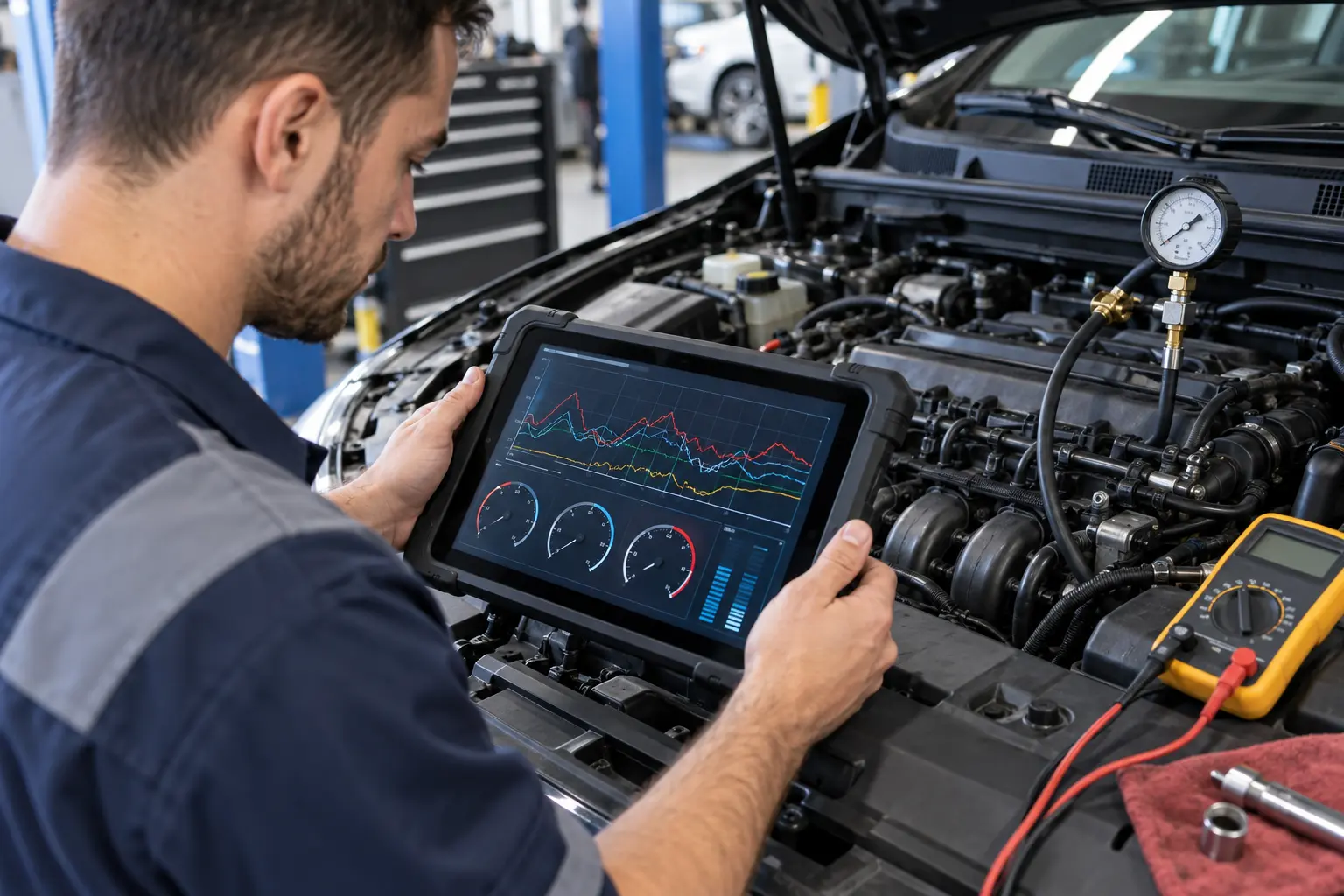
Confirm the exact behavior
Record when it began, whether the vehicle is cold or warm, which speed or gear is involved, recent repairs, warning lights and any noise, smell or vibration. A short accompanied road test may help reproduce the concern when safe.
Inspect before dismantling
Look for disconnected hoses, leaks, damaged wiring, loose intake parts, tire problems, fluid concerns and other visible evidence. Simple findings should still be verified instead of being assumed to explain every symptom.
Scan and review live data
A proper computer diagnostic check can read stored, pending and manufacturer-specific faults where the equipment supports them. Live values and freeze-frame conditions help place a code in context.
Test the suspected system
Depending on the evidence, this may include ignition checks, pressure tests, intake or boost leak testing, charging-system measurements, exhaust assessment, transmission data or brake-drag checks.
Confirm what the quote includes
Before approving the repair, ask for a written quote showing:
- The fault found and the repair needed
- Which parts will be used, including their brand and whether they are new or reconditioned
- Labor charges, VAT and the total price
- Any extra tests or work that need your approval first
Verify the repair under the original conditions
After any required adaptations or drive cycle, recheck acceleration, relevant live values, temperatures and leaks under safe conditions. Clearing the warning alone is not proof.
If the symptom returns, retain the invoice, record the conditions and return for a follow-up. The same code can return because a wiring, air-leak or mechanical problem remains; it does not automatically condemn the new part.
Before approving a repair
- Ask what failed and why. Which test connects the component to the complaint? Was the problem reproduced?
- Separate maintenance from diagnosis. A routine service may address overdue items without resolving the acceleration fault.
- Check the estimate. Confirm the parts basis, labor, fluids, calibration, VAT, exclusions and the point at which further approval is needed.
Do not buy a list of common causes. A split hose or damaged connector may be repairable without replacing an assembly. An internal engine or transmission recommendation needs appropriate test evidence. For shift slip, the transmission inspection service explains the focused next step.
What Dubai driving conditions change
Record whether the loss of response follows a hot restart, traffic, heavy AC use or a long drive. Heat can make a marginal cooling, electrical or fuel-delivery problem more noticeable, but it is not a diagnosis. Follow the vehicle’s dusty-use maintenance guidance instead of assuming every sensor or filter needs early replacement.
Send the model year, engine, mileage, service history and whether the car is GCC-spec or imported. Gasoline, diesel, turbocharged and hybrid versions need different test values. On a hybrid, note whether the hesitation occurs as the engine starts or during combined acceleration. Fully electric vehicles need a separate battery, motor and power-limitation assessment.
Sluggish acceleration diagnostic costs in Dubai
The price depends on the test needed, not the symptom name. These planning ranges match our current diagnostic service prices. Base prices exclude 5% VAT; the next column shows the total including VAT. Agree on the scope before testing begins.
| Diagnostic scope | AED before VAT | AED including 5% VAT | What is covered |
|---|---|---|---|
| Computer scan | 145 to 285 | 152.25 to 299.25 | Supported-system scan, available codes and status, and recommended next step. It does not by itself confirm a failed part. |
| Focused warning-light diagnosis | 240 to 525 | 252 to 551.25 | Initial scan plus focused electrical, visual or operating checks for one warning or related system. |
| Intermittent fault testing | 475 to 1,145 | 498.75 to 1,202.25 | Extra testing time for cold-start, warm-up, road or repeated observation conditions. |
Parts, repair work, dismantling, programming and calibration are separate unless the written estimate includes them. Do not add every row together: the workshop should identify the appropriate scope and explain any additional stage first. A hose repair, ignition fault and internal gearbox repair have very different parts and labor costs.
Technical references
Transport Canada on floor mats and pedal interference; HELLA on airflow-sensor faults and electrical checks. Follow the owner’s manual and service information for your exact vehicle.
Start with the pattern and confirm the cause
Sluggish acceleration is a symptom, not a diagnosis. Record when it happens, which warnings appear, and whether engine speed rises without matching road speed. Stop driving when power loss comes with overheating, oil-pressure warnings, smoke, fuel odor, severe shaking, or reduced control. If the vehicle cannot accelerate predictably into traffic or maintain speed, arrange recovery. For a stable concern without urgent symptoms, follow the manual and arrange diagnosis before approving parts.
Book an acceleration check in Al Quoz 4
Send the vehicle details and the exact acceleration pattern. Mention warning lights, stalling or difficulty keeping pace with traffic before planning to drive to the workshop.
Sluggish acceleration FAQs
Can a dirty air filter cause sluggish acceleration?
A heavily restricted filter can reduce airflow on some vehicles, but the filter should be inspected rather than assumed to be the cause. Similar symptoms can come from intake leaks, sensors, fuel delivery, ignition, exhaust restriction or transmission behavior.
Why does my car hesitate only when overtaking?
A fault may appear only when the engine is under higher load. Ignition breakdown, fuel delivery, boost control, protective power reduction and transmission operation are possible areas to test. Record the speed, gear, engine temperature and warning lights when it happens.
Can a weak battery affect acceleration?
A weak battery or charging fault can create unstable voltage and multiple electronic symptoms, especially on vehicles with electronically controlled throttle, transmission and steering systems. Voltage testing may be appropriate when warnings are inconsistent or appeared after starting trouble.
Is it safe to drive with reduced engine power?
It depends on the accompanying symptoms and whether the car can join traffic and maintain control safely. Stop safely if the light flashes, the engine overheats, there is smoke, a fuel smell, a red oil-pressure warning, severe shaking or reduced control. Arrange recovery if it cannot maintain speed or accelerate predictably.
Will a diagnostic scan identify the exact failed part?
Not always. A scan can reveal codes, freeze-frame conditions and live data, but a code may describe a circuit, value or system condition. Physical inspection and targeted testing are often needed before a part is confirmed.
Why does my car feel sluggish without a warning light?
Some mechanical, brake, tire or intermittent faults do not trigger a dashboard warning. The absence of a light does not establish that driving is safe. Record the pattern and arrange inspection; stop if the car cannot accelerate reliably or has serious accompanying symptoms.