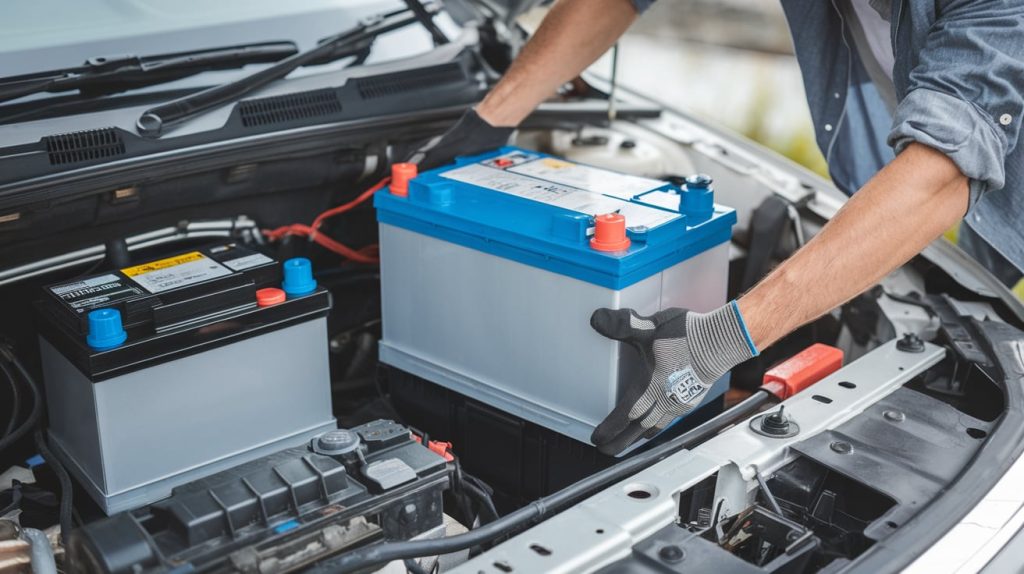
Battery selection for UAE conditions
The engine hesitates, the dashboard flickers, and now you are wondering whether the car will start after the next stop. Buying the first battery offered may fix the symptom for a day, or leave you paying twice. The best car battery in UAE is the one that matches the vehicle’s battery technology, size, terminal layout, Ah and CCA ratings, start-stop system, and battery-management requirements. Brand comes after fitment and test results.
“A battery that fits the tray is not automatically the right battery for the car.”
UAE heat makes battery condition especially important, but “heat resistant” is not a substitute for correct fitment. A premium AGM battery fitted to a car that requires a different size or battery-management setup can still create problems. Likewise, installing a basic flooded battery in a vehicle designed for AGM or EFB can reduce cycle performance and interfere with start-stop operation.
Start with battery technology
| Battery type | Typical application | Replacement point |
|---|---|---|
| Conventional SLI / flooded lead-acid | Vehicles without demanding start-stop or deep cycling requirements, where specified by the manufacturer | Match size, capacity, terminal layout and application. Do not substitute it for AGM/EFB simply because it is cheaper. |
| EFB | Many entry-level or less demanding start-stop systems and higher-cycle applications | VARTA advises replacing an EFB with the same type; in some applications an upgrade to AGM may be appropriate when the application supports it. |
| AGM | Higher electrical loads, start-stop systems, regenerative braking and vehicles that require strong cycling performance | AGM should be replaced with AGM when specified. Vehicle registration/adaptation may be required after installation. |
| Auxiliary 12V battery | Some luxury cars, hybrids and EVs use a separate low-voltage support battery | Do not confuse it with a traction battery. Access, chemistry and reset procedures can be model-specific. |
VARTA’s start-stop replacement guidance says an AGM battery should be replaced with AGM, while EFB should remain EFB or, in supported applications, be upgraded to AGM. Bosch battery information also separates AGM, EFB, and SLI technologies by vehicle demand. The vehicle application remains the deciding factor.
What Ah and CCA actually mean
Capacity in amp-hours
Amp-hour capacity, written Ah, is an indication of the amount of electrical charge the battery is designed to deliver under specified test conditions. More Ah is not automatically better if the battery is physically wrong or the vehicle’s charging strategy is calibrated for a different specification.
Cold-cranking amps
CCA describes starting-current capability under a defined cold test. Dubai is not a cold-start climate, but CCA is still part of the battery specification. The correct application should meet the manufacturer’s required starting performance rather than choosing a battery solely because its CCA number is larger.
Voltage
Most conventional passenger-car starter batteries are nominally 12 volts, but a “12V” label alone tells you almost nothing about fitment. Battery chemistry, size, terminals, capacity and vehicle electronics still need to match.
Reserve and cycling demand
Vehicles with stop-start, extensive electronics or engine-off electrical use place more cycling demand on the battery. That is one reason an ordinary flooded starter battery cannot be treated as equivalent to every AGM or EFB application.
Battery Size and Physical Fitment
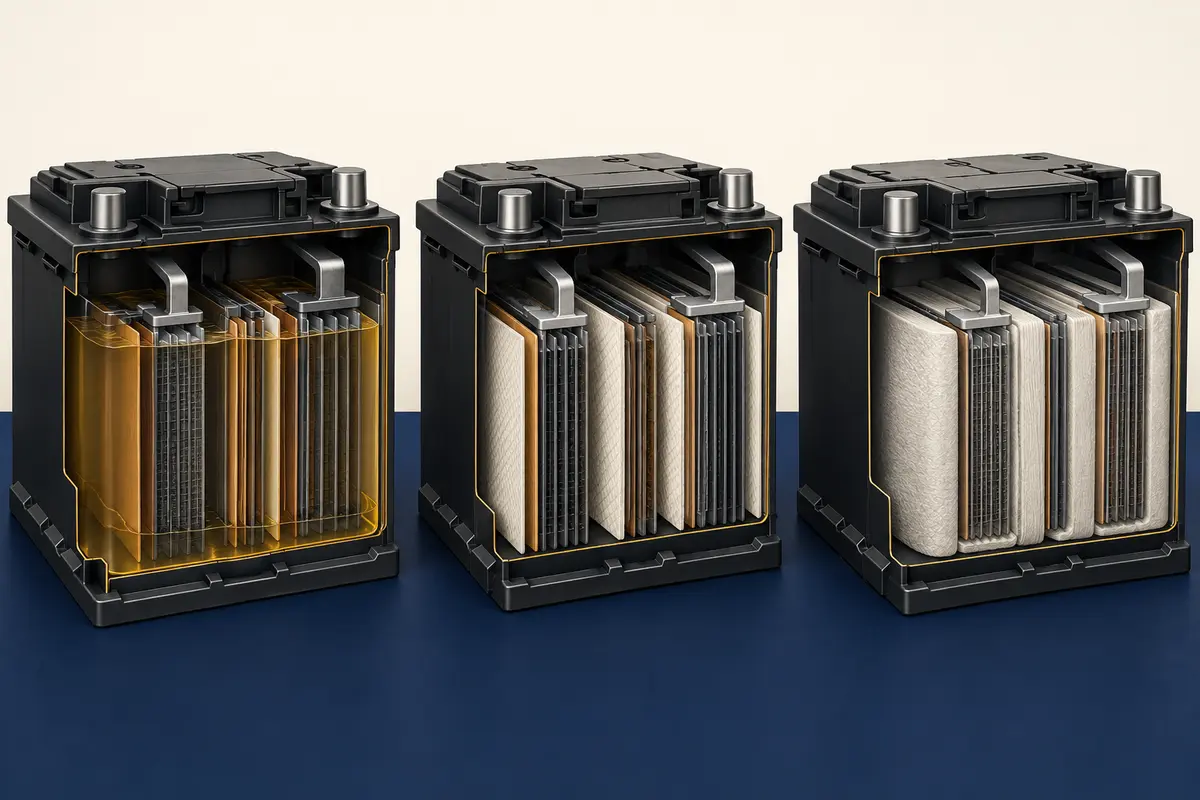
Start with the specified technology
AGM, EFB, and flooded starter batteries are built for different duty cycles. Match the original specification before comparing brands or prices.
Physical fitment can make or break the replacement
Length, width, height, hold-down design, terminal position, terminal type, and any vent connection must match. A battery that can be forced into the tray is not a correct fit.
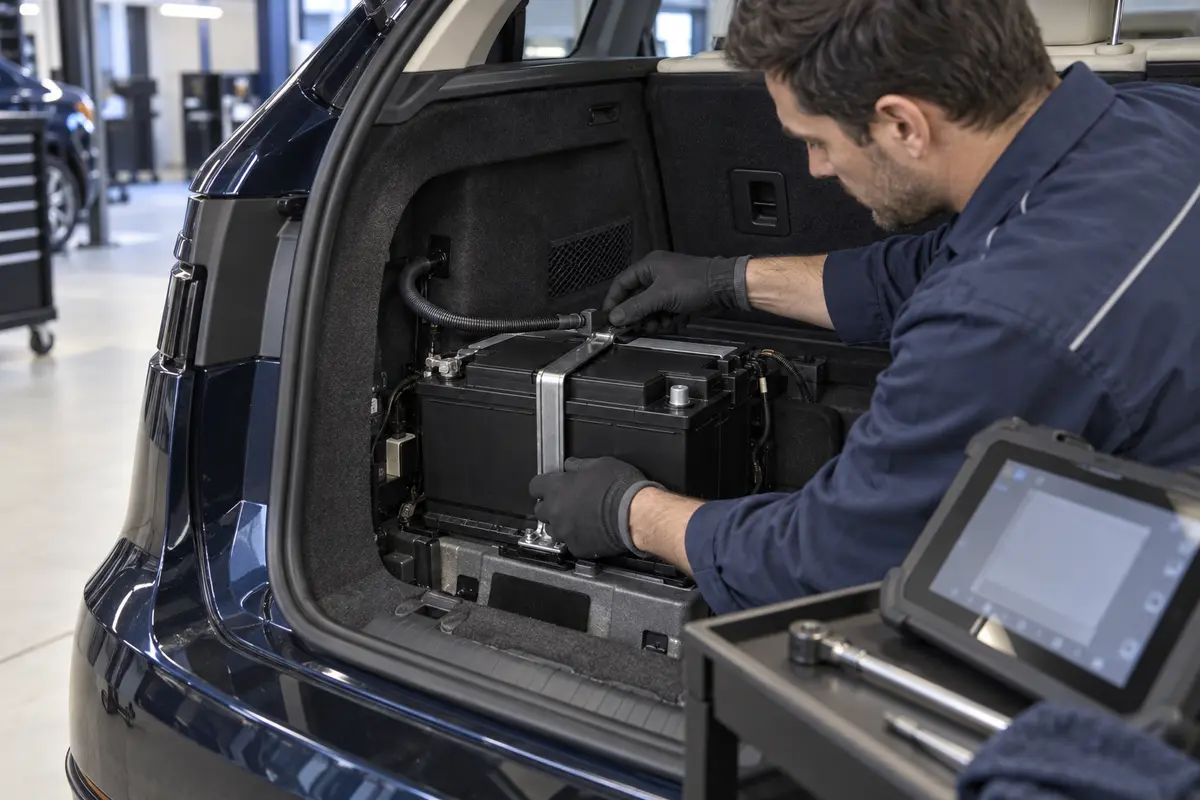
Modern vehicles may place the battery under the hood, in the trunk, beneath a seat, or behind trim. Access can involve shutdown steps and service procedures that a roadside swap may miss.
Why battery registration or coding matters
Some vehicles use an intelligent battery sensor and energy-management system that tracks battery age, state of charge and charging behaviour. After replacement, the new battery may need to be registered or adapted with a diagnostic tool so the vehicle knows that a new battery of the correct type and capacity has been installed.
Registration is not a marketing add-on. On vehicles that require it, failing to perform the procedure can leave the charging strategy based on assumptions about the old battery. If battery type or capacity changes within an approved application, additional coding may be required. The exact procedure is vehicle-specific, so it should be confirmed rather than promised for every model.
If you want the workshop to test, replace and perform the applicable reset route, use our car battery replacement service. For repeated electrical drain or charging problems, a broader car electrical diagnosis is more useful than repeatedly fitting new batteries.
UAE heat changes how you should think about battery life
High temperature accelerates chemical activity and can increase internal degradation in lead-acid batteries. Under-bonnet heat, long periods parked outside, high electrical load and repeated partial charging can all contribute to a battery reaching the end of useful life sooner than a driver expects. That does not mean every battery in the UAE should be replaced at a fixed age.
Use test results and symptoms. A battery that still starts the car can be weak, but a slow crank can also come from poor terminals, a starter problem or low state of charge. Conversely, a new battery can go flat if the alternator, DC-DC converter, wiring or parasitic current problem is not addressed.
Short Trips and Long Parking Periods
Read the specification before ordering
Confirm the case size, terminal layout, hold-down, Ah rating, CCA rating, and vent connection. A battery that looks close can still be unsafe or impossible to secure.
A car used for short journeys may start repeatedly without enough driving time to restore the energy used. A vehicle parked for weeks may lose charge through standby use, battery wear, or an abnormal parasitic draw.

If a healthy battery repeatedly discharges, do not treat jump-starting as the repair. Measure battery condition, charging output, and key-off current after the vehicle enters sleep mode. Our jump-start guide covers the emergency step, but repeated failure needs diagnosis.
What to test before condemning the battery
- Battery resting state and state of charge before interpreting a load or conductance test.
- Battery terminals, cable connections and visible corrosion.
- Starting voltage behaviour and cranking symptom.
- Charging-system output or DC-DC charging on the applicable vehicle.
- Fault codes or battery-management data where relevant.
- Parasitic current after the vehicle has entered its normal sleep state if repeated discharge is reported.
- Any recent accessory installation, dashcam hardwiring, tracker, audio equipment or repair that could affect standby draw.
What Makes One Car Battery a Better Buy
Once the specification is correct, brand comparison becomes useful. If you are comparing vehicle-branded, supplier-branded and replacement-market options, use our OEM car battery buying guide to understand what those labels do and do not prove. ACDelco, Bosch, VARTA, Exide, Amaron, Optima and other established manufacturers all have products aimed at different applications. The important question is not “Which logo is best?” but “Which exact product line and part number meets this car’s specification, and how fresh is the stock?”
Correct application
Use the manufacturer or reputable application catalogue, VIN where appropriate and the original-equipment specification. Do not select only by what physically fits the tray.
Manufacturing date and storage
A battery that has spent a long time undercharged in storage is less attractive than fresh stock that has been maintained correctly. Ask how stock is rotated and test state of charge before installation.
Warranty terms
Compare what the written warranty actually covers, the duration, required proof of purchase and how a claim is tested. Do not assume every battery from one brand carries the same warranty.
Local availability
An exotic part number can create unnecessary downtime later. For a daily driver, availability of the correct replacement and local support can be as valuable as a small specification advantage.
Best Car Battery Brands in UAE
Once the specification is fixed, compare the product line rather than the logo alone. VARTA, Bosch, ACDelco, Amaron, Exide, and Optima sell batteries for different duties. One brand may have a suitable AGM for a start-stop sedan and an unsuitable flooded battery for the same car. That is why a blanket “best brand” answer is not much help.
| Brand | Common options | Often considered for | Check before buying |
|---|---|---|---|
| VARTA | AGM, EFB, SLI | European and start-stop applications | Exact part number, type, stock date, registration need |
| Bosch | AGM, EFB, SLI | European, Asian, and mixed applications | Product series, dimensions, warranty terms |
| ACDelco | Flooded, EFB, AGM options | American, Asian, and general applications | Regional specification and terminal layout |
| Amaron | Maintenance-free starter batteries | Daily-use cars and SUVs | Application, manufacture date, written warranty |
| Exide | SLI, EFB, AGM options | General and start-stop applications | Product line and local stock support |
| Optima | AGM products | Cycling demand and accessory use | Charging compatibility, size, and hold-down |
Car Battery Price in UAE
These are Auto Repair UAE planning prices in AED for fitted battery service. Standard installation includes removal, accessible terminal cleaning, secure fitment, starting and charging checks, and handling of the old battery. Alternator repair, starter repair, damaged cable work, parasitic-draw diagnosis, recovery, and control-module programming are separate when required. VAT treatment appears on the written estimate. Testing may show that replacement is unnecessary.
| Battery or service | Price range | Scope | Price changes when |
|---|---|---|---|
| Standard flooded battery | AED 450 to 850 | Compatible battery and standard installation | Capacity, size, and access differ |
| Large-capacity battery | AED 700 to 1,300 | Battery for supported larger engines, SUVs, pickups, or vans | Ah, case size, and stock differ |
| EFB or AGM battery | AED 900 to 1,850 | Supported start-stop or high-demand application | Technology, capacity, location, and brand differ |
| Auxiliary battery | AED 550 to 1,200 | Battery matched to a separate support system | Access and part specification differ |
| Battery registration or coding | AED 100 to 350 | Applicable reset or adaptation | Diagnostic procedure and model differ |
Prices vary by model, battery specification, condition, stock, and work required. These are planning ranges, not a final quote. Call before traveling if the vehicle uses start-stop, has more than one battery, or shows an energy-management warning.
Luxury cars can have more than one battery
Some vehicles use a main starter battery plus an auxiliary battery for stop-start, braking, electronics or backup functions. Replacing the main battery does not automatically solve an auxiliary-battery warning, and a message about the secondary battery does not automatically mean the main battery is weak.
Battery location can also matter for chemistry. AGM is commonly used where spill resistance, cycling and enclosed installation characteristics are relevant. Always match the vehicle specification rather than substituting based on price.
Hybrid and electric cars still use low-voltage batteries
An EV traction battery may operate at hundreds of volts, but the vehicle still relies on a low-voltage electrical system to wake control units, close high-voltage contactors, operate locks and support many conventional electrical functions. A weak 12V battery can therefore make an EV appear to have a much larger failure than it actually does.
Do not attempt to substitute or jump-start an EV low-voltage system without the vehicle-specific procedure. Connection points and safe methods vary. The traction battery and the 12V auxiliary battery are separate systems and require different service knowledge.
Signs that justify a battery test
- Slower engine cranking than normal.
- Repeated need for a jump start.
- Start-stop function unavailable alongside battery-related symptoms.
- Battery or energy-management warning.
- Electrical systems resetting after starting.
- Vehicle was left unused for a long period and now struggles to wake or start.
- Visible swelling, leakage or severe terminal corrosion. A physically damaged battery should be handled cautiously.
How a battery test should be interpreted
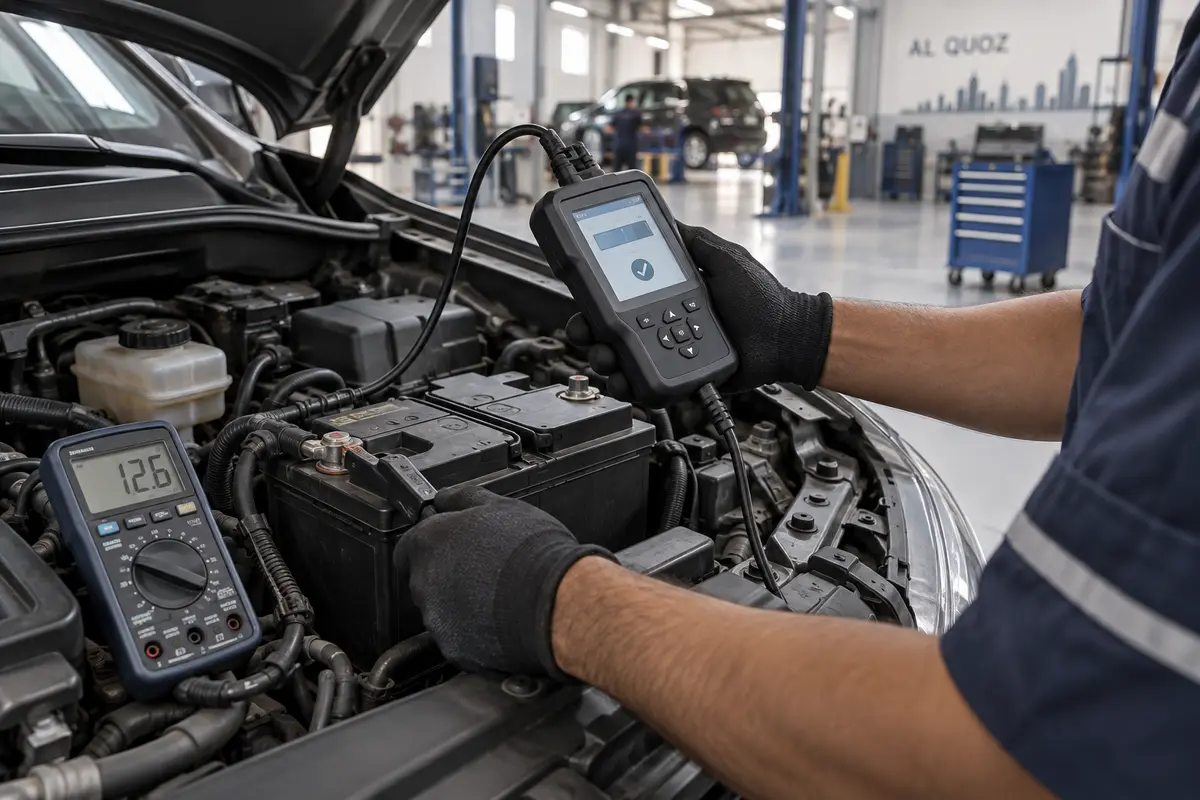
Test before condemning the battery
Low charge can distort a quick result. Inspect connections, establish charge condition, then test the battery and charging system in the correct sequence.
A battery tester is useful, but the number on the screen needs context. A deeply discharged but otherwise healthy battery can fail a quick conductance test until it has been charged correctly. A battery can also show acceptable open-circuit voltage immediately after charging while having poor usable capacity. Good diagnosis therefore begins with state of charge, battery age and the customer symptom.
For a conventional starter-battery complaint, the sequence is usually to inspect the battery and connections, establish charge condition, test battery performance, observe cranking behaviour and verify that the vehicle is charging correctly. If the battery repeatedly goes flat while parked, key-off current should be measured only after the vehicle has had enough time to enter its normal sleep state. Testing too early can make normal module activity look like a parasitic drain.
On vehicles with intelligent energy management, diagnostic data can add useful context: recorded low-voltage events, battery state-of-charge estimates, charging strategy and fault codes. None of those should replace a physical battery and connection check. Software data based on a failing sensor or poor terminal connection can also mislead diagnosis.
What repeated battery failure can reveal
Charging-system fault
An alternator, regulator, belt, wiring or control problem can leave a new battery chronically undercharged. On hybrids and EVs, the low-voltage system may be supported by a DC-DC converter rather than a conventional alternator, so the correct architecture has to be identified first.
Parasitic draw
A control module that does not sleep, aftermarket tracker, dashcam, audio equipment, faulty relay or other circuit can drain the battery after the car is parked. The current has to be measured after normal sleep timing, then isolated methodically.
Usage pattern
Repeated short journeys, long parking periods and heavy engine-off accessory use can keep a battery below a healthy state of charge even when nothing is technically broken. The solution may involve charging habits or a maintenance charger, not a larger random battery.
Wrong battery installed
An incorrect AGM/EFB/SLI type, unsuitable capacity, wrong terminal layout or unregistered replacement can create poor service life or system warnings. Check the installed battery against the application rather than assuming the previous replacement was correct.
Battery size codes are not interchangeable shorthand
The code is only a starting point. Physical fit, polarity, terminals and venting must agree with the vehicle specification.
Case dimensions
DIN, JIS and BCI systems describe batteries differently. Similar Ah ratings do not guarantee the same length, width or height.
Terminal layout
Positive and negative posts must sit on the correct sides. Reversed polarity can leave cables stretched or impossible to connect safely.
Hold-down design
The base lip, top clamp and tray must secure the battery. A loose case can move under braking or on rough roads.
Venting and posts
Terminal diameter and vent connections can differ. Preserve the original vent arrangement when the battery sits inside the luggage or passenger compartment.
Do not use battery size as a performance upgrade by guesswork
Some owners ask for the largest battery that will fit after adding lights, audio equipment, a refrigerator or camping accessories. Extra capacity can help in an engineered system, but tray space alone does not make the change suitable.
- Confirm the alternator and charging strategy can support it.
- Check the tray, clamp, cable capacity and terminal clearance.
- Verify approved coding or battery-management values.
Maintenance-free does not mean inspection-free
It usually means no routine electrolyte top-up. It does not mean the battery, mounting or charging system can be ignored.
Terminals
Keep connections secure and free from corrosion or looseness.
Case
Check for swelling, cracks, leakage or heat damage.
Hold-down
Confirm the clamp and tray prevent movement.
Charging result
Investigate overcharging, undercharging or repeated discharge.
Do not apply serviceable flooded-battery advice to sealed, EFB or AGM products. Follow the battery manufacturer and vehicle service information for the exact application.
How to buy a battery for a used car
Do not assume the battery installed by the previous owner is the correct reference for the next replacement.
- 1
Verify the specification
Use the VIN or application catalogue. Confirm battery type, approved capacity, start-stop equipment and battery-management requirements.
- 2
Test before ordering
Check battery condition, starting performance and charging output. Scan intermittent electrical warnings instead of treating every low-voltage code as a separate failed component.
- 3
Inspect the installation
Read the date code and examine the terminals, clamp, tray and venting. Look for evidence of frequent disconnection or an improvised fit.
- 4
Judge the wider vehicle
A weak battery alone is rarely a reason to reject an otherwise suitable used vehicle. Repeated low-voltage history, however, can complicate diagnosis and deserves investigation.
Safe replacement details that are easy to overlook
Installation is part of the specification
Vent tubes, monitoring sensors, hold-downs, and battery registration can affect safety and service life. Replacement is not complete when the terminals are merely connected.
- Confirm ignition-off and vehicle shutdown procedure before disconnecting.
- Keep tools from bridging the positive terminal to body ground.
- Use the vehicle’s specified support-voltage procedure if memory retention is required.
- Reconnect battery monitoring sensors and vent tubes correctly.
- Secure the hold-down so the battery cannot move under braking or off-road vibration.
- Perform battery registration/adaptation when the vehicle requires it.
- Check clock, windows, steering-angle or other learned functions only according to the model’s reset procedure.
- Dispose of the old lead-acid battery through an appropriate recycling route rather than household waste.
If you want to check battery condition before replacing it, use our battery tester tool guide for cars in the UAE to compare tester types, read CCA results, and avoid confusing low charge with battery failure.
Can You Drive With a Weak Car Battery
A weak starter battery does not always stop a running engine, but it can leave the vehicle unable to restart. A battery warning while driving may point to a charging-system fault rather than the battery alone. That distinction changes the decision.
| Condition | Driving decision | Next step |
|---|---|---|
| Slow crank, no warning while driving, stable electrical functions | A short planned trip may be possible, but the car may not restart | Arrange battery and charging tests soon |
| Repeated jump-starts | Do not rely on another jump as a repair | Test the battery, alternator, cables, and parasitic draw |
| Battery warning while the engine is running | Continued driving can end in electrical shutdown | Reduce nonessential loads and arrange inspection or recovery |
| Swollen, leaking, hot, or damaged battery | Do not continue normal use or handle it casually | Keep clear of sparks and arrange workshop support |
| Smoke, burning smell, hot cables, or unstable electrical systems | Stop when safe | Switch off if safe and arrange recovery |
Car Battery Shop Near Me
A nearby battery seller only helps when the correct part is in stock and the vehicle’s installation requirements are understood. Before traveling, send the make, model, year, engine, start-stop status, warning message, and a clear photo of the current label. Battery testing, charging checks, installation, and applicable registration are available through the Al Quoz 4 workshop.
When Not to Buy a New Car Battery
A replacement is not the first answer when the battery is merely discharged, a terminal is loose, the alternator is undercharging, a starter motor is failing, or a module stays awake after parking. Charge and test first. Repair the cause when the battery itself still passes.
Recharge
Consider controlled charging when storage or short trips caused a low state of charge and the battery passes after recovery.
Repair another fault
Fix loose connections, charging faults, or parasitic draw before another battery is installed.
Replace
Replace a battery that fails after correct charging, has internal damage, leaks, swells, or no longer meets the required performance.
A second battery is not a diagnosis. If the new one goes flat, stop buying batteries and find where the energy is going.
DIY Battery Replacement or Workshop Installation
| Situation | DIY decision | Workshop reason |
|---|---|---|
| Accessible conventional battery with known specification | Possible for an experienced owner | Useful when fitment or testing is uncertain |
| AGM, EFB, or coded battery | Not advised without model procedure and scan tool | Registration and energy-management checks may apply |
| Battery under a seat or behind trunk trim | Avoid guessing | Vent, sensors, shutdown steps, and trim access matter |
| Repeated discharge | Do not keep swapping batteries | Charging and parasitic-draw diagnosis are required |
| Swollen, leaking, hot, or damaged case | Do not handle casually | Arrange safe workshop support or recovery |
How This Guide Was Prepared
Fahad Saleem prepared this guide around the questions a vehicle owner must answer before buying a battery. Technical statements were checked against current battery-manufacturer and industry guidance listed below. Prices are Auto Repair UAE planning ranges for the stated scope, not claims about a market average. No separate technical reviewer is claimed.
Technical Sources
What Matters Before You Pay
Match the battery technology, dimensions, terminals, Ah, and CCA. Check the stock date and written warranty. Test the charging system. Complete registration when the vehicle requires it. Most of all, do not use a new battery to hide a drain, wiring fault, or charging problem.
Workshop support in Al Quoz 4
Test the battery before replacement
Confirm the battery specification, test result and vehicle requirements before approving replacement.
Clear answers
Frequently asked questions
Which car battery brand is most reliable in the UAE?
There is no universal winner. First match the vehicle’s required technology, physical size, terminal layout, Ah, CCA and battery-management requirements. Then compare reputable brands that offer the correct application, fresh stock and clear local warranty support.
Can I replace an AGM battery with a normal battery?
Not when the vehicle specifies AGM. Current VARTA guidance states that AGM should be replaced with AGM. Downgrading can reduce cycling capability and interfere with systems designed around the higher-performance battery.
Can EFB be replaced with AGM?
In some supported applications, yes. VARTA notes that an EFB replacement can sometimes be upgraded to AGM, but the vehicle application and charging system should be checked before changing technology.
Does a new battery need coding?
Some modern vehicles require battery registration or adaptation, and some require coding if approved battery specifications change. The requirement is model-specific.
How long should a car battery last in the UAE?
There is no responsible fixed lifespan for every vehicle. Heat, battery technology, location, driving pattern, charging condition, electrical load, storage and battery quality all affect service life. Test condition instead of replacing only by age.
Why does my new battery keep going flat?
Possible causes include an undercharging system, parasitic draw, poor connection, repeated short trips, long parking periods or a control module/accessory that does not sleep correctly. A second replacement battery is not the diagnosis.
How much does a car battery cost in the UAE?
Our fitted planning prices are AED 450 to 850 for a supported standard battery, AED 700 to 1,300 for a large-capacity battery, and AED 900 to 1,850 for an EFB or AGM application. Capacity, case size, access, brand, model procedures, stock, and coding can change the written total.
Can I install a battery with a higher Ah rating?
Only when the vehicle application, tray, hold-down, cables, charging strategy, and available coding values support it. Higher Ah does not correct the wrong battery type or terminal layout.
Can I drive after jump-starting the car?
A jump-start may get the engine running, but it does not prove the battery or charging system is sound. If a battery warning stays on, electrical functions become unstable, or the engine stalls, stop and arrange inspection or recovery.
Does an electric car still have a 12-volt battery?
Yes. Electric and hybrid vehicles use a low-voltage battery to wake control units, operate locks, and close high-voltage contactors. It is separate from the traction battery and needs the model-specific service procedure.