
MINI ownership guide
Common MINI Problems by Symptom and Urgency
This table is a starting point, not a diagnosis. A MINI Cooper hatch, Clubman, Countryman, Convertible, Paceman, Aceman, and John Cooper Works model can use different engines, transmissions, cooling layouts, and electronic systems. The model year and vehicle identification number matter. The engine-rattle, ignition and conventional gearbox rows concern combustion models; use the applicability table for an electric MINI.
| What the driver notices | Possible area | Urgency | Next step |
|---|---|---|---|
| Temperature warning, steam, coolant smell, or repeated coolant loss | Cooling-system leak, thermostat housing, hose, radiator, expansion tank, or pump | High | Stop if temperature rises. Pressure-test only when the system is safe and cool. |
| Metallic rattle during cold start | Timing drive, oil supply, accessory drive, heat shield, or another moving component | High if persistent | Record the sound and avoid repeated starts until inspected. |
| Misfire, shaking, reduced power, or flashing engine light | Ignition, fuel delivery, air leak, compression, or control fault | High | Reduce load and arrange diagnosis. Stop if the warning flashes or the engine runs severely rough. |
| Delayed engagement, slipping, harsh shift, or clutch smell | Transmission controls, fluid, clutch, dual-mass flywheel, mounts, or internal wear | Medium to high | Do not approve a complete gearbox before scan, fluid, adaptation, and mechanical checks. |
| Heavy steering, knocking, vibration, or uneven tire wear | Steering, suspension, wheel, tire, alignment, or mount concern | Depends on severity | Inspect before highway driving if steering effort changes or a tire is damaged. |
First Identify the MINI Generation and Engine
“MINI problem” is too broad for a reliable repair decision. Earlier supercharged hatchbacks, later turbocharged models, newer BMW-platform vehicles, and current electric models do not share one fault list. Even two Cooper S vehicles can require different oil specifications, diagnostic routines, parts, and labor.
- Model, trim, year, mileage, and VIN when available
- Engine or electric powertrain type
- Automatic, dual-clutch, or manual transmission
- Exact warning message and when it appears
- Cold, hot, idle, acceleration, braking, or turning conditions
- Recent repairs, fluid additions, battery work, and accident history
This information prevents a quote for the wrong generation. It also helps separate a known service pattern from a symptom that only sounds similar.

Which Problems Apply to Your MINI Generation
Use this table to decide which sections to read, not to predict a failure. The engine codes are examples documented by MINI; they are not a complete VIN decoder. Model-year examples below describe the cited bulletin’s scope, not each generation’s full production run.
| Generation or model example | Engine or powertrain | What applies in this guide |
|---|---|---|
| First-generation Cooper S, launched in 2002 | 1.6-liter supercharged gasoline engine. Source 1 | Read categories 1–8 when symptoms fit. Do not order later turbo-engine parts or treat turbo plumbing as a component this engine has. |
| R55 Clubman, R56 hatch and R57 Convertible | Examples in MINI’s bulletin include Cooper N12/N16 and Cooper S N14/N18. Listed model years vary by body and version within 2007–2013. Source 2 | Read 1–8 as applicable. Verify the actual engine before pricing timing-drive, cooling or oil-leak work. “Cooper S” alone does not identify N14 versus N18. |
| R58 Coupe, R59 Roadster and R60 Countryman | The cited 2011–2013 model-year examples include Cooper N16 and Cooper S N18; exact years differ by model. Source 2 | Engine symptoms still need engine-specific tests. Body style, ALL4 equipment and gearbox can change access and the quote. Do not copy a hatchback estimate unchanged. |
| F55 five-door and F56 hatch, gasoline examples | B38 and B48 are explicitly identified in MINI’s March 2016 bulletin. Other market variants require VIN confirmation. Source 3 | Read 1–8 when relevant. Camshaft-control codes do not establish chain failure; the applicable test plan also considers software and hardware. |
| Second-generation Countryman Cooper S E ALL4, introduced in 2017 | Plug-in hybrid with a three-cylinder gasoline engine and an electric motor. Source 4 | Engine categories still apply to its combustion engine. Charging and high-voltage faults need hybrid-qualified diagnosis. Electric driving does not remove engine maintenance. |
| Cooper SE three-door introduced in 2019 | Battery-electric drive with single-stage transmission. Source 5 | Skip engine timing, engine oil and spark-plug misfire advice in 2–4. Category 5’s manual-clutch and multi-speed shifting examples do not apply. Use electric-model thermal, chassis, 12V and cabin checks. |
| Current all-electric Cooper, Aceman and Countryman | Separate battery-electric models in MINI’s UAE lineup, checked September 27, 2026. Source 6 | Use the electric distinction above. A Countryman name or SE badge alone is insufficient: identify whether the car is an older plug-in hybrid or a battery-electric version. |
Not listed? For a Paceman, later gasoline Clubman or Countryman, newer combustion Cooper, imported diesel, or another JCW variant, ask the workshop to confirm the VIN build record and engine code. Do not infer applicability from registration year, badge, or exterior styling.
The US service bulletins support the model/engine examples. They do not establish UAE failure frequency, recall eligibility or warranty coverage. The category selection above follows the vehicle’s components; it is not a claim that those components will fail.
Eight MINI Repair Categories Owners Commonly Ask About
Cooling leaks and overheating
Applicability Combustion-engine examples below. Electric and hybrid thermal systems require their own test procedures.
Coolant residue, a sweet smell, a low-level warning, steam, or temperature rise can point to the expansion tank, cap, hose connection, thermostat housing, radiator, pump, or another sealed joint. A small external leak can disappear on a hot engine and leave only dried residue. Repeatedly topping up the reservoir hides the rate of loss and can introduce the wrong coolant mixture.
Do not drive through an overheating warning. Allow the system to cool and arrange a pressure test, visual inspection, fault-code check, and cooling-fan verification. Cylinder-head or combustion-gas testing is justified when overheating history, pressure behavior, misfire, or contamination supports it.
Timing-drive or cold-start rattle
Applicability Combustion engines only. A battery-electric MINI has no engine timing chain.
A brief cold-start rattle may come from a timing component, oil-pressure delay, belt drive, pulley, heat shield, exhaust part, or another source. Sound alone does not prove that the chain needs replacement. The technician should check oil level and specification, listen at controlled points, inspect stored timing or correlation faults, and compare camshaft data where supported.
Persistent rattle, poor running, timing faults, or metal in the oil needs prompt attention. Replacing only a chain without inspecting guides, tensioning, sprockets, oil supply, and related damage can leave the cause unresolved.
Oil leaks and oil consumption
Applicability Engine-oil examples apply to combustion engines, including the engine in a plug-in hybrid.
Oil around the valve cover, filter housing area, sump, turbo plumbing, vacuum system, or crankcase-ventilation components may spread with airflow and make the highest wet point important. A burning smell can occur when oil reaches a hot surface. Oil consumption may instead involve leakage, ventilation faults, turbocharger sealing, internal engine wear, or an unsuitable service history.
Clean the suspect area, confirm the oil level correctly, and trace fresh leakage before replacing several seals. A dye test can help when the source is not visible. Blue smoke, low oil pressure, or rapid loss changes the urgency.
Misfires and reduced engine power
Applicability Spark plugs and ignition coils apply to gasoline engines. Electric drive faults are a different diagnosis.
Shaking under load, a flashing engine light, hesitation, or reduced-power mode can involve spark plugs, ignition coils, injectors, fuel pressure, intake leaks, sensors, carbon deposits, wiring, compression, or mechanical timing. Swapping coils can be useful only when the test is controlled and the fault follows the component.
Do not keep driving hard with an active misfire. Unburned fuel can overheat the catalytic converter. A proper diagnosis compares fault codes, misfire counters, fuel trims, ignition condition, air leaks, fuel delivery, and compression when necessary.
Automatic transmission and clutch complaints
Applicability Match the installed gearbox. Manual clutches and multi-speed shift symptoms do not describe battery-electric drive.
A delayed Drive or Reverse engagement, flare between shifts, harsh take-up, shudder, or slipping clutch requires the exact gearbox type. Software, voltage, mounts, adaptation values, fluid condition, mechatronics, clutch wear, flywheel condition, or internal damage can create overlapping symptoms.
A fluid service is maintenance, not a cure for every shift problem. Likewise, a clutch smell after hill holding can reflect driving load rather than immediate total failure. Test the symptom cold and hot, scan the correct control unit, inspect leaks and mounts, and compare repair, rebuild, and replacement only after the fault is localized.
Steering and suspension wear
Applicability Relevant across powertrains, but steering design, suspension and parts differ by generation.
Clunks over speed bumps, steering knock, wandering, vibration, or uneven tire wear can come from control-arm bushes, ball joints, strut mounts, dampers, links, wheel bearings, wheels, tires, alignment, or steering components. Earlier hydraulic or electro-hydraulic systems and later electric systems follow different tests.
Alignment should follow mechanical inspection. Otherwise, worn joints or damaged tires can make the readings temporary. Sudden heavy steering, looseness, tire sidewall damage, or a wheel that will not track correctly requires inspection before normal driving.
Battery, charging, and warning messages
Applicability This section concerns the low-voltage system. A high-voltage battery or charging-system fault is separate.
Low voltage can create several warnings at once, but a battery should not be blamed without testing. Battery age, state of charge, charging output, sleep-current draw, terminals, grounds, battery monitoring, registration requirements, and stored undervoltage faults all matter.
A successful jump-start only shows that additional electrical energy helped. It does not distinguish a weak battery from a charging fault or parasitic drain. On models that require battery registration, fitting the correct type and completing the supported procedure protects charging strategy and diagnostic accuracy.
On hybrid or electric models, leave high-voltage isolation, orange cables, traction-battery and electric-compressor work to trained personnel using the vehicle-specific procedure. Follow the manual for any low-voltage assistance; do not treat an EV charging warning as permission to jump-start or keep driving.
AC, cabin electronics, and water entry
Applicability Relevant across powertrains. Compressor design, refrigerant and electrical safety procedures differ.
Weak cooling, blower noise, intermittent windows, central-locking faults, or moisture inside the cabin can involve separate systems. AC performance depends on refrigerant charge, pressure control, airflow, compressor operation, condenser cooling, sensors, and flap control. Electrical symptoms may follow a low-voltage event, damaged wiring, a wet connector, or a failed component.
Do not recharge the AC repeatedly without leak and performance checks. If water is found inside, locate the entry path and dry affected areas before replacing modules. For noise-based AC diagnosis, see the car AC noise guide.
Can You Keep Driving With a MINI Warning or Noise
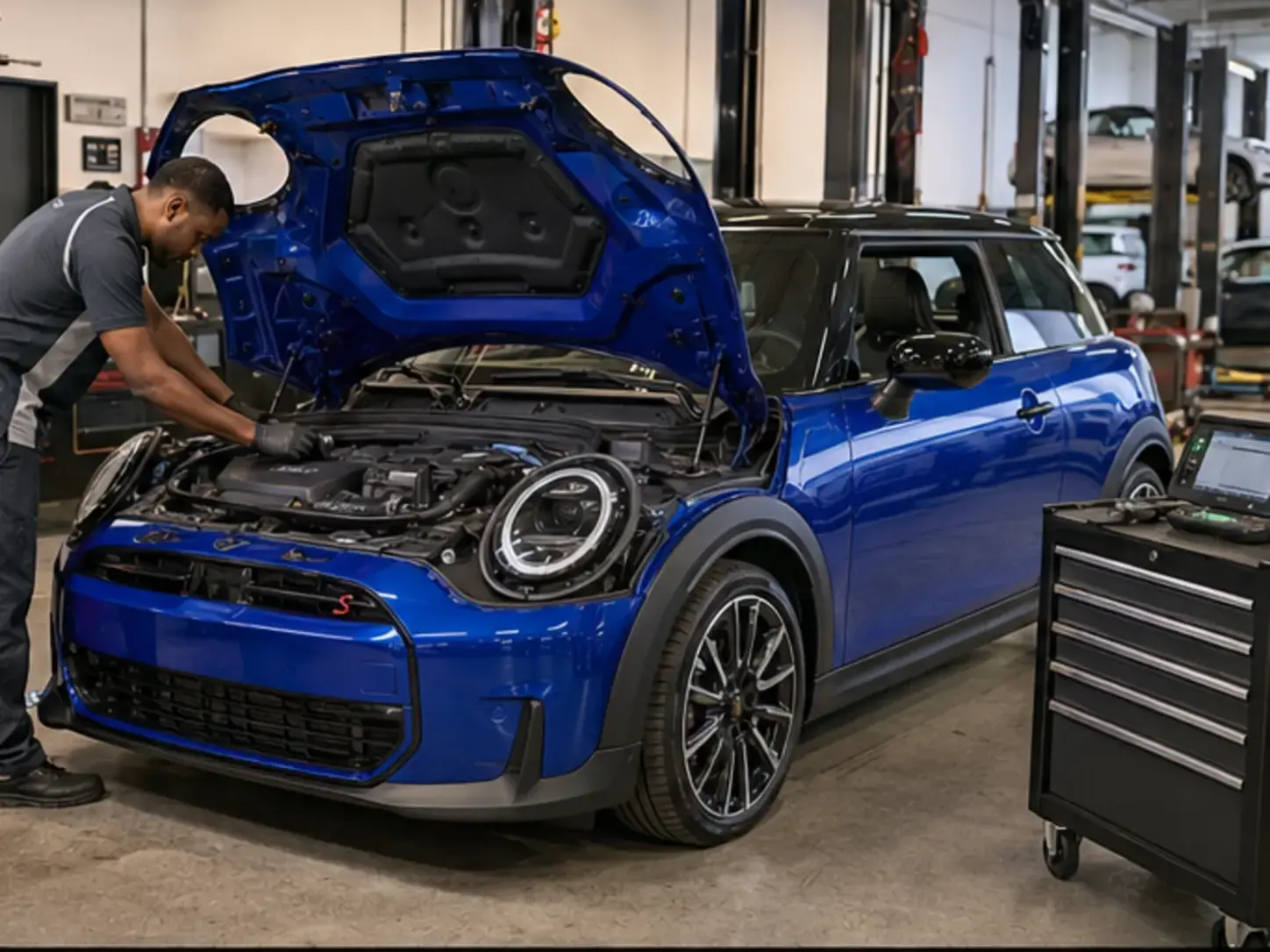
Some symptoms allow a careful trip to a workshop. Others justify stopping immediately. The decision should be based on vehicle behavior, temperature, fluid loss, warning severity, and whether steering or braking has changed.
How a MINI Problem Should Be Diagnosed
Verify the complaint
Record when it happens, reproduce it safely, and separate normal operating behavior from the reported fault.
Scan every relevant module
Read current, stored, pending, and history faults. Save freeze-frame and live data before clearing anything.
Inspect before dismantling
Check fluids, leaks, connectors, mounts, belts, tires, battery condition, recent work, and visible damage.
Test the suspected system
Use pressure, voltage-drop, smoke, compression, temperature, mechanical-play, or road testing as the symptom requires.
Separate cause from damage
A failed seal may cause fluid loss, while overheating or low lubrication may create secondary damage. Both need evaluation.
Verify the repair
Repeat the original conditions, recheck leaks and warnings, review data, and document parts, fluids, and remaining observations.
Common MINI Misdiagnoses That Waste Money
Brand reputation can push a repair toward the most expensive possibility. A timing chain is blamed for every cold rattle. A gearbox is condemned for a mount or low-voltage problem. A battery is replaced because many warning messages appeared together. A water pump is ordered because coolant is low, even though the leak is elsewhere.
Do not approve from a fault code alone
A code identifies the circuit or operating condition the control unit detected. It does not automatically name the failed part. Wiring, power supply, mechanical faults, and software context still need testing.
Do not approve a package before the scope is clear
Ask which component failed, how it was tested, which related items are included, what remains excluded, and how the result will be verified. This matters most for engine, cooling, transmission, and electrical estimates.
MINI Repair Costs in Dubai
These are our planning prices for the stated work on conventional passenger MINI models with normal access, before 5% VAT. They are not fixed quotes or observed average invoices. Generation, engine, parts choice, access and additional damage change the scope. High-voltage battery, inverter and electric-drive repairs are outside these ranges.
| Inspection or repair | Planning price before 5% VAT | Scope and exclusions |
|---|---|---|
| Focused warning-light diagnosis | AED 240 to 525 | Scan and targeted basic checks. Extended monitoring, dismantling and programming are separate. |
| Cooling leak repair | AED 450 to 2,800+ | Varies from hose or housing work to pump or radiator replacement. Overheating damage is excluded. |
| Timing-drive inspection or repair | AED 350 to 5,500+ | Noise and data checks at the lower end. Complete chain, guides, tensioning and related parts cost more. |
| Oil leak repair | AED 450 to 3,500+ | Depends on source and access. Cleaning, dye, multiple seals, turbo, or internal engine work may change scope. |
| Ignition or misfire repair | AED 350 to 2,400+ | Testing, plugs, coils or accessible intake faults. Injectors, compression loss and catalyst damage are excluded. |
| Suspension or steering repair | AED 500 to 4,500+ | One wear item versus axle-level work, steering components, tires and alignment. |
| Transmission or clutch work | AED 650 to 12,000+ | Service or control repair through clutch, mechatronics, rebuild or replacement. Exact gearbox required. |
VAT example: AED 240–525 before 5% VAT becomes AED 252–551.25 including VAT. The written quotation must show the included parts and labor, diagnostic charges, required fluids, programming, alignment, recovery, exclusions, VAT and final payable total. A “+” means the upper figure is not a cap.
Read the scope before comparing totals
AED 350 at the lower end of the timing row is inspection work, not a complete timing-chain replacement. Likewise, the transmission range spans small service or control jobs through major repairs; it is not the price of one standard gearbox job.
Request separate lines for diagnosis and the confirmed repair, with the engine or gearbox identified. Compare the same parts quality and included labor. Ask whether a dealer campaign applies before paying for overlapping work.
Repair, Replace, or Walk Away
Repair the local fault
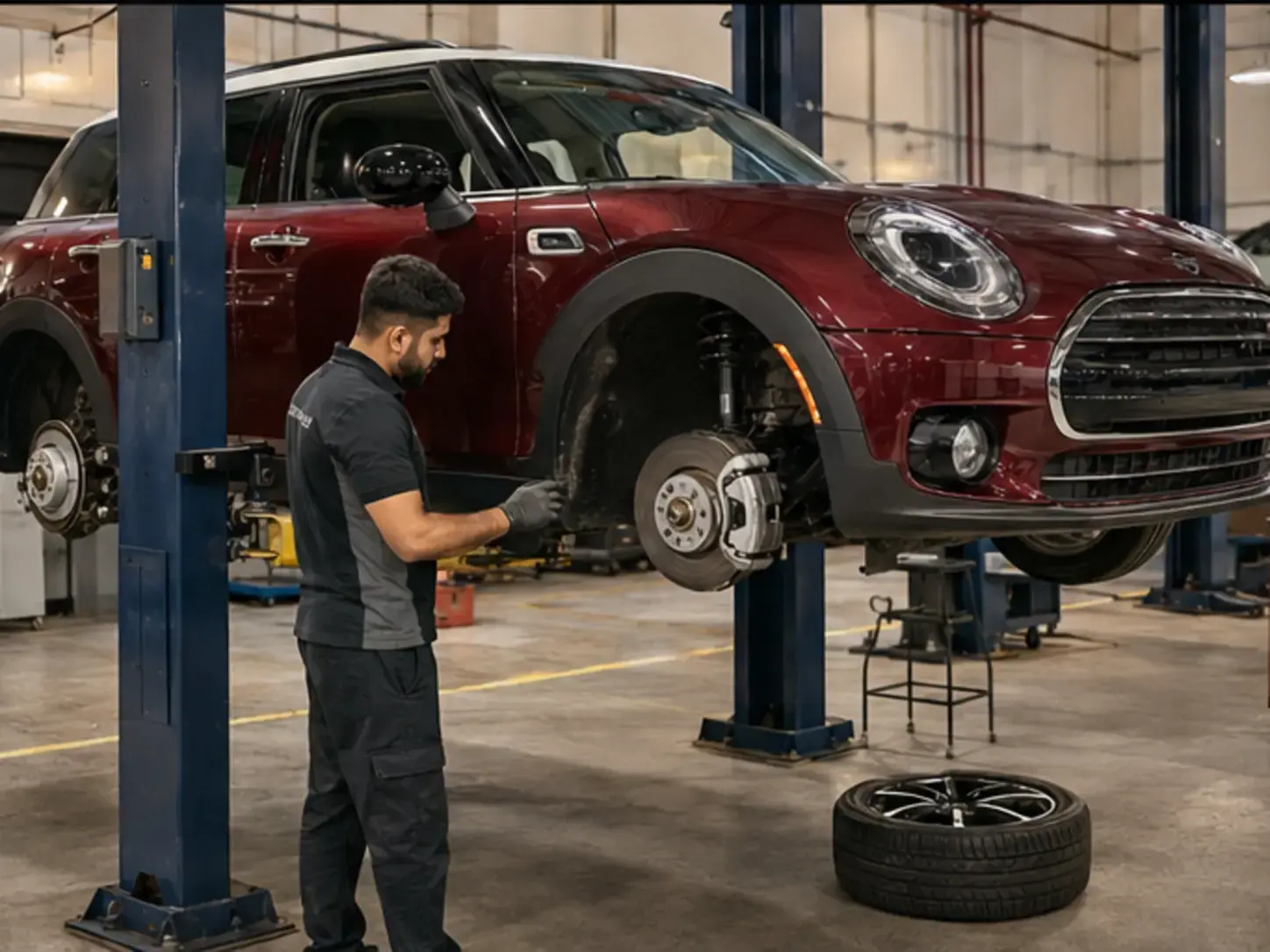
Choose a focused repair when testing identifies an accessible leak, sensor, connector, mount, ignition part, bush, hose, or serviceable control issue.
Replace the assembly
Replacement can make sense when an assembly is internally damaged, separately unavailable, unsafe to reuse, or more costly to rebuild reliably.
Rebuild with evidence
A transmission or engine rebuild needs measured wear, a defined parts list, machining or specialist scope, exclusions, and post-repair testing.
Do not buy yet
Pause when the quote is based only on a generic scan, when the symptom was not reproduced, or when the wrong MINI generation was used for parts pricing.
For an older or accident-damaged MINI, compare the repair total with realistic vehicle value, known maintenance due, tire and brake condition, registration needs, and unresolved electrical faults. One repair may be reasonable. Several major systems at once can change the decision.
Used MINI Inspection Before You Buy
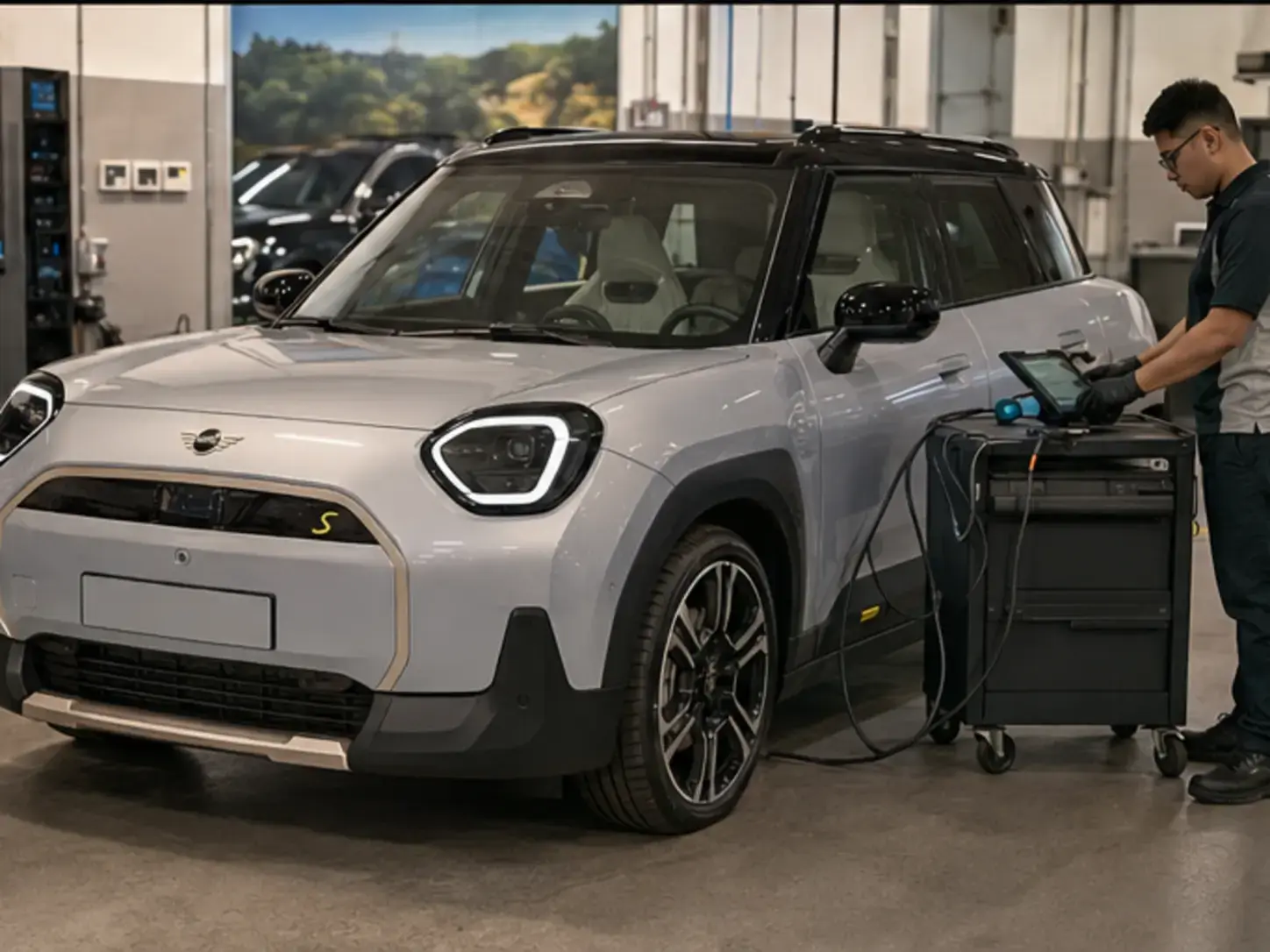
A short test drive can miss a cold-start rattle, slow coolant loss, overnight battery drain, or a fault that returns after a complete drive cycle. Inspect the vehicle cold when possible and scan it before codes are cleared.
- Confirm VIN, generation, engine, transmission, and option list
- Check service records against the vehicle’s condition
- Inspect cooling residue, oil leaks, fluid levels, and repair marks
- For combustion models, test cold start, idle and shifting. For every model, assess acceleration, steering, braking, AC and the warnings relevant to its powertrain.
- Inspect tires, wheels, bushes, mounts, underbody, and accident repairs
- Scan all modules and note readiness monitors or recently cleared faults
- Price immediate work and near-term maintenance separately
Walk away when the seller will not allow an independent inspection, the engine is already hot on arrival without explanation, warning systems have been disabled, identification does not match, or the repair exposure cannot be priced. A lower purchase price does not make an unknown engine or transmission risk cheap.
For a plug-in hybrid or electric MINI, also request charging verification, high-voltage fault history and an appropriate battery-condition assessment from a qualified workshop. Displayed range alone does not establish battery health. Check that the charging equipment and vehicle market specification suit your intended UAE use.
Maintenance That Reduces Avoidable MINI Problems
- For combustion engines, use the oil specification and service interval listed for the exact engine and operating conditions. Battery-electric MINIs do not need engine-oil service.
- Investigate fluid loss instead of repeatedly topping up.
- Keep cooling fans, radiator surfaces, and AC condenser airflow clear.
- Test battery condition before heat and low voltage create multiple warnings.
- Repair tire damage and suspension play before alignment.
- Record software updates, programming, fluid types, part numbers, and repair results.
- Do not use a universal mileage rule when the vehicle’s condition-based service display and manufacturer schedule give model-specific requirements.
Dubai heat, traffic, short trips, and long idling can change how quickly a weak cooling, battery, or AC system becomes noticeable. They do not replace the maintenance schedule. Use them as reasons to inspect condition more carefully.
Check MINI Recalls by VIN in the UAE
A clear US VIN result is not proof that a GCC MINI has no open campaigns. NHTSA’s US recall lookup excludes international vehicles, completed recalls and manufacturer non-safety campaigns; newly announced recalls may also take time to appear.
- Copy the full VIN from the vehicle or registration record and confirm the original market. Do not rely on a model-year search.
- Contact the official MINI AGMC service network for Dubai, Sharjah and the Northern Emirates, or MINI Abu Dhabi Motors for Abu Dhabi and Al Ain.
- Ask the service team to check that VIN for open safety recalls and technical/service campaigns, and to confirm completed work, the applicable remedy, any driving restrictions and whether a charge applies.
- For a US import, check NHTSA as well, then ask the UAE dealer to confirm local handling and parts availability. Save the response with the service history.
A technical bulletin, warranty extension and safety recall are different things. A US bulletin linked below is not a promise of free UAE repairs. Campaign eligibility depends on the VIN, market and campaign terms; an unrelated fault still needs diagnosis.
Sources and Technical References
Model and market details checked September 27, 2026. Historical releases identify the powertrain at introduction; they do not establish present UAE availability or reliability.
- BMW Group MINI Cooper S press kit, May 17, 2002. First-generation 1.6-liter supercharged example.
- MINI SI M01 12 16, December 2016 (PDF). Model/engine examples for R55–R60 in a limited US water-pump warranty bulletin. Listed model years are bulletin coverage examples, not complete production dates or UAE entitlements.
- MINI SI M12 12 14, March 2016 (PDF). F55/F56 B38/B48 applicability and the software/hardware distinction in specified VANOS faults.
- BMW Group Countryman Cooper S E ALL4 release, March 3, 2017. Three-cylinder gasoline plus electric plug-in hybrid.
- BMW Group Middle East Cooper SE release, July 9, 2019. Battery-electric three-door and single-stage transmission.
- Official MINI AGMC UAE model lineup. Current all-electric Cooper, Aceman and Countryman listings; checked September 27, 2026.
Use the owner manual supplied for your exact VIN and market for warnings, fluids and emergency procedures. MINI USA manuals are a reference for US vehicles and may differ from GCC specifications. The official UAE dealer contacts and the US recall tool are linked in the VIN-check section above.
Key Takeaway
Common MINI problems are best treated as diagnostic categories, not guaranteed defects. Start with the exact model, generation, engine, transmission, mileage, warning message, and operating condition. Stop driving for overheating, oil-pressure warnings, severe misfire, smoke, fuel smell, changed braking, sudden heavy steering, or loud mechanical noise. For less urgent symptoms, preserve scan data and approve parts only after the workshop shows how the suspected fault was tested.
Book a MINI Diagnostic Inspection in Al Quoz 4
Send the MINI model, year, mileage, warning message, and the conditions that trigger the problem. We can plan cooling, engine, transmission, steering, suspension, electrical, or AC checks before parts are approved. For repair and booking services, visit our MINI Cooper repair page.
Common MINI Problems FAQs
Is every MINI with an SE badge fully electric?
No. The Countryman Cooper S E ALL4 introduced in 2017 is a plug-in hybrid with a gasoline engine. The Cooper SE three-door introduced in 2019 is battery-electric. Newer electric Countryman variants add another reason to check the exact model and VIN before applying engine-maintenance advice.
Why is my MINI losing coolant without a large puddle?
A small leak can evaporate on hot components or appear only under pressure. Inspect dried residue, cap and tank condition, hose joints, thermostat housing, radiator, pump area, and cabin heater circuit. Do not open a hot cooling system.
Does a cold-start rattle mean the timing chain has failed?
Not automatically. Timing components are one possibility, but oil-pressure delay, belt drives, pulleys, exhaust parts, and heat shields can sound similar. Persistent noise, timing faults, or poor running needs prompt testing.
Can I drive a MINI with a check-engine light?
Follow the exact warning and vehicle manual. A steady light does not itself establish that driving is safe. A short trip may be reasonable only when the manual permits it and the car runs normally without other warnings or fluid loss. Stop safely and arrange recovery for a flashing light, severe shaking, smoke, overheating or fuel smell.
Should transmission fluid fix harsh shifting?
Fluid service can be valid maintenance, but it is not a universal cure. Harsh shifting can involve voltage, software, adaptations, mounts, controls, clutch wear, mechatronics, leakage, or internal damage.
Why do several MINI warning lights appear together?
Low system voltage can trigger several module warnings, but the battery is not always the cause. Test battery state, charging, grounds, connections, sleep-current draw, and stored faults before replacing it.
How much does MINI diagnosis cost in Dubai?
Our focused warning-light diagnosis is AED 240–525 before 5% VAT, or AED 252–551.25 including VAT. This covers a scan and targeted basic checks. Extended monitoring, dismantling, programming and additional testing are quoted separately.
When should I avoid buying a used MINI?
Avoid the purchase when an independent inspection is refused, warning systems are disabled, the vehicle is pre-warmed to hide cold behavior, identification does not match, or major engine, transmission, cooling, and electrical risks cannot be priced.