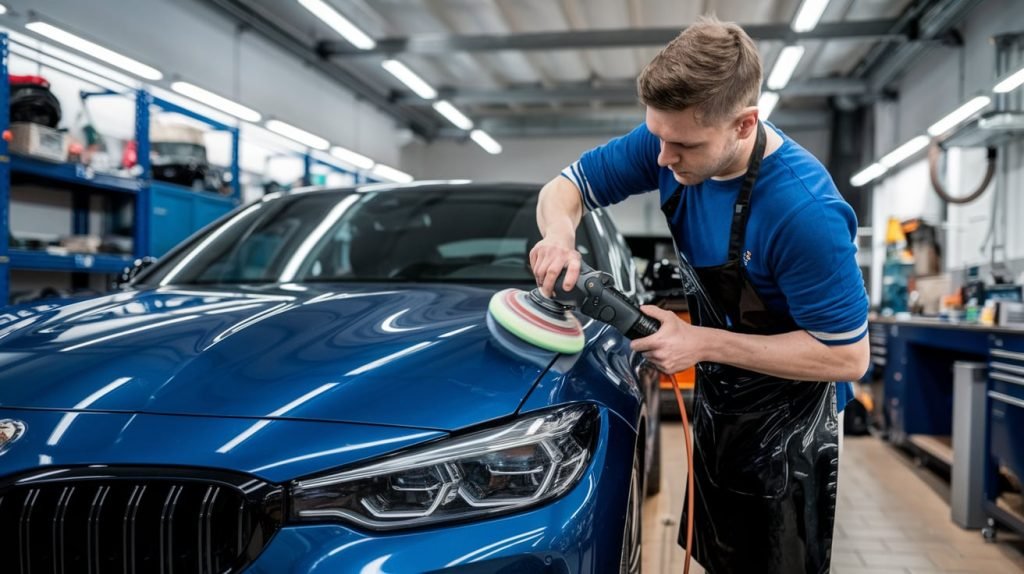
You wash the car, dry it, and step back expecting clean paint. Instead, sunlight exposes circles, haze, water marks, and scratches that were almost invisible in the shade. That is the frustrating part. Another wash will not remove defects that sit in or on the clear coat, and an aggressive polish can make the finish worse.
Is Car Polishing the Right Service for Your Paint
Polishing makes sense when defects affect the upper paint surface and enough clear coat remains for safe correction. The decision should not start with a package name. It should start with the defect, paint history, panel condition, and the result you expect.
| What you see | Likely treatment | What polishing cannot promise |
|---|---|---|
| Light circular wash marks | Test spot followed by one-stage or multi-stage machine polishing | Removal without first checking paint response |
| Dull or hazy paint | Decontamination and polishing if oxidation is within the clear coat | Repair of clear-coat failure or exposed base coat |
| Water spots | Chemical removal first, then polishing if etching remains | Removal of deep mineral etching from thin paint |
| Scratch catches a fingernail | Inspect depth; consider touch-up or paint repair | Safe full removal of a scratch through the clear coat |
| Peeling, cracking, or faded clear coat | Body and paint assessment | Restoration by adding gloss over failed paint |
| Stone chips or exposed primer | Touch-up or refinishing based on size and location | Replacement of missing paint |

What a Paint Inspection Should Check
A clean panel can still hide previous body repairs, thin edges, touch-up paint, sanding marks, overspray, and coating residue. These conditions change the safe approach. A technician should inspect the car in direct and diffused light, identify repainted panels where possible, and discuss defects that will remain.
Paint-depth readings can help compare panels, but one number does not reveal the exact thickness of the clear coat. Plastic panels, edges, body lines, and previously repaired areas need added caution. The test spot remains important because it shows how that paint responds to a selected pad, compound, machine, and working time.
Car Polishing, Waxing, Ceramic Coating, and Paint Correction
Polishing
Uses abrasives to refine paint defects. It changes the surface and should be performed only as aggressively as the condition requires.
Wax or sealant
Adds a temporary protective layer and changes water behavior. It may mask fine defects briefly but does not correct them.
Ceramic coating
Adds a harder-to-remove protective layer after preparation. It does not make existing scratches disappear and is not scratch-proof.
Paint correction
Uses one or more polishing stages to pursue a measured defect-reduction target. More stages mean more labor and potentially more clear-coat removal.
Touch-up
Adds paint to chips or narrow damage. It protects exposed areas but may remain visible at close range.
Repainting
Rebuilds damaged coating layers when paint is missing, failing, deeply scratched, or unsuitable for further correction.
These services are not upgrades in a fixed ladder. A car can need polishing without needing a coating. Another car may need touch-up and localized refinishing before any correction work. The useful combination depends on paint condition and ownership plans.
Car Polishing Prices in Dubai
These Auto Repair UAE planning ranges depend on vehicle size, paint hardness, contamination, defect severity, access, previous repairs, and the correction target. The final scope is confirmed after inspection and a test area. VAT treatment should be shown on the written estimate.
| Service | Estimated price | Typical scope | Common exclusion |
|---|---|---|---|
| Paint inspection and test spot | AED 150 to 300 | Clean test area, defect review, paint response, and recommended plan | Whole-car correction |
| Gloss-enhancement polish | AED 450 to 800 | Wash, basic preparation, one refining stage, and short-term protection | Deep scratch or heavy swirl removal |
| One-stage paint correction | AED 800 to 1,500 | Decontamination, test spot, machine correction, panel wipe, and protection | Guaranteed removal of every defect |
| Two-stage paint correction | AED 1,500 to 3,000 | Cutting and refining stages for suitable paint, followed by protection | Body repair, touch-up, and coating unless listed |
| Localized scratch refinement | AED 250 to 750 per area | Assessment and focused work where the defect is safely correctable | Damage through the color coat |
| Polishing plus ceramic coating | AED 1,800 to 4,500+ | Preparation, agreed correction, coating application, and curing instructions | Paint repair and later maintenance products |
How Professional Car Polishing Is Completed
- Record the condition. Photograph existing chips, dents, deep scratches, peeling paint, trim damage, and repainted areas.
- Wash safely. Remove loose dirt without grinding particles across the surface.
- Decontaminate the paint. Remove bonded material such as industrial fallout, tar, or mineral residue using a suitable chemical and mechanical process.
- Inspect and measure. Review paint behavior, panel history, edges, trim, and accessible depth readings.
- Complete a test spot. Use the least aggressive pad and product combination that produces the agreed improvement.
- Correct section by section. Control machine speed, pressure, temperature, pad cleanliness, and working time.
- Refine the finish. Remove compound haze where a cutting stage was required.
- Clean and inspect again. Remove polishing residue and check the result under suitable lighting.
- Apply protection. Use the wax, sealant, or coating stated in the estimate.
- Explain aftercare. Provide curing, washing, and maintenance instructions for the chosen protection.
One-Stage or Two-Stage Paint Correction
A one-stage service uses one machine-polishing combination to balance defect reduction and finish. It suits paint that needs moderate improvement without an aggressive first cut. A two-stage service uses a cutting step and a separate refining step. It can improve heavier swirls and haze on suitable paint, but it takes longer and removes more material.
The number of stages should follow the test spot. Dark paint may reveal haze that lighter colors hide. Hard paint may require more work for the same change, while soft paint can mark easily during washing and finishing. A written target such as “reduce visible wash marks while preserving paint” is more useful than a promised percentage without measurements.

Which Scratches Can Be Polished Out
A pale mark may be paint transfer sitting above the clear coat. A dark line may be a scratch that has passed through the color. Appearance alone is not enough. Clean the area, inspect from several angles, and determine whether material is sitting on the paint or missing from it.
Very light clear-coat marks may respond to polishing. A fingernail-catching scratch, exposed primer, visible metal, or split plastic usually needs another repair route. Some deep marks can be softened rather than removed. Leaving a faint line may protect more original clear coat than chasing complete removal.
Dubai Conditions That Affect Car Paint
Sun exposure, surface heat, dust, construction fallout, sprinklers, hard-water deposits, bird droppings, tree residue, and repeated automatic washing can change paint condition. They do not all require polishing. Fresh contamination should first be removed with the least abrasive safe method.
Do not polish a hot panel in direct sun. Product can dry before it is worked correctly, pads may load quickly, and the technician loses control of temperature and finish. A shaded, clean work area with inspection lighting produces a more consistent result.
Water spots deserve a staged response. Wash first. Use an appropriate mineral-removal process if deposits remain. Polish only when etching is present and the paint can be corrected safely. Repeatedly compounding the car after every spotting event consumes clear coat without fixing the source.
When Not to Pay for Car Polishing
| Situation | Better decision | Why |
|---|---|---|
| The car is dirty but paint looks sound after washing | Use a safe wash and suitable protection | Abrasive correction is unnecessary |
| Clear coat is peeling or cracking | Request paint and body assessment | Polish cannot replace failed coating |
| Scratches expose primer or metal | Use touch-up or refinishing based on damage | Paint material is missing |
| You plan body repairs soon | Complete repairs before final correction or coating | Polishing may be repeated after refinishing |
| The seller wants a fast shine over unknown defects | Inspect under clear light before buying | Filler-heavy products can temporarily hide marks |
| Paint is already thin from repeated correction | Preserve it and accept remaining defects | Appearance is not worth coating failure |
DIY Polishing or Workshop Paint Correction
Hand-applied cleaner polish can improve minor haze on a small test area, provided the product is suitable and instructions are followed. Machine correction creates more consistent movement, but it also raises the consequences of poor technique. Heat, pressure, a dirty pad, an aggressive compound, or lingering on an edge can damage paint.
Choose workshop correction when defects cover several panels, paint history is unknown, the vehicle has repainted areas, wet sanding is proposed, or you expect a coating afterward. DIY work is more sensible for routine washing, contamination removal with known products, and applying nonabrasive protection.
Do not use household scouring compounds, dry cloths, or an abrasive pad. Keep polishing residue away from textured plastic and rubber unless the product is approved for them. If you cannot identify whether a mark is on top of or through the paint, inspect before cutting.

What to Check Before Collecting the Car
- Inspect the finish under direct and diffused light.
- Check several panels from different angles.
- Confirm which scratches or chips remain and why.
- Look for compound residue around badges, trim, seals, and panel gaps.
- Confirm trim and rubber have not been stained.
- Review the protection product and curing instructions.
- Check the invoice for preparation, polishing stages, coating, VAT, and exclusions.
- Ask when the vehicle can be washed and which products should be avoided.
How to Keep the Finish After Polishing
- Rinse loose dust before touching the paint.
- Use clean wash media and separate tools for wheels and bodywork.
- Dry with a clean, paint-safe towel instead of allowing mineral-rich water to evaporate.
- Remove bird droppings and insect residue promptly using a suitable method.
- Avoid tunnel washes that use dirty or aggressive brushes.
- Follow the maintenance instructions for the wax, sealant, or coating applied.
- Do not polish on a calendar. Inspect first and correct only when needed.
A coating can make cleaning easier, but it does not remove the need for careful washing. Poor wash technique can mark coated paint. Protection changes surface behavior; it does not make the clear coat immune to contact.
Car Polishing Near Me in Dubai
If you are comparing a car polishing service near you in Dubai, send clear photos taken in shade and direct light, along with the vehicle model, color, repaint history, and your main concern. Photographs help plan the inspection, but the final polishing method should follow an in-person paint check and test area.
Auto Repair UAE provides paint inspection and car polishing support from Al Quoz 4. Tell us whether you need gloss improvement, swirl reduction, water-spot treatment, sale preparation, or coating preparation. We will separate correctable defects from chips, deep scratches, and paint failure before quoting the work.
Related Paint and Bodywork Decisions
Start with our safe car-washing guide for Dubai conditions if the finish mainly needs cleaning. For dents, chips, peeling paint, or damage through the coating layers, compare the car body and paint repair options in Dubai. Owners considering longer-term surface protection can also review our car detailing and paint-protection services.
Key Takeaway
Car polishing should remove only as much clear coat as the agreed result requires. Inspect first, use a test spot, correct contamination before abrasion, and accept that deep scratches or failed paint need a different repair. Buy the process and evidence, not a package name or a promise that every mark will disappear.
Book a Car Paint Inspection in Al Quoz 4
Send the vehicle model and photos of the paint in direct light. We can assess swirl marks, haze, water spotting, scratches, and previous repairs before recommending polishing, protection, touch-up, or refinishing.
Car Polishing Questions
How often should a car be polished?
There is no safe fixed interval. Polish when inspection confirms correctable defects and the improvement justifies removing a small amount of clear coat. Routine washing and protection do not require repeated correction.
Does polishing remove every scratch?
No. It can reduce defects within the upper clear coat. Scratches through the clear or color layer need touch-up or refinishing, and some marks should remain to preserve paint thickness.
Is car polishing the same as waxing?
No. Polishing uses abrasives to refine defects. Wax adds temporary protection and may change gloss or water behavior without leveling the paint.
Should a new car be polished before ceramic coating?
Inspect it first. New vehicles can have transport marks, dealer preparation haze, or no meaningful defects. Correction should match the observed condition rather than being added automatically.
Can water spots be polished out?
Some etched spots can be reduced through polishing, but surface mineral deposits should be treated chemically first. Deep etching may remain if correction would remove too much coating.
How long does car polishing take?
A gloss-enhancement service may take several hours. Multi-stage correction can require one or more working days depending on vehicle size, paint response, defect target, and coating cure time.
Will polishing damage repainted panels?
Repainted panels can be polished, but their coating type, thickness, cure condition, and previous work must be considered. Inspect and test before using an aggressive process.
Can polishing fix peeling clear coat?
No. Peeling means the coating has failed or separated. Refinishing is the relevant repair, not further abrasion.