Parking door ding
A shallow round dent with intact paint may suit paintless dent repair. We check whether a brace, glass track, wiring, sound insulation, or door electronics restrict access before promising a paint-free result.
Restore a door ding, body-line crease, bumper dent, or damaged panel with a method selected for the panel, paint, access, and finish. We inspect the complete area, explain whether paintless dent repair or conventional body repair is suitable, and provide a written estimate before work begins.
Free workshop inspection, free pickup and delivery across Dubai, and dedicated on-site inspection options are available. On-site terms are confirmed before dispatch.
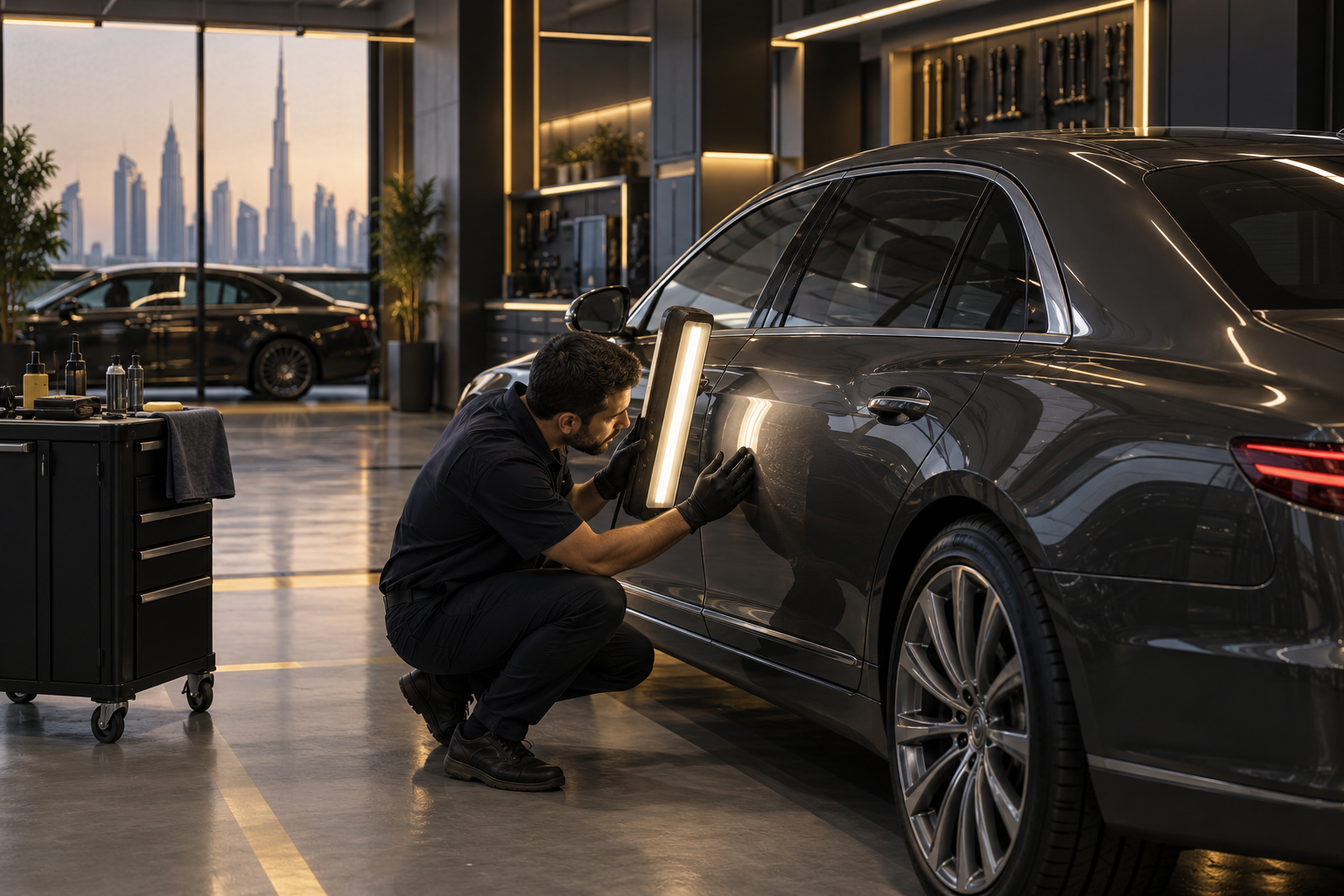
A dent is not priced only by diameter. The point of impact, depth, metal stretch, panel edge, styling line, finish condition, and access behind the skin determine the repair choice. These common conditions help explain what the first inspection will address.
A shallow round dent with intact paint may suit paintless dent repair. We check whether a brace, glass track, wiring, sound insulation, or door electronics restrict access before promising a paint-free result.
A narrow crease concentrates tension and can stretch the metal. Some lines can be restored gradually, while a sharp fold, cracked finish, or edge damage may need conventional reshaping and refinishing.
Aluminum responds to reshaping in its own way and can require more controlled heat, access, and movement than a steel skin. The exact panel construction is confirmed before a PDR tool or body-repair method is selected.
A bumper can appear pushed in while mounting tabs, brackets, trim, parking sensors, wiring, or the reinforcement behind it is also affected. Cosmetic reshaping alone is not enough when fit or function has changed.
Cracked clear coat, a deep scratch, exposed substrate, peeling finish, or a previous filler repair changes the route. The metal may be repairable, but the finish needs separate preparation and paint work.
A dent near a mirror, handle, lamp, grille, bumper sensor, or camera may require careful removal and refitting. Function checks, aiming, coding, or calibration are included only when the repair affects those items.
The best method is the least invasive route that can deliver a stable, presentable panel without hiding damage. We explain the expected finish and limitations before you approve the work.
PDR is considered when the finish is intact, the metal has not stretched beyond a controllable point, and safe access is available. It preserves the existing paint and avoids filler, color matching, and a spray process. It is not suitable for every crease, edge, previous repaint, or closed reinforcement area.
Selected dents can be moved from the painted side when rear access is restricted. Paint adhesion, previous refinishing, coatings, temperature, and dent shape affect suitability. If the surface could release or the method cannot control the panel, another repair is recommended.
Cracked paint, sharper metal movement, stretched areas, and damaged edges may need reshaping, limited filler, surface preparation, primer, color matching, clear coat, and polishing. The quote identifies the panel and any blending area rather than hiding paint work inside a broad body-shop line.
Replacement is considered when the panel is torn, badly stretched, structurally restricted, uneconomical to restore, or unable to hold the required shape. Part condition, trim transfer, paint, fit, electronics, and final checks are stated separately.
These estimated prices are useful for planning. The final total depends on the model, panel, finish, damage depth, access, trim removal, parts condition, paint system, and any electronic work. A free workshop inspection confirms the written scope.
| Repair choice | Estimated price | What the estimate covers | What may change the total |
|---|---|---|---|
| Small accessible PDR | AED 450–950 per dent | Panel and paint assessment, controlled correction, and reflection check for one eligible shallow dent | Body line, edge position, trim access, previous paint, or aluminum construction |
| Complex crease or body-line PDR | AED 900–2,400 per panel | Staged metal correction for an eligible crease with intact, stable paint | Depth, crown tension, stretched metal, panel bracing, finish target, and access time |
| Bumper dent and repaint | AED 1,200–2,800 | Removal where required, reshaping, preparation, refinishing, refitting, and visual checks | Broken tabs, brackets, sensors, trim, reinforcement damage, and paint specification |
| Aluminum panel repair and refinish | AED 2,200–6,500 | Controlled panel repair, surface preparation, paint materials, clear coat, and finishing | Panel location, metal stretch, access, finish complexity, blending, and replacement risk |
| Panel replacement and paint | AED 4,500–15,000+ | Planning range for one panel, fitting labor, preparation, refinishing, and normal trim transfer | New or used part, availability, shipping, bonded or structural work, and related damage |
| Sensor or camera calibration | AED 650–2,500+ | Applicable scan, setup, aiming, coding, or calibration when required by the affected repair | System type, fault history, equipment, targets, related mounts, and prior damage |
Your quote identifies labor, parts, paint materials, trim work, testing, calibration, outside services, exclusions, and VAT treatment. On equivalent scope and parts, independent workshop pricing can be about 65% to 70% below agency pricing.
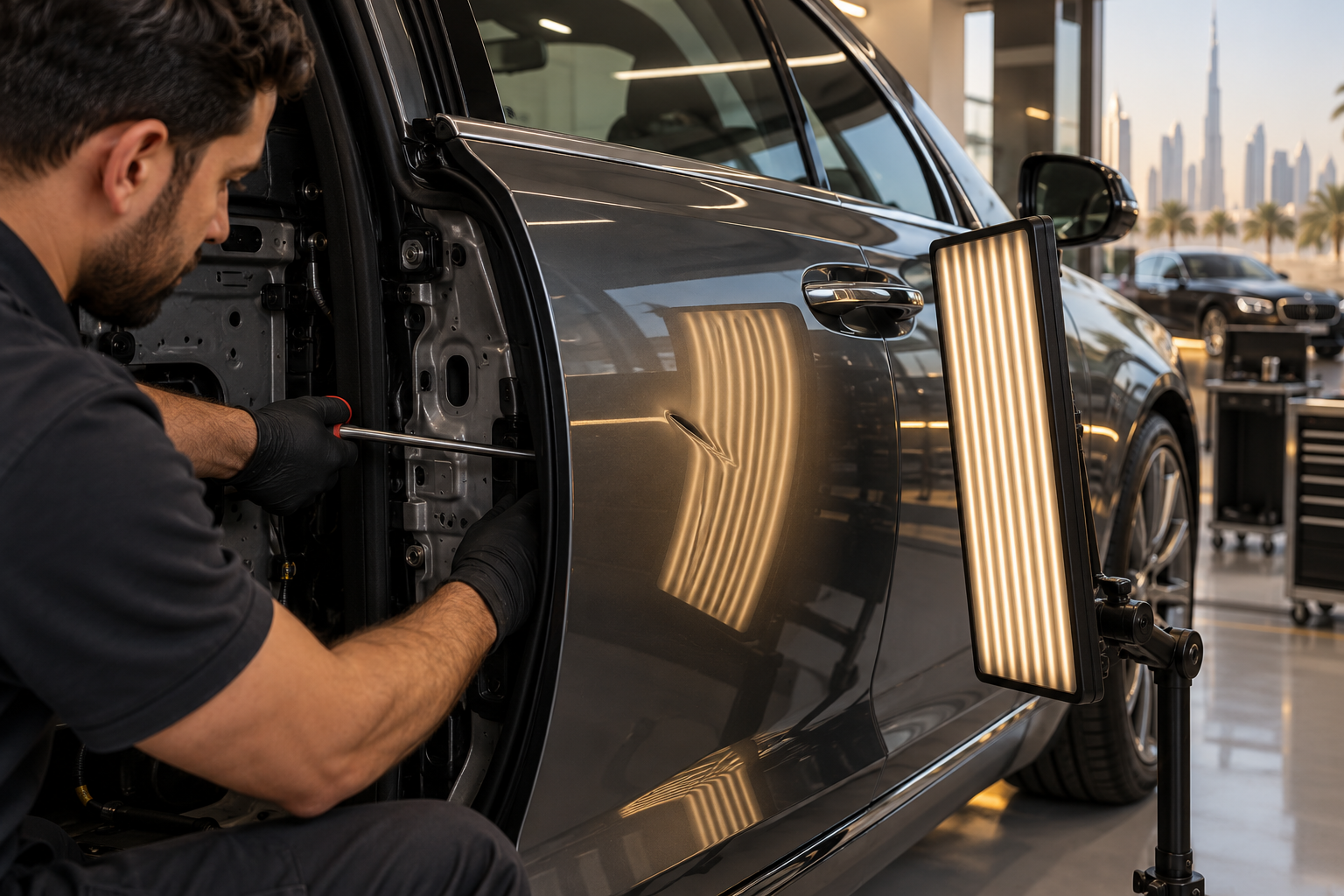
Controlled reflection lighting shows the deepest point, the elevated areas surrounding it, and the path of tension across the panel. A phone photo may show the dent, but it usually cannot reveal the complete distortion, a weak repaint, filler beneath the surface, or an inaccessible brace.
We inspect the finish for chips, cracking, separation, sanding marks, and evidence of earlier body work. Paint thickness readings can help identify a previously refinished area. Earlier refinishing does not always rule out correction, although uncertain adhesion makes glue pulling more risky.
Access is then checked from the rear. A Rolls-Royce door or quarter area can include glass tracks, wiring, speakers, soft-close hardware, insulation, reinforcement, and carefully fitted trim. Access must protect those items. Creating a fresh access hole is never our default shortcut.
The desired result matters too. A shallow dent on a low-visibility area may have a different practical route from a crease that interrupts a prominent reflection line. We state whether the aim is a full correction, a controlled improvement, or a painted repair before the work begins.
Stop if the panel or bumper touches a tire, a wheel is displaced, steering or braking has changed, a loose component can detach, or fluid is leaking. Moving the car can turn repairable damage into a larger mechanical or body problem.
A door that will not latch, broken glass, a mirror that is loose, sharp metal, or a panel that obstructs the driver needs attention before travel. Keep people away from unstable parts and do not force a powered closure.
Photograph dashboard warnings and visible damage. Parking sensors, cameras, lamps, restraint systems, and control modules may need diagnosis when the impact area or warning history makes them relevant.
Your model and a short description are enough to start. Clear photos help us understand the panel and arrange inspection, but the final method and price are confirmed on the vehicle.
We review dent shape, surrounding crowns, paint, earlier repairs, panel fit, nearby trim, and visible impact concerns under controlled light.
The likely panel construction, rear access, braces, electronics, glass, bonded areas, and required trim removal are checked before tools are chosen.
You receive the proposed repair method, parts condition, paint scope, expected result, price range, exclusions, and any testing that applies.
PDR uses repeated small corrections. Painted repair uses measured reshaping, preparation, refinishing, and curing suited to the panel and finish.
Removed trim, handles, lamps, sensors, liners, and fittings are reinstalled. Related functions are operated and warning information is reviewed where relevant.
The finish is checked across natural and controlled reflections. Panel gaps, clean edges, paint appearance, and agreed functional checks are reviewed with the completed scope.
These figures illustrate likely repair scopes and do not represent recorded customer vehicles. The free inspection checks the actual panel, finish, access, parts, and electronics before a total is approved.
One shallow rear-door ding with stable paint and a workable access route. The estimate includes trim protection, staged PDR correction, reflection inspection, and basic function checks after refitting.
Bumper-corner dent and surface scuff requiring removal, reshaping, preparation, refinishing, refitting, and checks of the nearby parking sensor. The estimate assumes reusable mounts and no hidden reinforcement damage.
An aluminum front-fender crease with damaged finish, requiring controlled panel repair, surface preparation, color matching, refinishing, polishing, and a blending decision based on the adjacent panel.
Exact construction can vary by model year and panel position, so it is verified before the procedure is selected. We do not assume that the same method applies to every Ghost, Phantom, Cullinan, Wraith, Dawn, or Spectre panel.
| Area | What may suit a localized repair | What needs extra attention |
|---|---|---|
| Doors and rear coach doors | Shallow dings or selected creases with stable paint and controlled access | Glass, soft-close hardware, wiring, speakers, trim, reinforcement, hinges, and edge alignment |
| Front fenders and rear quarters | Open outer-skin dents away from torn edges or structural mounting points | Aluminum behavior, wheel-house access, liners, side cameras, trim, bonded areas, and blending |
| Hood and deck lid | Selected shallow dents where the outer skin and finish remain workable | Double skins, bonded reinforcement, powered mechanisms, ornament or trim mounts, and sharp lines |
| Bumpers and lower trim | Heat-safe reshaping or localized refinishing when the component and mounts remain serviceable | Sensor brackets, cameras, grilles, lamps, tabs, reinforcement, texture, and paint flexibility |
| Roof and pillars | Limited non-structural surface dents after access and reinforcement are confirmed | Headlining, roof structure, panoramic features, bonded areas, safety zones, and large-panel distortion |
| Mirror, grille, and lamp surrounds | Small cosmetic corrections when adjacent equipment is undamaged and securely mounted | Camera views, radar or sensor position, wiring, aiming, coding, calibration, and replacement trim |
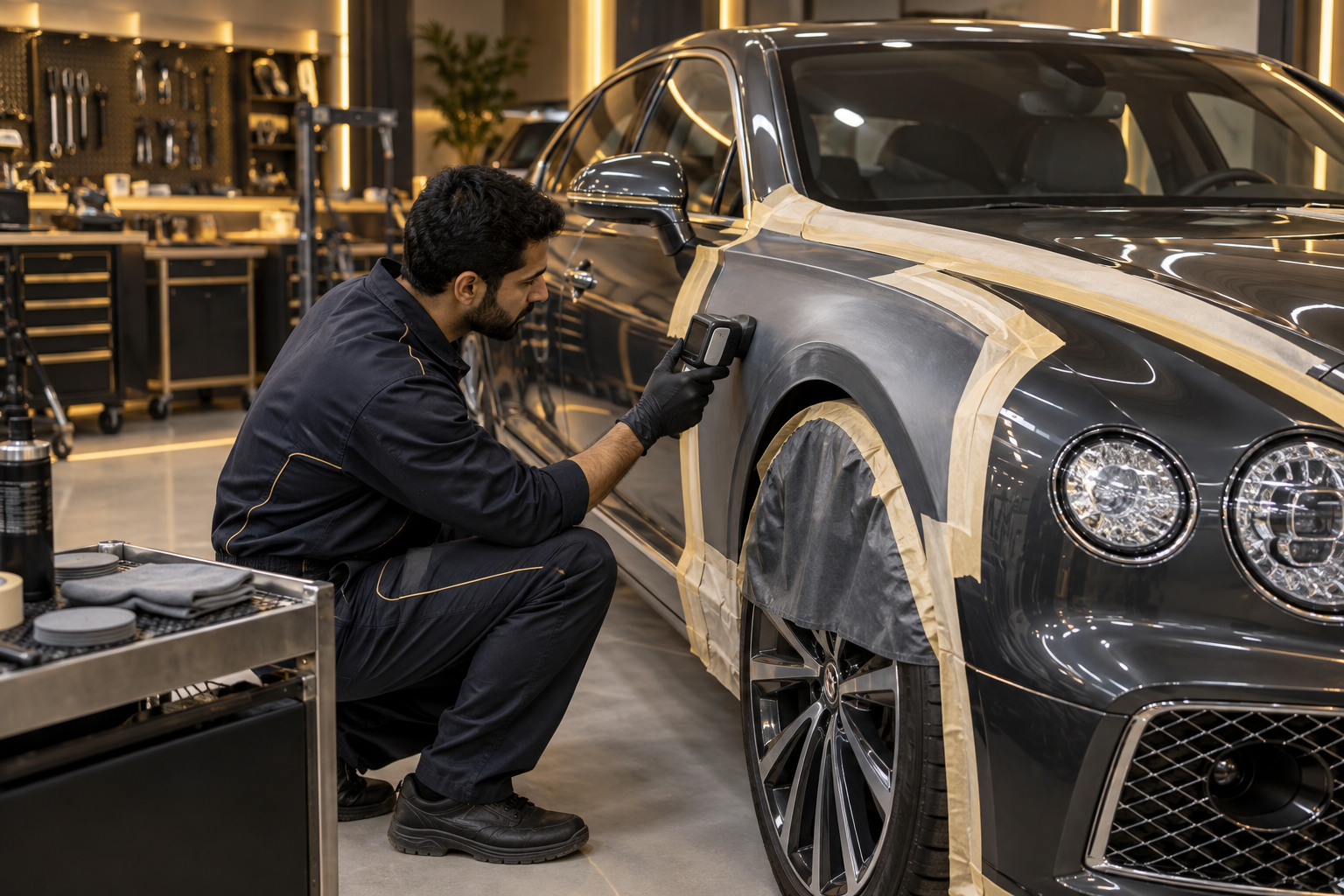
The vehicle paint code is the starting point, not the complete match. Age, sun exposure, previous refinishing, metallic or pearl orientation, clear-coat condition, and the way a curved panel reflects light can change how the finished color appears beside the original surface.
Preparation is kept within the approved repair area where practical. Trim, seals, handles, badges, lamps, and sensors are removed or protected according to the job. The panel is cleaned, reshaped, prepared, primed where required, color matched, cleared, cured, and finished before it is compared with adjacent surfaces.
Blending is discussed when the repaired panel cannot be matched reliably as an isolated edge-to-edge paint operation. The estimate identifies any neighboring panel included for appearance, so the decision is visible before painting starts. Paint materials, masking, polishing, and reassembly should not appear later as unexplained additions.
After refitting, we check panel gaps and the operation of disturbed components. If a camera, parking sensor, lamp, or other electronic item was moved, its required functional check or calibration is listed in the written scope.
The quote should name each affected panel, the proposed PDR, reshaping, filler, or replacement route, and any trim removal. It should also state the parts condition and whether previous damage changes the method.
Primer, base color, clear coat, masking, curing, polishing, and any blending area should be visible. A paint line should not conceal a separate panel or an uncertain finish target.
Refitting, sensor or camera checks, coding, calibration, outside services, exclusions, VAT treatment, and the expected handover condition should be clear. Additional work needs approval before it is added.
Our workshop is in Al Quoz Industrial Area 4, Dubai. The initial workshop inspection is free, and free pickup and delivery are available across Dubai. Tell us if the vehicle can start, steer, move, and maintain safe tire clearance so transport can be planned.
Controlled lighting, access review, paint checks, and nearby function checks are easiest at the workshop. The inspection supports the repair choice and an itemized estimate.
Pickup and delivery can reduce unnecessary driving and protect a loose bumper or damaged panel. We discuss access, vehicle condition, and the suitable transport approach before collection.
An inspection van can assess certain visible conditions at the vehicle location. Access requirements, limits, timing, and any separate site-visit fee are confirmed before dispatch. Most repairs still require workshop equipment.
No. PDR depends on stable paint, controllable metal movement, panel construction, access, and the expected finish. Cracked paint, sharp folds, stretched metal, torn edges, and some previous repairs need a painted body-repair route.
Photos can support an initial range and help plan the visit. The final price is confirmed after controlled-light inspection reveals the full dent, paint condition, previous work, access, and any related trim or sensor concern.
The aim of PDR is to preserve stable existing paint. The surface is inspected first, and the method changes if chips, cracking, weak repaint adhesion, filler, or a coating creates an unacceptable risk.
A small accessible PDR job may be completed within a day, subject to workshop capacity. Painted work, complex access, curing, replacement parts, or calibration can take longer. The estimate includes a practical timing range after inspection.
Selected aluminum dents and damaged panels can be assessed for PDR or conventional repair. The exact panel construction, location, paint, metal stretch, access, and model information determine the safe method.
Only when stated in the written scope. Removal, refitting, diagnosis, aiming, coding, and calibration depend on the affected area and system. We separate those items so the complete cost is understandable.
The workshop inspection is free, and pickup and delivery are available free across Dubai. Dedicated on-site inspection is also available, but its terms and any separate fee are confirmed before dispatch.
Send the model and clear photos showing the full panel, the dent straight on, angled reflections, and any paint damage. That is enough to begin. We will request additional details only if parts matching or a safety concern makes them necessary.
Send the model, damaged panel, and clear photos, or call to arrange the Al Quoz 4 workshop visit, free pickup, or an appropriate on-site assessment. We will inspect first and provide a written repair estimate before work begins.