Independent inspection and workshop planning

Pagani repair in Dubai

Book a Pagani inspection in Dubai before approving mechanical, electrical, cooling, brake, suspension or maintenance work. Send the exact model, VIN or chassis number, symptoms and service history so we can confirm safe access, technical information, parts support and whether any work must go through Pagani’s official network before the car is transported.

Model identity checked firstDismantling agreed in advanceOfficial work kept separate
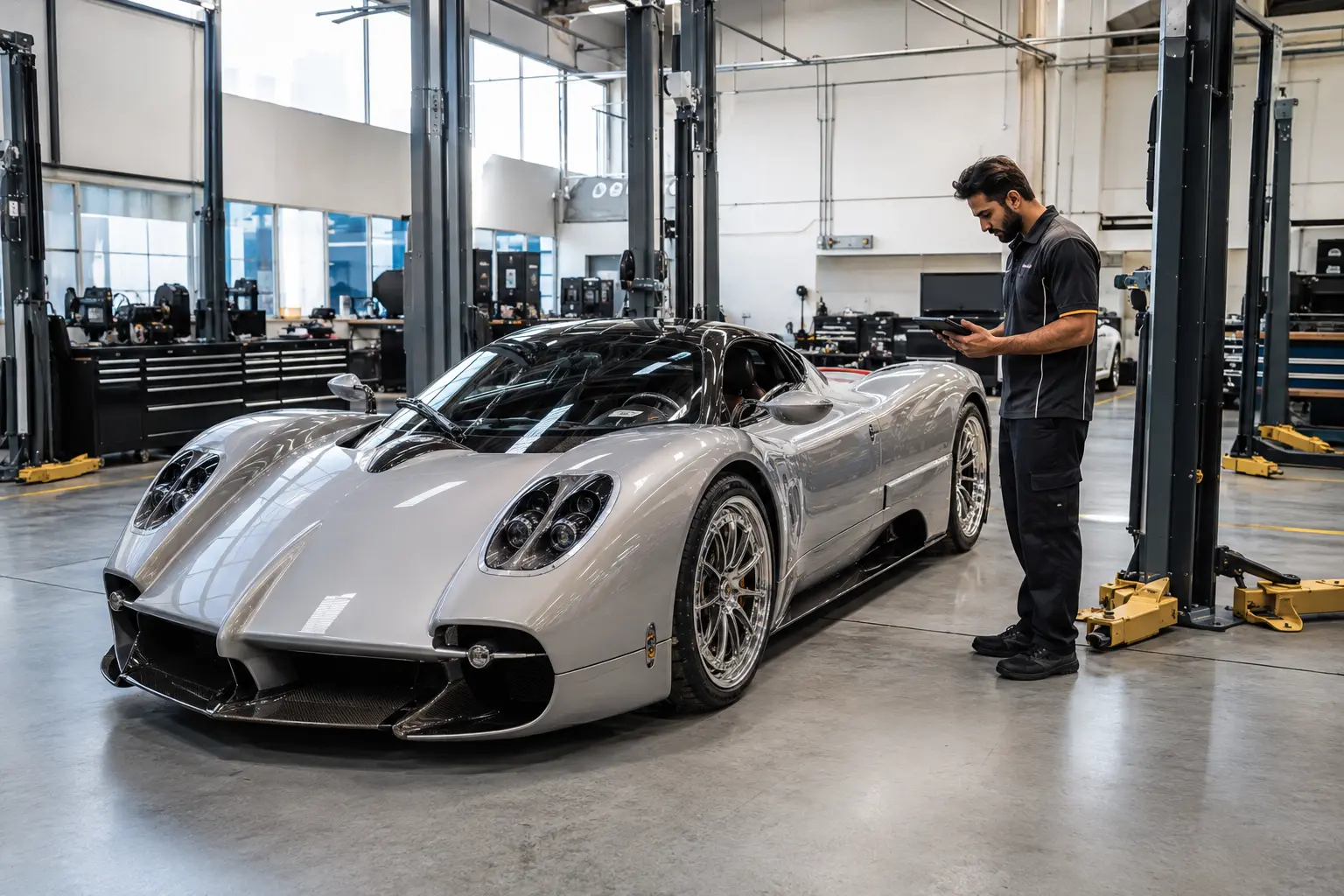
Silver Pagani Utopia receiving diagnostic intake in a Dubai workshop
Begin with a controlled intakeLow clearance, composite bodywork, vehicle configuration and the reported event all affect how the car should be received.
Identify the exact carSend the model, year, VIN, market specification and any special-series information available.
Preserve the first evidencePhotograph warnings, fluid traces and damaged areas before cycling systems or cleaning the vehicle.
Declare earlier workList transport incidents, storage, battery support, modifications and recent maintenance or dismantling.
Separate official operationsCampaigns, authentication, protected software and manufacturer records may require the official Pagani network.
The intake determines the repair path

Protect the car before diagnosis begins

A Pagani enquiry should not begin with a generic promise that every repair can be completed. Utopia, Huayra, Zonda and limited derivatives differ in structure, systems, access and documentation. The first job is to identify the car accurately and decide what can be inspected without disturbing a protected assembly or compromising evidence.

Tell the advisor whether the vehicle drives normally, has entered a warning state, has suffered an impact, has been stored, or has arrived after another workshop attempted a repair. Include the sequence of events rather than only the final symptom. A warning that appeared after charging, washing, wheel work or battery disconnection may require a different first test from the same message appearing under load.

This is an independent workshop service. It is not a claim of Pagani authorization, official after-sales status, factory certification or access to every protected procedure.

Vehicle identity
VIN, registration market, model derivative, production year, transmission type and any bespoke equipment help define information and access requirements.
Movement plan
Confirm ground clearance, steering condition, brake operation, wheel security and whether a low-angle transporter is needed.
Condition record
Photograph exposed carbon, painted panels, wheels, glass and cabin touchpoints before work begins.
What the visit includes
Agree whether the visit is inspection only, fault isolation, maintenance planning, a defined repair or preparation for official-network work.
Evidence before replacement

Record exactly when the problem appears

A scan result is one part of the case. The technician still needs to reproduce the complaint where safe, inspect the relevant area and compare electrical, thermal and mechanical evidence before recommending a component.

01

Warning or restricted operation

Record the exact display message, operating mode, engine temperature, road speed and recent intervention. Stored events, live values and supply stability can narrow the system involved, but a named code does not by itself prove that the named part is defective.

02

Noise, vibration or changed response

Describe whether the condition follows engine speed, vehicle speed, steering angle, braking, road surface or temperature. This separates rotating, driveline, chassis, aero and body-contact possibilities before parts are removed.

03

Leak, smell or temperature concern

Identify the first location, fluid appearance, odor, operating condition and whether the level changed. Cleaning the area too early can erase the path. Cooling pressure, hose condition, sealing surfaces and heat shielding may need a staged inspection.

04

Battery or starting event

Record the parked interval, battery-maintainer arrangement, any boost-start event and the outcome of each ignition attempt. Supply voltage, grounds, charging behavior, starter demand and vehicle sleep state answer different questions.

Repair approval table

Approve work only after the checks are explained

The estimate should explain what was observed, what remains uncertain and what the next authorized step is expected to prove.

Reported concernUseful first evidenceApproval question
Engine warning under loadSaved fault history, supply stability, relevant live values, intake and boost integrity, fluid condition and repeatable operating circumstances.Which measured result identifies the next mechanical or electrical test?
High temperature or coolant traceCold level, pressure retention, hose and joint condition, fan operation, airflow path, heat shielding and leak location.Will the next step isolate the source without unnecessary dismantling?
Brake vibration or noiseWheel security, disc and pad condition, runout where appropriate, tire condition, suspension play and the speed or temperature at which it occurs.Which finding separates friction, wheel, hub and suspension causes?
Ride height or handling changeCorner measurements, tire pressures, wheel condition, visible links, dampers, joints, alignment evidence and any recent transport or impact.Is movement safe and what must be protected during lifting?
Intermittent electrical behaviorBattery capacity, voltage drop, grounds, connector condition, network status, recent accessories and storage history.Can the condition be repeated before a module or harness is disturbed?
Body or carbon damageComplete photo record, alignment of adjacent parts, mounting points, exposed edges and incident history.Does the assessment require an authorized centre, structural specialist or composite specialist?
Workshop views with context

Inspect systems without losing the whole-car view

These workshop scenes represent different stages of an assessment. They do not imply that every repair is available for every chassis. Capability, information, tooling and parts must be confirmed for the exact vehicle.

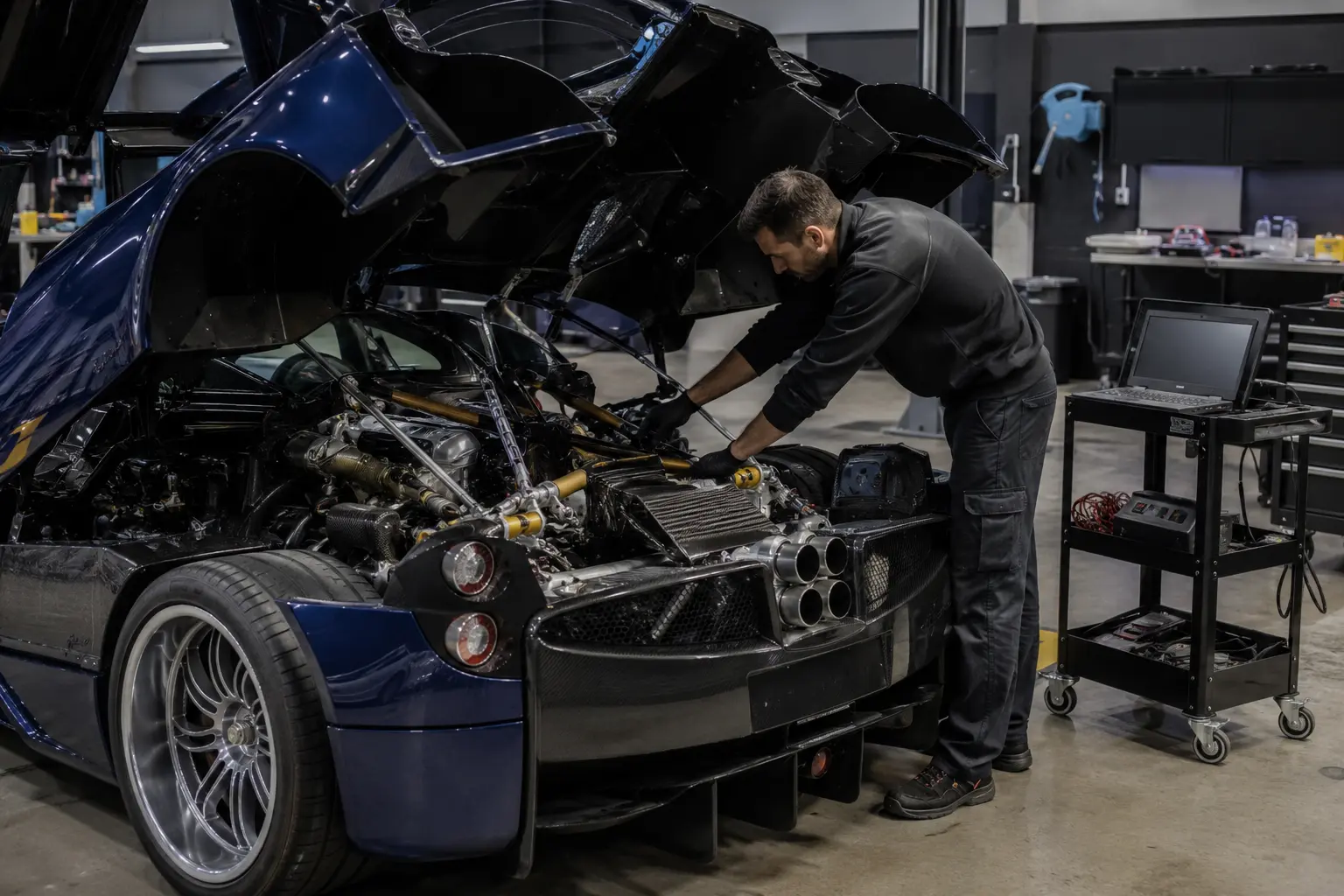
Technician inspecting the rear engine bay of a Pagani Huayra in a workshop
Open access deliberatelyProtect finished surfaces, document fasteners and confirm the test purpose before disturbing covers or assemblies.
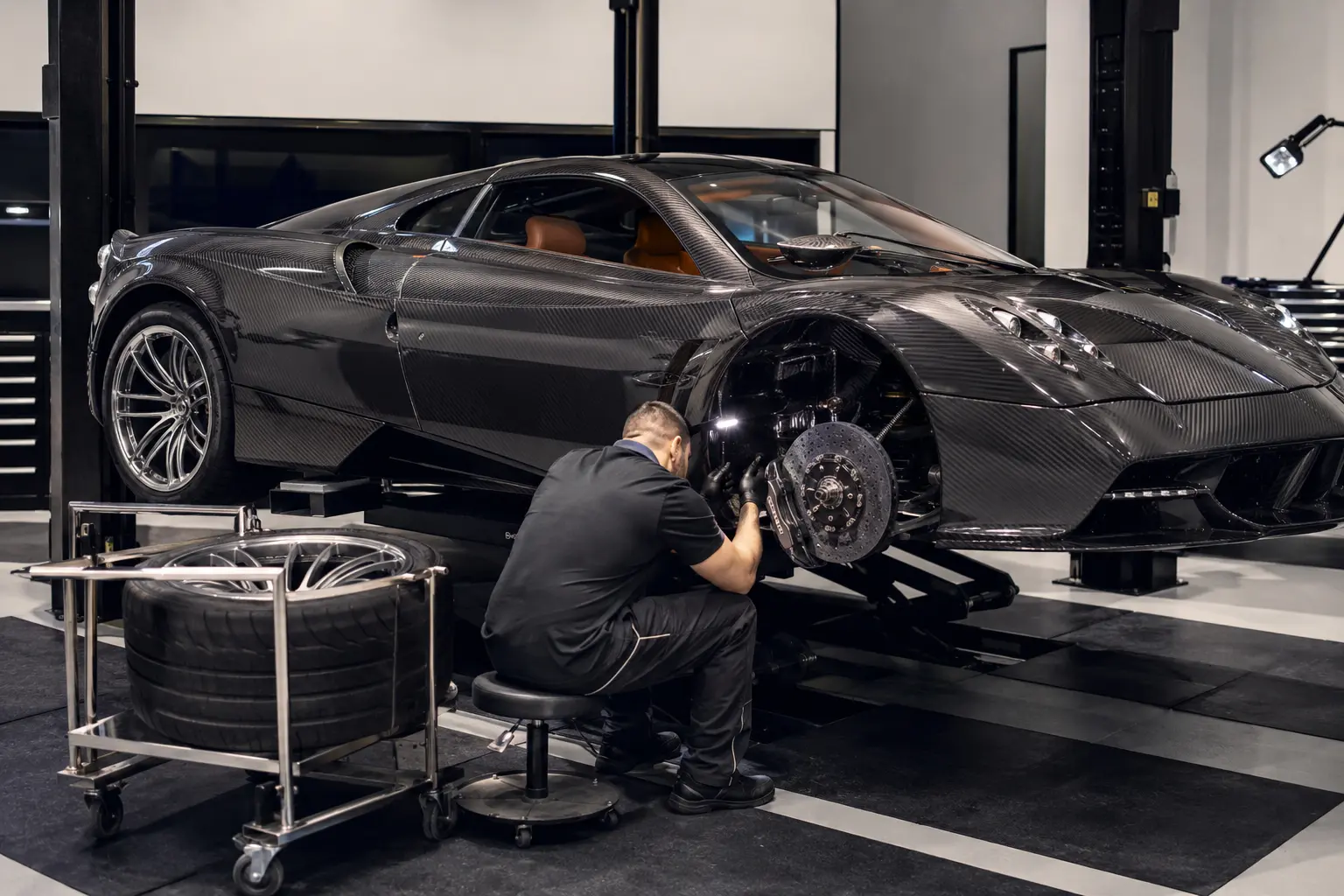
Technician inspecting Pagani brakes and suspension with the wheel removed
Control wheel and lift workCorrect lifting points, wheel handling, tightening procedure and condition records matter as much as the component inspection.
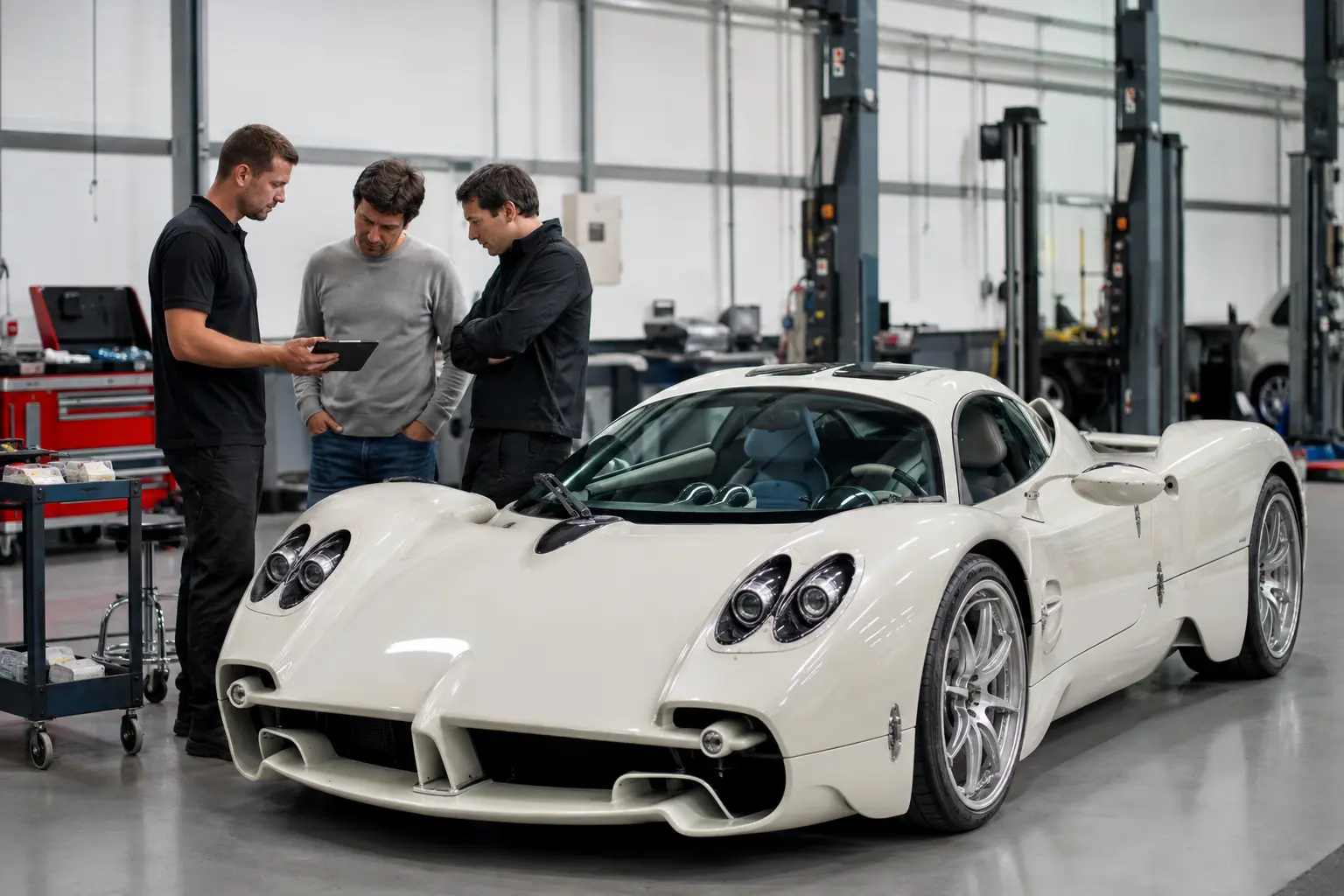
Pagani repair findings reviewed beside the vehicle in a workshop
Hand over evidence, not surprisesThe owner should receive the findings, completed checks, limits of the inspection and any work that must go to the official network.
related workshop services

Choose the right specialist for the problem

This page helps you decide what to do first. Use the linked service pages for detailed information about the affected system.

Diagnostic review

Use stored events and live values as evidence, then connect them to physical checks and the conditions in which the fault appears.

Review computer diagnostics

Engine investigation

Noise, smoke, pressure, temperature and performance concerns need a defined mechanical path rather than a generic tune-up promise.

See engine repair

Transmission and shift evidence

Record selection, shift quality, temperature, warnings and whether the condition changes between cold and hot operation.

Explore transmission repair

Brake assessment

Separate pad or disc condition from hub, wheel, tire, suspension and temperature-related causes before approving replacement.

Open brake repair

Cabin cooling concern

Airflow, refrigerant performance, temperature control and electrical command faults need different measurements.

View AC repair

Workshop appointment

Send the vehicle identity, present location, symptoms and preferred date so reception and access requirements can be checked first.

Request an appointment
model and usage differences

Check the exact chassis and specification

Pagani’s road-car history includes Zonda, Huayra and Utopia families, plus limited, track-oriented and highly personalized derivatives. The badge alone is not enough for a work order. Powertrain, chassis, transmission, wheel hardware, market specification and earlier upgrades must be identified from the individual car.

A road car, a track-focused derivative and a vehicle carrying bespoke factory work do not create the same service question. Transportation, lifting, information access and parts sourcing should be agreed before arrival. If the request involves authenticity, manufacturer certification, an official service record, protected programming, recall or campaign work, the owner should use the official Pagani dealer and service network.

A carefully defined independent inspection can still be useful. It can document condition, preserve fault evidence, check accessible systems, help the owner understand a general mechanical or electrical concern, and prepare an organized handover to an authorized or specialist destination where required.

  • Utopia familyConfirm Coupé or Roadster configuration, transmission and any owner-supplied technical instructions.
  • Huayra familyIdentify the exact derivative and whether the concern involves road-car or track-focused equipment.
  • Zonda familyRecord chassis identity, earlier restoration or upgrade work and the origin of replacement components.
  • Limited configurationsDo not assume interchangeability. Serialized, bespoke or protected items need an approved sourcing decision.
  • Modified or stored carsProvide transport, battery-support, fuel, tire and preservation history before attempting operation.
A controlled service sequence

Keep every stage reversible and documented

The process below prevents a broad enquiry from turning into uncontrolled dismantling or an unsupported promise.

  1. 01

    Share the complete brief

    Send identity, symptoms, warning images, recent events, service history, location and transport needs.

  2. 02

    Confirm intake limits

    Agree safe movement, inspection access, information availability and which official operations are not available here.

  3. 03

    Inspect and preserve evidence

    Record condition, reproduce the symptom where safe and collect relevant mechanical, electrical and thermal results.

  4. 04

    Approve the next test

    Separate confirmed work from exploratory access, parts research and official-network referral.

  5. 05

    Repeat the check before handover

    Recheck the agreed function, document remaining limitations and explain any monitoring or onward action.

Before the car arrives

Prepare a transport-safe handover

Tell the workshop whether the vehicle starts, selects gear, steers, rolls and holds brake pressure. Also report low ride height, locked wheels, a deployed restraint, fluid loss, body contact or loose aerodynamic parts. Those details determine whether ordinary loading is inappropriate and whether the collection vehicle needs a lower approach, skates, additional protection or a different recovery method.

Do not repeatedly start a car with new mechanical noise, a serious pressure warning, an overheating condition or visible fluid loss merely to make collection easier. Preserve the last warning display and describe the final operating event instead. If safe, photograph the instrument panel, the ground beneath the vehicle and the affected corner without removing covers or reaching near hot or moving components.

Arrival condition is part of the diagnosis. The intake record should note mileage, fuel level, battery support, visible marks, wheel and tire condition, warning displays, supplied keys, removable accessories and documents. A joint photo walkaround protects both the owner and the workshop, especially when a low-clearance car has travelled by transporter.

Agree who may authorize further investigation and how approval will be recorded. If inspection reveals a different concern from the original booking, the technician should stop at a safe evidence point, explain what changed and obtain a new instruction. That keeps cost, responsibility and work plan aligned.

Parts and access control

Approve components only after identity is proven

A rare vehicle can be damaged by an ordinary assumption. Similar-looking seals, fasteners, filters, wheel hardware and electrical parts are not automatically interchangeable. The work order should record how the requested component was identified and whether its source, specification and installation method are suitable for the individual chassis.

Confirm the part and its source

Ask whether the proposal uses a genuine item obtained through an official service network, an owner-supplied part, a specialist repair, or an alternative that still needs technical approval. The invoice should not blur those categories. Packaging, part markings and supplied documentation should be preserved where they matter to provenance or a future official inspection.

Do not authorize an expensive order only because a fault code names a system. The diagnostic evidence should establish why the component cannot perform its function and what checks exclude wiring, supply, mounting, adjustment or a related mechanical cause.

Plan access before dismantling

Composite panels, finished carbon surfaces, lightweight fasteners and tightly packaged systems require a deliberate protection plan. The technician should know which panels, undertrays or trim pieces need removal, how their locations will be recorded and how exposed openings will be protected during the job.

If the required instruction, fixture or tightening information is unavailable, pausing is better than improvising. A referral made before damage is evidence of a controlled decision, not an unfinished repair.

Verify more than the warning lamp

A cleared message is not a complete handover. Verification should revisit the original operating condition where safe, confirm that no new fault was introduced and record any limit that prevented a full road or load test. Fluid levels, leaks, fasteners, wheel security, protective covers and touchpoints also need a final review.

Keep a complete inspection record

Retain the inspection summary, before-and-after photographs, measurements, scan reports, approved estimate, parts documentation and final findings together. If the vehicle later enters the official network, the dated evidence lets a receiving team see the original observations and every independently completed action without presenting it as a factory record.

Pagani workshop questions

Answers before you move the car

Give the workshop enough information to decide whether the vehicle should be driven, transported, inspected in place or directed to an official service centre.

Is Auto Repair UAE an authorized Pagani service centre?

No. This page describes an independent workshop assessment and repair-planning service. It does not claim Pagani authorization, factory certification or official after-sales status.

Can you accept every Pagani model and repair?

We can confirm the booking after reviewing the exact chassis, requested work, safe access, available technical information, tooling and parts. Send the VIN, derivative and symptom first so the workshop can confirm whether it can take the job before transport.

Should I drive a Pagani with a new warning?

Do not assume it is safe. Stop if there is overheating, oil-pressure concern, severe vibration, braking change, smoke, fluid loss or restricted steering. Share the exact warning and circumstances for transport guidance.

What should I send before booking?

Send the VIN, model, year, mileage, warning photos, a clear symptom timeline, recent work, storage history, current location and whether the car can move under its own power.

Can a diagnostic scan identify the failed component?

Not by itself. A fault record identifies an observed condition or affected circuit. Physical inspection, supply checks, measurements and safe symptom reproduction are still needed before a component is condemned.

How is low-clearance transport handled?

Ground clearance, steering, braking, wheel condition and loading angle must be discussed with the transporter. The workshop should know the equipment and arrival plan before the vehicle is dispatched.

Can you provide an official Pagani service record?

An independent invoice or inspection record is not a manufacturer service record. Work requiring official records, authentication, protected software, campaigns or manufacturer approval should be routed through Pagani’s official network.

Will you quote a repair before inspection?

A useful quotation needs an identified vehicle and clearly defined work. The workshop can explain an intake or diagnostic stage first, then provide an evidence-based repair proposal when the cause and access requirements are clearer.

Prepare a useful Pagani enquiry

Send the chassis details before transport

Include the exact car, event sequence, warning images, recent work and present condition. The workshop can then confirm whether it can inspect the car, how it should arrive and which tests are possible.