12-volt diagnosis with hybrid boundaries

McLaren battery replacement in Dubai

Model-specific 12-volt battery testing, fitment confirmation and replacement planning for McLaren vehicles, with storage history, charger use and high-voltage separation recorded before access.

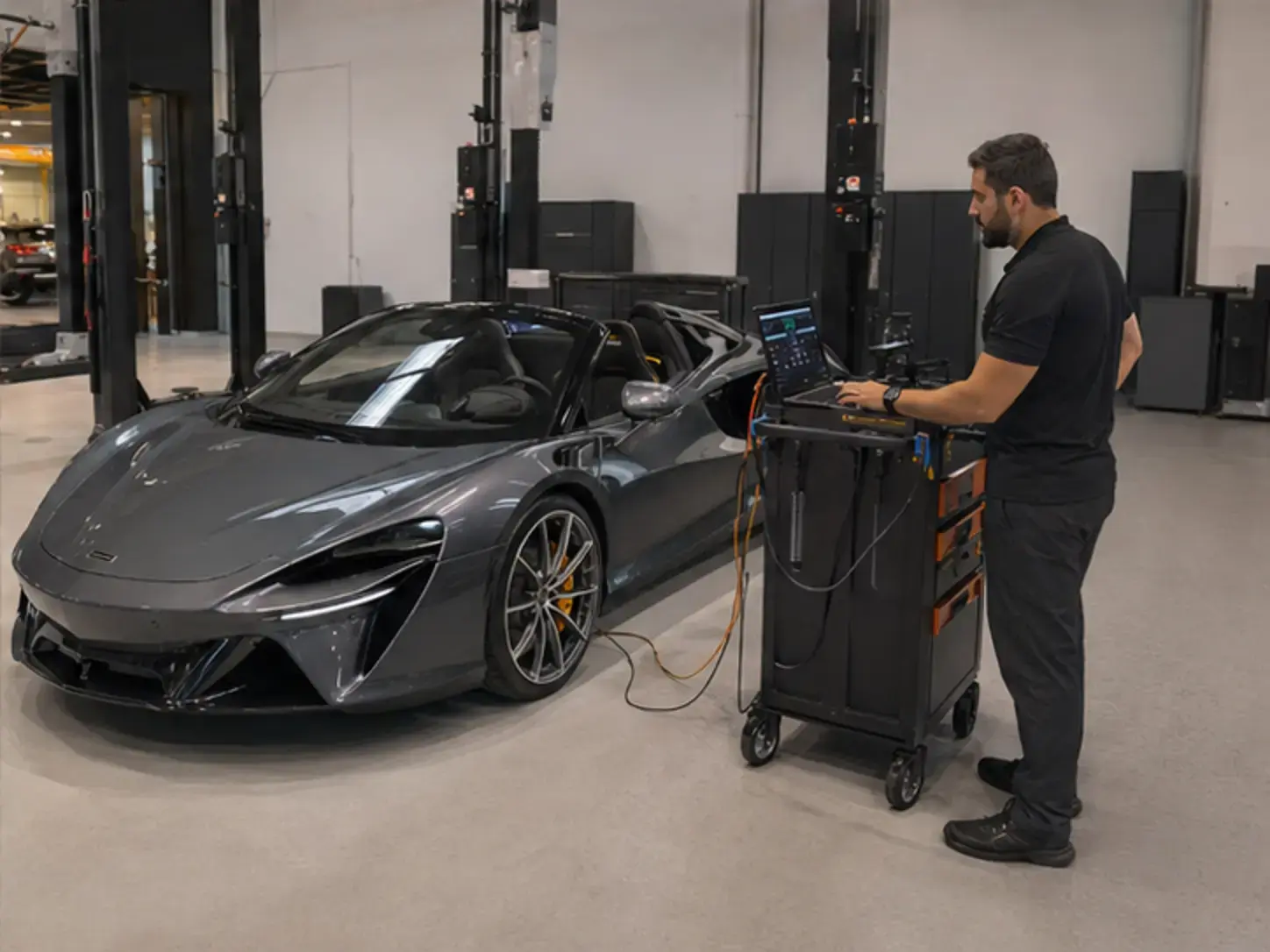
Technician carrying out low-voltage diagnostic verification on a McLaren Artura
A 12-volt complaint and a hybrid high-voltage concern are different technical domains. The exact McLaren establishes the safe route.
Name the model VIN, year and exact derivative
Describe storage Parked time and charger use
Preserve the event Unlock, wake-up and warning order
Confirm the domain 12 volt or hybrid high voltage

Battery is not one interchangeable label

Separate low-voltage support from the traction system

McLaren vehicles use a 12-volt electrical supply for wake-up, control and conventional low-voltage functions. Hybrid models such as the Artura, and current electrified products such as the W1, also have a separate high-voltage traction domain. A no-start, no-wake or repeat-discharge report must not be used to authorize work in both systems.

12-volt assessment scope

The low-voltage assessment can record resting condition, supported voltage, cable and ground integrity, charging behavior, wake-up sequence and parasitic draw where justified. It also verifies the fitted battery label, dimensions, terminal arrangement, hold-down and model information before a replacement is selected.

Access and support instructions differ by model. The correct owner handbook or technical procedure for the specific VIN should control charger connection, access and any isolation or initialization steps.

High-voltage boundary

A hybrid-system warning, isolation fault, charging fault, collision event, underbody impact, unusual heat, vapour or damaged orange cabling requires a separate capability and safety decision. Routine 12-volt diagnosis does not authorize removal of traction-battery covers or high-voltage connectors.

When the fault belongs to the hybrid domain, the estimate should state the limitation clearly and identify the information, trained personnel and equipment required before further work.
The sequence changes the diagnosis

Describe what the McLaren did before calling it a failed battery

A weak battery can create secondary warnings, but the same symptoms can arise from poor connections, storage practices, charger problems, a wakeful control unit or another fault. The first useful evidence is the order in which the vehicle responded.

Vehicle will not unlock normally

State whether the key is recognized, whether another key was tried, how long the car was parked, whether the charger was connected and which lights or sounds occur. Avoid repeated improvised power connections. The correct access and support points must be confirmed for the exact model.

Displays wake but start is inhibited

Photograph every message before cycling the ignition repeatedly. A low-voltage condition, interlock, selector state, key authorization, control fault or hybrid warning can inhibit start. Test supply stability and read fault context rather than treating the display as proof of a battery-only problem.

Battery discharges after parking

Record parked duration, locking method, charger model, charger indicators, tracking or camera accessories, recent software or body work and whether the condition repeats at the same interval. Confirm battery capacity and state before measuring sleep behavior or quiescent draw.

Jump or support power restores operation

Temporary recovery does not identify why the battery became depleted. Note the support method, time connected, warnings present afterward and whether the vehicle was driven. Battery condition, charging support and draw still require measurement.

Warning appears while driving

Record voltage or electrical wording, steering and brake behavior, temperature, lighting changes and any smell or heat. A charging or network event while moving can be different from normal storage discharge. Stop if essential functions change or electrical heating is suspected.

Test before ordering

Build a 12-volt diagnosis from measured evidence

A replacement should be the result of confirmed condition and correct application, not only the age written on an invoice. Battery state, support history, connections and vehicle behavior are considered together.

Identity and visual record

Confirm VIN, model, year, mileage and the fitted battery label where safe access allows. Photograph terminal orientation, case, venting or connection arrangement, hold-down and any previous repair. Do not assume an Artura, 750S, GT, 720S or earlier model shares one battery procedure.

Battery condition

Measure voltage under controlled conditions and use a test appropriate to the installed battery technology and state. A recently charged surface voltage, deeply discharged unit or unsupported vehicle can mislead a quick pass-or-fail test. Record the conditions with the result.

Cables and grounds

Inspect accessible connections and use voltage-drop measurements when current demand makes them meaningful. A clean-looking terminal can still have resistance elsewhere in the path. Heating, looseness or previous improvised wiring changes the repair scope.

Charging and support behavior

Confirm the model-specific way the 12-volt system is maintained while the car operates or charges. Output and control behavior should be evaluated with the correct procedure rather than a generic alternator assumption, particularly on an electrified McLaren.

Parked current investigation

A quiescent-draw test only becomes useful after battery condition, support and measurement setup are stable. The vehicle may need time and correct locking conditions to enter sleep. Opening panels or polling networks can wake it and invalidate the result.

Fault and event context

Read relevant control information before clearing warnings. Low supply can create communication or plausibility faults across several modules. The chronology helps distinguish a primary battery event from another system that discharged or destabilized it.

Fitment includes more than physical size

Confirm the replacement specification and procedure

The part choice should use the VIN, installed label and current model information together. Chemistry, capacity, output, dimensions, terminals, mounting and any ventilation or monitoring arrangement must be compatible. The owner handbook or verified technical information should control support and connection points.

Application

Model, derivative, build year, market and VIN identify the relevant technical path. Imported or modified vehicles need installed evidence as well.

Specification

Record battery technology, electrical rating, case size, terminal layout and any model-specific requirement. Do not substitute by dimensions alone.

Support

Use the correct external support method if the procedure requires it. Incorrect polarity, connection point or voltage can cause extensive damage.

Access

Protect trim and body surfaces, follow defined access, and keep tools away from unrelated energized areas. Never treat high-voltage covers as a shortcut.

Completion

Secure the battery and routing, restore removed components, perform required initialization, verify wake-up and review returning warnings.

Storage history is diagnostic evidence

Record charger use instead of guessing from parked time

Low annual mileage does not automatically mean low electrical demand. A McLaren may spend long periods parked while security, access and control systems still depend on stable support. Storage practice can be part of both the cause and the prevention plan.

Charger identity

Record the device, connection point, mode, indicators, extension arrangements and whether power was interrupted. A green indicator from a wall outlet or adapter may not prove the battery received the intended support.

Parking sequence

Note whether the car was locked, whether doors or compartments remained open, how keys were stored nearby and whether accessories, trackers or cameras were active. Reproduce the relevant setup safely when investigating draw.

After deep discharge

Do not judge recovery only by the ability to start once. A deeply discharged battery may accept surface charge yet lack capacity. Review faults, condition and charger behavior before returning the vehicle to storage.

Low clearance changes the arrival plan

Choose stationary support or specialist transport safely

Do not improvise towing or repeated boost attempts when the vehicle cannot wake, release a parking control or select the required state. Share the exact model, position, clearance, steering state and wheel condition with the recovery provider.

Information for recovery

State whether the vehicle unlocks, rolls, steers, selects neutral, has a locked wheel, sits in a basement or narrow ramp and has any hybrid, collision or electrical-heat warning. Photographs of access and approach angles reduce handling surprises.

Stop conditions

Keep clear and seek an appropriate response after collision damage near the battery area, underbody impact, unusual heat, vapour, hissing, arcing, smoke or a high-voltage isolation warning. Routine 12-volt support must not continue through those signs.

For concerns beyond the battery scope, the main McLaren repair assessment preserves the same model-specific intake while routing engine, cooling, chassis, electrical or hybrid evidence to the relevant checks.

Replacement is not complete at connection

Verify wake-up, retained functions and the original complaint

Completion checks should demonstrate that the vehicle responds normally and that work around the battery has not disturbed adjacent systems. A single successful start is useful but does not by itself resolve repeat discharge.

Physical check

Confirm secure mounting, protected cables, correct covers, undamaged trim and no trapped routing or loose items.

Electrical check

Verify stable supply, wake-up, charging-support behavior and expected control communication under the defined conditions.

Function check

Review windows, locks, displays, lighting, stored settings and any functions affected by power interruption or access.

Return plan

Record charger guidance, storage conditions, limitations and any follow-up draw test or unrelated fault that remains open.

Model and ownership history control the procedure

Prepare the correct McLaren battery record before access

A vehicle described only as a McLaren may be an earlier Sports Series, Super Series or GT, a current GTS or 750S, or an Artura with a hybrid traction system. Different layouts and electrical strategies mean the workshop should not reuse access, support or battery details from another model without confirmation.

Recently purchased vehicle

Ask for available service invoices, storage history, charger and any battery receipt from the previous owner. Photograph aftermarket trackers, cameras or accessories without disconnecting them. A fitted unit may differ from the original application, so both the VIN and installed label matter.

If the car arrived after long transport or auction storage, record how it was powered, moved and charged during that period. Repeated deep discharge can influence test interpretation.

Seasonal or collection storage

Record the usual parked duration, temperature, locking routine, key location, charger connection and power interruptions. State whether the car is periodically started without being driven or left open for detailing and display.

A prevention plan should follow verified handbook guidance for the exact model. Generic advice about disconnecting a terminal can create access, alarm or initialization problems.

Vehicle used frequently

A discharge after regular driving points to a different history from a car parked for several weeks. Record journey duration, electrical warnings, charging behavior, recent repair and whether heat or fan operation continued abnormally after shutdown.

The diagnosis still checks battery capacity and connections, but it also considers the support system and a component that may remain active.

A battery estimate should name its assumptions

Separate access, diagnosis, replacement and further faults

A quotation for a battery should not silently include unrelated electrical investigation, and a diagnostic authorization should not automatically become permission to replace the first unit that tests low after deep discharge.

Access scope

State the trim, covers or compartments expected to be opened and any low-clearance or locked-vehicle complication that may change the route.

Test scope

Define condition, connection, support and draw checks that are included. Extended sleep monitoring may require a separate time authorization.

Replacement scope

Name the confirmed specification, availability, support method, installation, initialization and verification included with the part.

Conditional finding

If water, altered wiring, an incompatible battery or a wakeful module appears, stop at the agreed point and present evidence before expanding work.

At handover, the record should identify the battery installed, measurements taken, charger or storage guidance provided and any limitation. Owners should know whether the original discharge cause was confirmed, whether only a depleted battery was found, or whether a separate intermittent investigation remains open.

A repeat-discharge result may need time

Define the parking condition for a meaningful retest

An intermittent discharge cannot always be verified during the same hour as replacement. The owner and workshop should agree the parked duration, locking state, charger condition and follow-up evidence that will decide whether the complaint is resolved.

Short-term verification

Confirm stable wake-up, expected charging support, no new warnings and normal functions after the work. Recheck accessible connections and the installation area before the car leaves.

Parked verification

Use the defined locking and key-storage condition. Record charger indicators and any power interruption. If draw monitoring is authorized, prevent doors, polling or test equipment from repeatedly waking the vehicle.

Return evidence

If the symptom returns, send parked time, charger state, unlock response and warning sequence without repeated boost attempts. That chronology helps decide whether capacity, support or an intermittent wakeful system needs the next test.

The handover should avoid a permanent-cure claim when the original interval has not yet elapsed. A clear retest rule is more useful than assuming one successful start has proven a long-storage condition.

Direct owner answers

McLaren battery replacement questions in Dubai

Does a McLaren no-start always mean the 12-volt battery has failed

No. Battery condition, connections, storage support, parasitic draw, authorization, control and hybrid warnings can create different no-start or no-wake symptoms. Testing identifies the route.

Is the 12-volt battery the same as the Artura hybrid battery

No. The low-voltage support battery and high-voltage traction system are separate domains. Routine 12-volt replacement does not authorize opening high-voltage components.

Can any battery with the same dimensions be fitted

No. Technology, rating, terminals, mounting, monitoring and model procedure matter as well as size. VIN and installed evidence should support the part selection.

Why do you need my charger and storage history

It helps distinguish loss of capacity from interrupted support, incorrect connection, sleep disruption or an electrical draw. Parked duration alone is not enough.

Can the battery be replaced after a jump start

Temporary support may restore operation but does not prove why the battery was depleted or whether it retains capacity. Condition, connections and support behavior still need review.

What should I send before booking

Send the VIN, model, year, mileage, parked duration, charger details, warning photographs, start or unlock sequence, recent work and whether the vehicle can roll or select neutral.

Prepare the battery case

Send the McLaren model, storage history and wake-up sequence

Include the VIN, fitted battery label if accessible, charger details, warnings and whether the vehicle can be moved safely.