Air struts and leaks
We assess corner height, leak-down behavior, air lines, fittings, air springs, and strut condition. A vehicle that settles overnight needs leak testing before a compressor is blamed.
Restore ride height, steering stability, comfort, and tyre contact with a diagnosis built around your Cadillac. We inspect air suspension, shocks, struts, control arms, bushes, links, sensors, compressors, and wheel alignment before recommending repair.
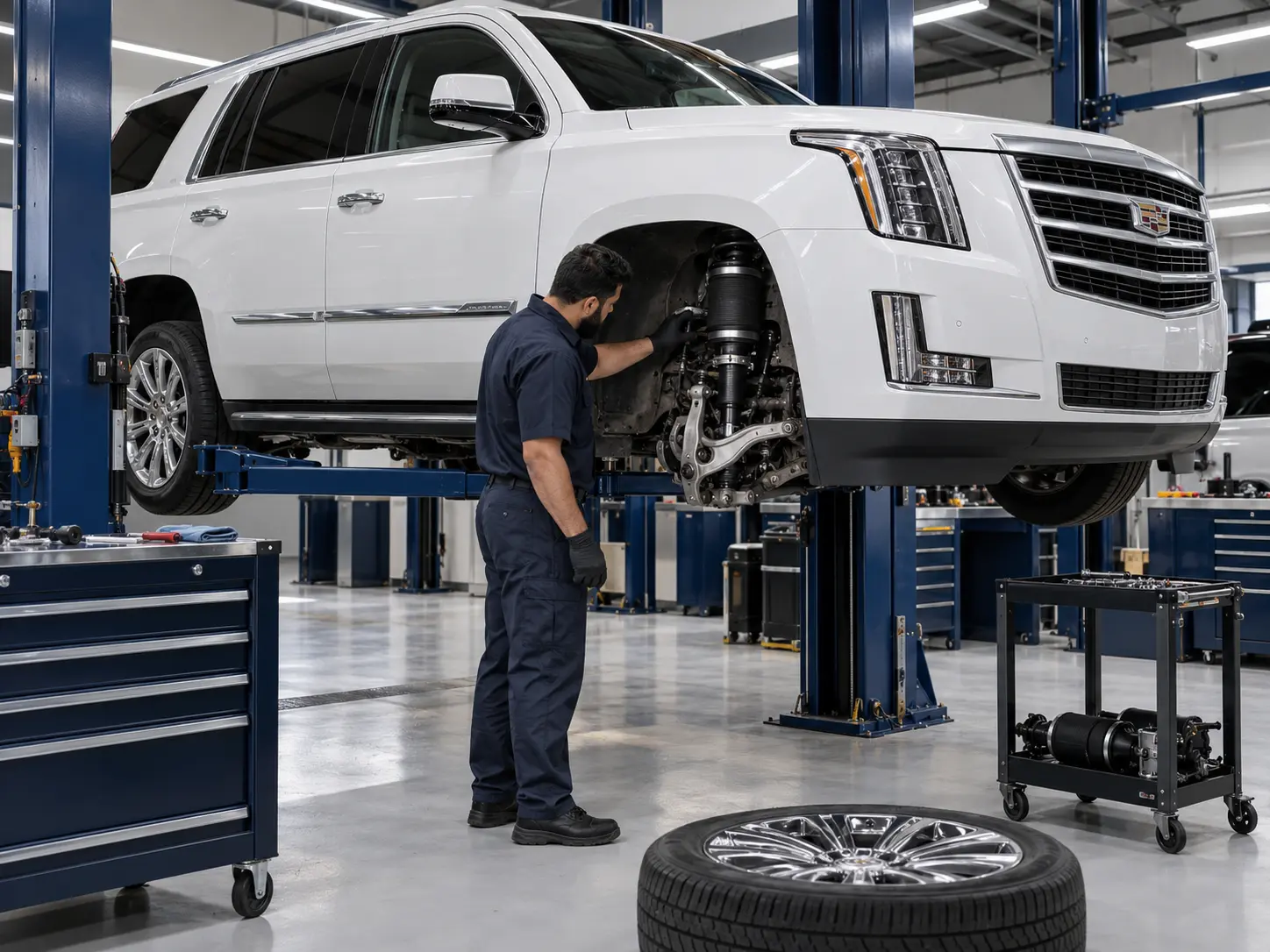
Cadillac ride complaints can be pneumatic, mechanical, electronic, or tyre-related. We check the connected systems so the quote addresses the cause rather than only the most obvious component.
We assess corner height, leak-down behavior, air lines, fittings, air springs, and strut condition. A vehicle that settles overnight needs leak testing before a compressor is blamed.
Supply pressure, run time, relay control, valve operation, and stored faults help distinguish a weak compressor from a leak or control problem elsewhere.
Worn control-arm bushes, ball joints, links, mounts, or bearings can cause knocks, wandering, vibration, and uneven tyre wear. We check movement under load.
Leaking or weak dampers can reduce stability. Adaptive systems also require wiring, sensor, connector, and fault-code checks before replacement is approved.
Wheel alignment is an important finishing step after many suspension repairs, but alignment alone will not correct worn joints, damaged bushes, weak dampers, a bent wheel, or a ride-height fault. We repair the confirmed looseness or height issue first, then align the vehicle when the mechanical condition allows an accurate setting.
These estimated Dubai ranges help compare common jobs. The total changes with model, axle, suspension type, parts availability, the number of affected components, and whether calibration or alignment is required.
| Suspension work | Estimated price | What the range can cover | What changes the total |
|---|---|---|---|
| Workshop suspension inspection | Free | Ride-height, visible wear, tyre pattern, noise, and basic movement checks | Advanced electronic or leak diagnosis is quoted when needed |
| Four-wheel alignment | AED 250 to 450 | Measurement and adjustment where the chassis permits | Wheel size, seized adjusters, and prior damage |
| Control arm or bush repair | AED 850 to 2,200 | One affected arm or bush area, installation, and checks | Arm design, side, axle, parts choice, and alignment |
| Shock or strut replacement per axle | AED 2,200 to 5,500 | Matched dampers or struts, installation, and road check | Adaptive damping, mounts, springs, and model specification |
| Air strut replacement each | AED 2,800 to 6,500 | One confirmed air strut, installation, height check, and leak review | New or suitable alternative part, availability, and calibration |
| Air compressor replacement | AED 2,500 to 5,500 | Confirmed compressor, installation, supply checks, and fault clearing | Relay, dryer, lines, valve block, or unresolved leakage |
| Ride-height sensor replacement | AED 700 to 1,600 | Confirmed sensor or linkage, installation, and value verification | Location, wiring condition, coding, and calibration |
| Adaptive suspension diagnosis | AED 350 to 650 | Fault scan, live data, wiring context, and function checks | Intermittent faults and road-test time |
Prices are estimated in AED and vary by Cadillac model, fault, service scope, and parts selection. The written quote lists parts, labor, VAT treatment, alignment, calibration, optional work, and exclusions. Equivalent repairs may be 65% to 70% below agency pricing when parts and scope are compared on the same basis.
A low corner after parking usually directs attention toward leakage or a local height issue. A compressor that runs often can be reacting to that leak, so replacing the compressor alone may leave the original cause in place. If the vehicle rises unevenly, we also review sensor values, linkages, valves, and mechanical restriction.
Knocks over small bumps often involve links, bushes, joints, mounts, or loose hardware. A floating or bouncing ride can involve weak damping, while wandering can involve tyres, alignment, bushes, steering parts, or ride-height differences. Vibration may come from wheels or tyres rather than suspension.
We combine the customer’s symptom with physical measurements, fault data, and a controlled road assessment when the vehicle is safe to drive.
We note ride height, warning messages, noise, parking time, and road conditions.
Tyres, wheels, arms, bushes, joints, mounts, dampers, and visible lines are checked.
Air leakage, supply operation, sensor values, wiring, and fault data are reviewed as needed.
We explain repair, replacement, parts options, alignment needs, timing, and price.
Ride height, warning status, noise, stability, alignment, and road behavior are rechecked.
Some faults need a complete component, while others can be corrected with a bush, link, fitting, sensor, wiring repair, or alignment. The inspection findings should support the choice.
A sound assembly may only need a bushing, link, connector, air-line fitting, or sensor linkage where the design allows service. This route can retain good components while correcting the confirmed fault.
We also check whether another worn part on the same axle will affect alignment or load the repaired component.
An air strut with a leaking bellows, a damper with internal weakness, a damaged control arm, or a compressor that cannot produce required pressure may need replacement. Matched left and right replacement can be advisable for dampers when wear differs significantly.
If a component remains within limits and the symptom cannot be repeated, monitoring may be reasonable. We explain what to watch, what would make the issue urgent, and when to return. We do not recommend parts only to remove uncertainty.
New, genuine, and suitable OEM-equivalent components can have different prices and availability. Refurbished parts should only be considered when their condition and terms are clear for the specific job. The quote states the selected option and any required programming, calibration, or alignment.
Describe whether the Cadillac sits low after parking, drops on one corner, rises slowly, bounces, knocks, wanders, or wears a tyre unevenly. Tell us whether the symptom appears only after a cold start, after a long drive, while turning, during braking, or on speed bumps. A level side photo taken after the vehicle has been parked can help document a ride-height concern before the workshop visit.
The estimate should identify the confirmed component, the affected side or axle, the proposed part choice, and any alignment, calibration, air-system filling, or road verification included. When an air suspension has more than one possible leak point, diagnosis should come before a major parts order. Replacing a compressor without locating a leaking strut, line, reservoir, or valve can leave the original cause unresolved.
Mechanical suspension work also needs connected checks. A worn control-arm bush can change wheel position; a weak damper can affect tyre contact; and a wheel, tyre, bearing, or steering fault can feel like suspension trouble. We separate these systems during inspection and explain related work as a distinct item. This keeps the repair decision understandable and prevents alignment from being used to hide worn components.
After fitting, we verify fasteners, ride height, warning status, alignment where required, and behavior during a controlled road test. The Cadillac should not be released with an unexplained low corner or active suspension message. If safe driving is doubtful, contact the workshop before moving the vehicle so pickup or recovery can be planned appropriately.
These planning scenarios show common combinations of parts and labor. They are not presented as completed customer repairs.
Leak confirmation, one front air-strut replacement, installation, system filling, ride-height review, and warning check. Compressor or valve-block work is excluded unless separately confirmed.
Two worn front control-arm assemblies, installation, fastener checks, and four-wheel alignment. Wheel bearing, steering, and tyre work would be quoted separately if required.
Matched rear shock absorbers, installation, mount inspection, and road verification. Adaptive electronic dampers or damaged springs can raise the total.
We inspect Cadillac sedans, crossovers, and full-size SUVs. The same model name can use different suspension parts according to year, trim, wheel package, drivetrain, and optional ride-control equipment.
Escalade ride-height complaints often require combined air-system and mechanical checks. Crossovers can develop bush, link, bearing, damper, or alignment concerns. Sedans with adaptive damping need both physical and electronic assessment. A VIN can be requested later when parts must be matched.
Dubai heat, road edges, speed bumps, heavy vehicle loads, and large wheels can expose weak suspension parts. Simple checks help catch changes before tyres or connected components are damaged.
Look at the Cadillac on level ground after it has been parked. A corner that repeatedly settles deserves attention. Check tyre shoulders for uneven wear and note whether the steering wheel moves off center. Repeatedly correcting alignment without repairing looseness wastes tyres and does not restore stability.
A small knock can come from a link or bush, while a deeper clunk can involve a larger joint, mount, or loose component. Record the road speed and bump type that produces the noise. Avoid overloading the vehicle or driving aggressively until a new instability is checked.
Keep wheel and tyre specifications consistent with the vehicle. Incorrect offsets, damaged wheels, very low tyre pressure, or mismatched tyres can change ride behavior and place additional load on suspension parts. After a hard pothole impact, inspect the wheel, tyre, steering, and chassis together rather than requesting alignment alone.
Use these answers to decide the next step for a Cadillac ride-height, noise, comfort, or stability problem.
Common work can range from AED 850 to 2,200 for a control-arm or bush area, AED 2,200 to 5,500 for shocks or struts per axle, and AED 2,800 to 6,500 for one air strut. Inspection confirms the exact system and scope.
An air spring, strut, fitting, line, valve, or height-control issue may allow the corner to settle. Leak-down testing and height comparison help locate the cause before the compressor is considered.
Low or unstable voltage can contribute to multiple electronic messages. Battery and charging condition may need checking, but a returning suspension warning still requires system-specific diagnosis.
Matched axle replacement is often appropriate when dampers have similar age and wear, because damping balance matters. The recommendation depends on the component type, condition, and parts availability.
No. Alignment adjusts wheel angles where the chassis permits. It does not repair a worn bush, joint, link, mount, bearing, shock, or air-system fault. Noise needs a physical inspection.
It depends on ride height and control. Do not drive if a corner is very low, a tyre contacts the body, steering is unstable, or a component is visibly damaged. Call us to discuss recovery.
We diagnose the supply system and explain whether service or replacement is suitable. Any leak that caused excessive compressor operation should also be repaired so the new or serviced unit is not overloaded.
Yes, free pickup and delivery are available. A dedicated on-site inspection can also be arranged separately. Vehicles that cannot maintain safe height or steering should use suitable recovery.
Call or WhatsApp +971 50 608 7150 with the Cadillac model and main symptom. You can choose a workshop visit in Al Quoz 4 or request pickup and delivery.
Send your model and describe the low corner, warning, noise, tyre wear, or unstable ride. We will arrange the free workshop inspection, explain the repair options, and provide a written estimate before work begins.