Brake pads and discs
We measure remaining pad material, disc thickness, surface condition, runout, and wear on both sides. Depending on the findings, the correct scope may be pads only, pads with discs, or additional hub cleaning and hardware.
Get your Cadillac brakes inspected, diagnosed, and repaired for confident stopping in Dubai. We handle pads, discs, calipers, brake fluid, parking brakes, sensors, and ABS faults, then explain the required work before repair begins.
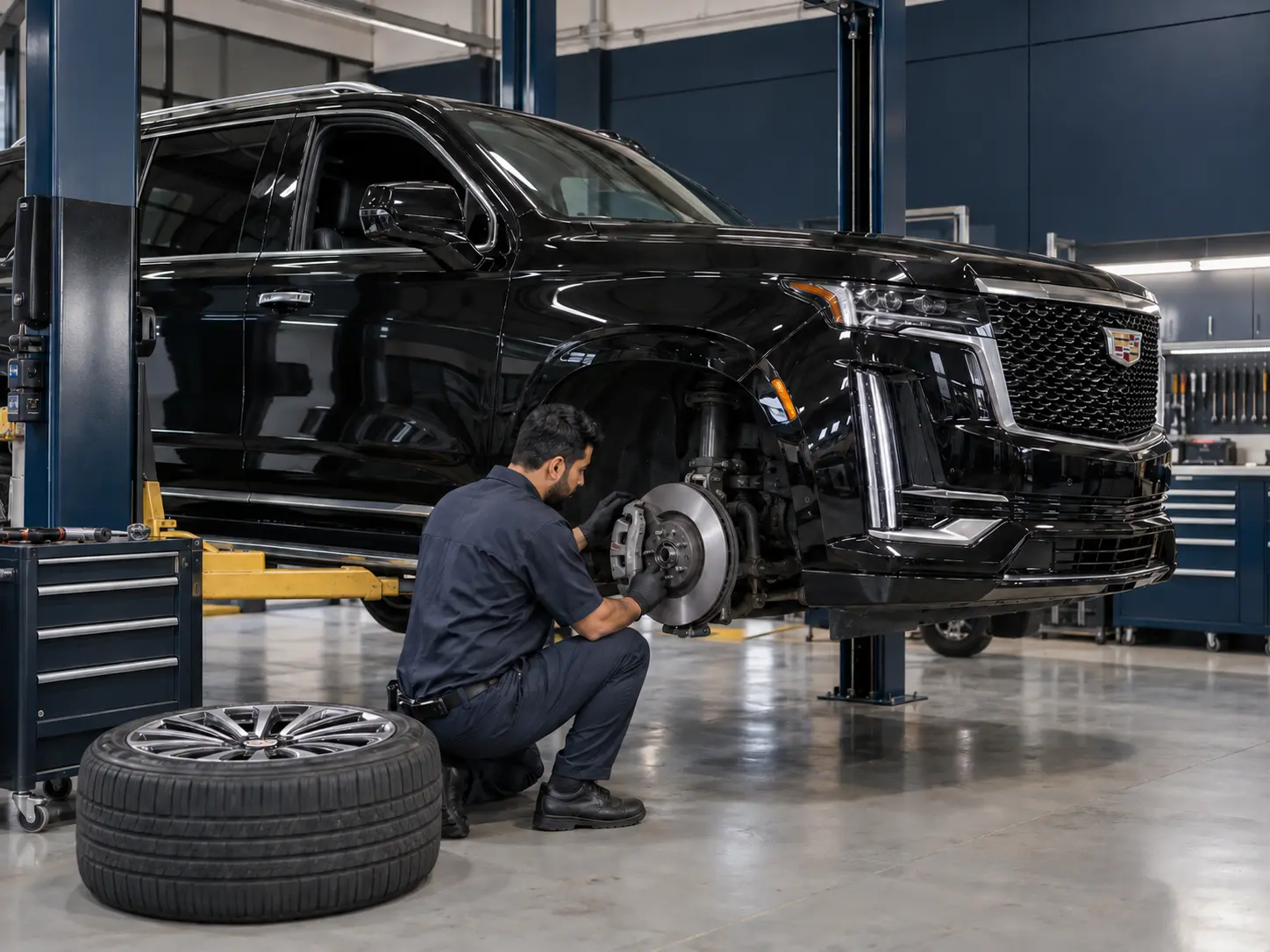
A brake warning does not always mean every component needs replacement. We inspect the complete system, identify the affected axle or circuit, and recommend work that matches the measured condition.
We measure remaining pad material, disc thickness, surface condition, runout, and wear on both sides. Depending on the findings, the correct scope may be pads only, pads with discs, or additional hub cleaning and hardware.
A sticking caliper, damaged hose, fluid leak, or contaminated fluid can change pedal feel and braking balance. Repairs can include caliper service, component replacement, fluid bleeding, and a final leak and pressure check.
Cadillac brake systems may use wheel-speed sensors, electronic parking brake motors, stability-control inputs, and control modules. We test the fault rather than replacing parts from a warning light alone.
Brake pad material and disc specification should suit the Cadillac model, wheel package, driving conditions, and expected use. An Escalade used for family transport or towing has different loading demands from a CT4 or CT5. We can compare genuine and suitable OEM-equivalent parts when available, while keeping the quoted option clear.
These planning ranges cover common Cadillac brake work. The final quote depends on model, axle, fitted brake package, measured wear, parts choice, and whether related hydraulic or electronic faults are present.
| Brake service | Estimated price | Typical scope | Main price variables |
|---|---|---|---|
| Brake system inspection | Free | Visual condition, pad and disc check, fluid and leak review, and pedal assessment | Advanced electronic diagnosis is quoted if required |
| Brake pads per axle | AED 650 to 1,250 | Suitable pads, installation, hardware review, and road check | Model, performance package, and parts choice |
| Pads and discs per axle | AED 1,800 to 3,800 | Pads, matching discs, installation, hub preparation, and final checks | Disc size, front or rear axle, and genuine or OEM-equivalent parts |
| Brake fluid service | AED 350 to 650 | Correct fluid, controlled bleeding, leak review, and pedal check | Fluid specification and bleeding procedure |
| Caliper repair or replacement | AED 650 to 2,600 | Affected caliper service or replacement, bleeding when required, and balance check | Caliper condition, availability, and electronic parking brake integration |
| ABS diagnosis | AED 250 to 450 | Code scan, live-data review, wiring and sensor checks | Intermittent faults and testing time |
| Wheel-speed sensor replacement | AED 550 to 1,300 | Confirmed sensor, installation, code clearing, and live-data verification | Sensor location, hub integration, and parts choice |
Prices are estimates in AED and may vary by Cadillac model, service scope, fault, and parts selection. Your written quote states labor, parts, VAT treatment, optional work, and exclusions before approval. Equivalent work can be priced 65% to 70% below agency pricing when scope and parts are compared like for like.
Squealing can come from worn pads, glazing, debris, or hardware. Grinding may indicate that friction material is exhausted. A vibration through the pedal or steering wheel can involve disc variation, hub condition, wheel runout, or looseness in connected suspension parts.
A soft pedal can point to air, fluid leakage, hose expansion, or a hydraulic fault. A hard pedal may involve brake-assist operation. Pulling under braking can be caused by uneven friction, a sticking caliper, tyre condition, alignment, or suspension movement. Diagnosis keeps the repair focused.
The process separates what is worn from what is faulty, then confirms that the approved repair produces a stable pedal and balanced braking.
Send the model, year, warning light, noise, and when the issue occurs.
We review pads, discs, hardware, calipers, hoses, fluid, and visible leaks.
Electronic warnings are scanned and confirmed with live data or circuit checks.
You receive the recommended scope, choices, timing, and estimated total.
After fitting, we check operation, pedal feel, warnings, and road behavior.
The best choice depends on measurements and damage, not only age. Our quote explains which parts can remain, which parts need service, and which parts must be replaced for safe operation.
A caliper may be serviceable when the housing is sound and the repair parts are available. Hardware can sometimes be cleaned or renewed without replacing the complete assembly. A fluid service can correct old or contaminated fluid, but it will not repair a leak or failing hydraulic component.
Electronic faults may come from wiring, connectors, sensor contamination, or a confirmed wheel-speed sensor. Proper testing prevents unnecessary module replacement.
Pads below their safe limit, discs below minimum thickness, cracked friction material, damaged hoses, leaking cylinders, or severely corroded components normally require replacement. Heat-damaged or seized parts can affect both sides of an axle and must be assessed together.
For matched braking, friction parts are normally renewed in axle pairs. The written scope will state whether discs, sensors, wear leads, hardware, fluid, or calibration are included.
Do not approve disc replacement based only on appearance. Ask for the thickness measurement, wear condition, or runout finding. Likewise, a dashboard warning needs a stored-code and live-data check. These checks help separate a mechanical brake problem from an ABS, stability-control, tyre, wheel, or suspension issue.
A useful brake estimate identifies the axle, the parts being fitted, the included labor, and the checks completed after installation. For pads and discs, it should state whether sensors, fitting hardware, hub cleaning, brake-fluid work, or electronic parking-brake procedures are included. For hydraulic work, it should identify the leaking or sticking component and confirm whether bleeding and a final leak check form part of the price.
Tell us when the symptom started, whether it changes with speed, whether the steering wheel or brake pedal vibrates, and which warning appears. Mention recent tyre, wheel, bearing, suspension, or brake work because those details can shorten diagnosis. A short video can help with a repeated noise, but a workshop inspection is still needed before safety-critical work is approved.
After repair, the pedal should feel consistent, the Cadillac should stop without an abnormal pull, and no related warning should remain without an explanation. We also check for fluid loss, wheel interference, unusual heat, and noise during a controlled road test when road testing is safe. If a separate ABS, tyre, or suspension fault remains, it is listed rather than being hidden inside the brake invoice.
Bring the wheel-lock key if the vehicle uses locking wheel bolts, and remove valuable items if pickup is arranged. If the pedal sinks, fluid is visible, braking is severely reduced, or a red warning stays on, do not drive the Cadillac to the workshop. Call us first so the safest transport option can be discussed.
These scenarios show how model, axle, and repair scope affect the total. They are planning estimates, not records of completed customer work.
Front pads and matching discs, installation, hub-surface preparation, hardware review, and final brake checks. Genuine or performance-grade parts can increase the total.
Rear brake pads, electronic parking-brake service procedure, brake-fluid replacement, controlled bleeding, and a road check. Discs and caliper work are excluded unless inspection finds a need.
ABS diagnosis, one confirmed wheel-speed sensor, installation, code clearing, and live wheel-speed verification. A hub assembly or wiring repair would change the quoted amount.
We handle brake concerns across popular Cadillac sedans, crossovers, and full-size SUVs. Exact parts and procedures vary by model year, engine, wheel size, performance package, and electronic parking-brake system.
Performance variants and larger factory wheels may use different discs, pads, and calipers. Imported or modified vehicles may also need VIN-based matching. We confirm the fitted specification before parts are ordered.
For wider Cadillac maintenance support, visit our Cadillac repair Dubai hub. If brake vibration is accompanied by clunks, uneven tyre wear, or unstable steering, our Cadillac suspension repair service may also be relevant.
A good handover includes practical guidance, not only new components. The first drives help the friction surfaces settle and give you a chance to notice any returning symptom early.
Use smooth, moderate stops during the initial bedding period. Avoid resting your foot on the pedal and avoid holding very hot brakes at a long stop when it is safe to do so.
Contact us if a warning returns, the pedal changes, new noise develops, or the vehicle pulls. Early feedback helps distinguish normal bedding from a fault that needs rechecking.
Tyres, wheel bearings, suspension joints, and alignment can influence braking feel. Keeping these items in good condition supports predictable stopping and even friction wear.
Brake fluid absorbs moisture over time, so its condition matters even when the pads still have life. Dubai heat and stop-and-go traffic can also raise brake temperatures. Regular inspections help detect taper wear, sticking hardware, cracked dust boots, fluid seepage, or disc damage before the repair becomes larger.
These answers cover the questions customers usually ask before arranging Cadillac brake repair in Dubai.
Common work ranges from about AED 650 to 1,250 for pads per axle and AED 1,800 to 3,800 for pads and discs per axle. Caliper, hydraulic, ABS, and performance-brake work can cost more. Inspection confirms the fitted system and required scope.
Yes, when the discs remain above minimum thickness, have an acceptable surface, and do not have excessive variation or damage. We measure the discs and explain whether pad-only service is suitable.
Possible causes include disc thickness variation, runout, hub contamination, uneven pad transfer, wheel or tyre runout, loose suspension parts, or wheel-bearing movement. The correct check covers more than the discs.
Normal hydraulic braking may remain, but anti-lock and stability functions can be limited. If braking feels different, another warning appears, or road conditions are difficult, stop and arrange assistance. We can scan and test the fault.
A soft or sinking pedal can involve air, a leak, degraded fluid, hose expansion, or a hydraulic component fault. Because stopping ability may be affected, avoid driving until the cause is assessed.
Yes. Depending on the model, rear brake work may require a controlled service mode, motor checks, or fault diagnosis. We confirm the system before moving the calipers.
Pad or pad-and-disc work can often be completed within a workshop visit when the correct parts are available. Hydraulic, caliper, ABS, or intermittent faults may take longer. Timing is confirmed with the quote.
Free pickup and delivery are available. If braking is unsafe, tell us clearly so suitable recovery can be arranged instead of normal driving or collection.
Call or WhatsApp +971 50 608 7150 with the Cadillac model and main symptom. Choose a workshop visit in Al Quoz 4 or ask about pickup and delivery. We can request further details later if needed.
Send your Cadillac model and the brake noise, warning, or pedal concern. We will arrange a free workshop inspection, explain the suitable repair choices, and provide a written estimate before work starts.