Slow engine cranking
The engine turns more slowly than normal, especially after standing. Battery state, terminal condition, temperature, starter demand and charging history all need context.
Starting and charging system checks
Book Cadillac battery testing and replacement in Dubai with a free workshop inspection, clear estimated prices and free pickup and delivery. We verify the battery and charging system before fitting a replacement.
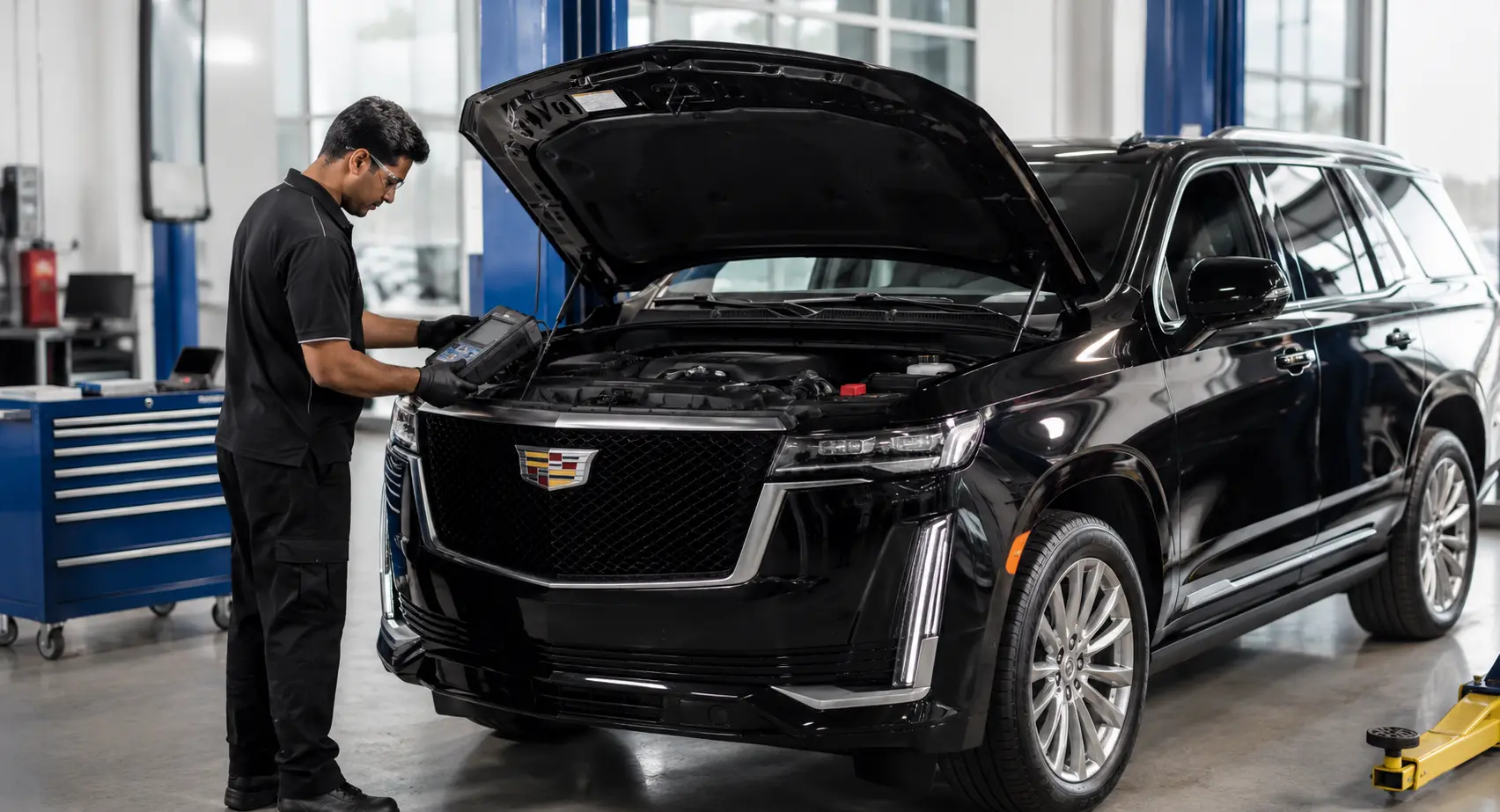
Test before replacing
A slow crank, clicking sound or battery warning can justify a battery inspection, but the symptom alone does not prove the battery is the only fault. A discharged battery may be healthy but undercharged. A new battery can also discharge again if the charging system, a loose connection or an excessive key-off electrical draw remains unresolved.
The first useful decision is whether the battery is discharged, internally weak, physically damaged or unsuitable for the vehicle. The second is whether another system caused the condition. Replacement should follow those checks, not precede them by default.
Describe the exact behaviour
The timing and sound of the fault can change the first checks. A vehicle that is completely silent presents a different path from one that cranks at normal speed but does not fire.
The engine turns more slowly than normal, especially after standing. Battery state, terminal condition, temperature, starter demand and charging history all need context.
Repeated clicking often accompanies low available voltage, but terminal contact and cable condition should be checked before a battery is condemned.
No visible electrical response can involve a deeply discharged battery, a connection, main fuse, power-distribution issue or access and key-related conditions.
A successful boost confirms that extra electrical support changed the outcome. It does not identify why the stored battery charge was insufficient.
A battery or charging warning while the engine runs can indicate a generation or control problem. Measure system output and review relevant fault information.
A battery that repeatedly goes flat may be ageing, undercharged, connected poorly or supporting a vehicle with excessive key-off draw.
Estimated battery prices
Use these estimated Dubai ranges to plan the visit. The written quotation depends on the model, battery group and technology, access, power-management requirements and the result of the starting and charging checks.
| Service | Estimated price | What the estimate covers |
|---|---|---|
| Workshop battery inspection | Free | Initial battery, starting and visible connection checks at our Al Quoz 4 workshop. |
| Standard battery replacement | AED 550–1,050 | Suitable battery, removal, fitting, terminal preparation and basic charging check. |
| AGM battery replacement | AED 850–1,450 | Vehicle-matched AGM battery, installation and applicable battery registration or reset. |
| Auxiliary battery replacement | AED 400–950 | Suitable auxiliary battery and installation, subject to model and access. |
| Starting or charging diagnosis | AED 250–650 | Targeted battery, alternator, starter-circuit or parasitic-draw checks for the reported symptom. |
Send the Cadillac model and describe the starting problem or dashboard warning. We can request the VIN later when exact battery matching requires it.
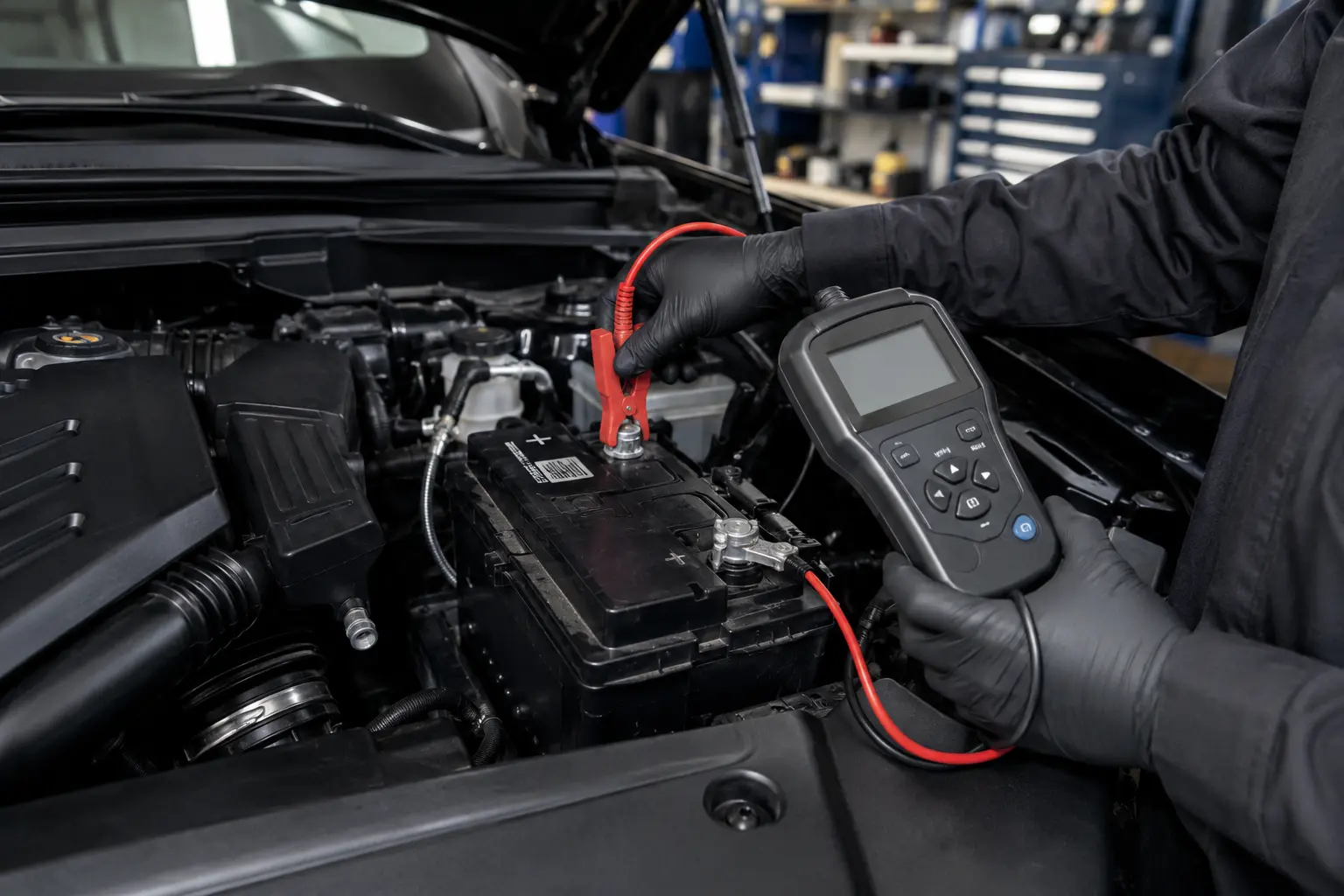
Battery test results
The test route depends on the condition in which the vehicle arrives. A deeply discharged battery cannot always be judged by one immediate reading. It may need controlled charging before a repeat test produces a useful result. Physical swelling, leakage, heat damage or a damaged case changes that approach.
A printout or tester message is not the whole diagnosis when the vehicle’s condition points elsewhere. Battery age, vehicle history, state of charge and connection quality provide necessary context.
Fitment is more than physical size
The battery must fit the tray, terminal orientation and hold-down arrangement. It must also provide the capacity and starting performance appropriate to the vehicle. Where the Cadillac specification calls for AGM or another battery construction, replacing it with a cheaper but unsuitable type can affect durability and power-management behaviour.
Model names such as Escalade, XT4, XT5, XT6, CT4, CT5, ATS, CTS and XTS span different years, engines and electrical layouts. A parts catalogue match should be checked against the actual vehicle. Imported specifications require extra care because a familiar model badge does not guarantee an identical battery arrangement.
Availability and brand choice can change. We therefore confirm the proposed battery and applicable supplier terms for the specific visit rather than promising one product on every page. If a battery is customer-supplied, compatibility and physical condition need to be reviewed before installation.
Controlled replacement
We note when the fault occurs, whether a boost was used, how long the vehicle stood and which messages appeared.
Voltage, battery state and connection condition are assessed. The battery may need charging before a fair retest.
The battery specification and fitment are checked against the exact vehicle before removal begins.
The removal route, retained settings and electrical support requirements are considered for that vehicle. One procedure does not suit every Cadillac.
Connections and the hold-down are completed correctly. A battery must not be left able to move in the tray.
Starting, charging and relevant power-management information are checked. Unrelated faults are reported separately.
Vehicle-dependent electronic steps
Some vehicles use battery-management information that may need a reset, registration or relearn after replacement. That does not mean every Cadillac requires the same scan-tool function. The procedure depends on the vehicle architecture, battery type and available service information.
Low voltage can also create several stored faults or temporary messages across modules. Those records require interpretation rather than an assumption that multiple parts failed. Once power supply is stable, check the relevant systems again and distinguish persistent faults from records created during the voltage event.
Radio presets, window functions, steering information or other learned settings can behave differently after power is disconnected. The workshop should consider appropriate support and post-installation checks. A promise that no setting will ever change would not be honest across every model and condition.
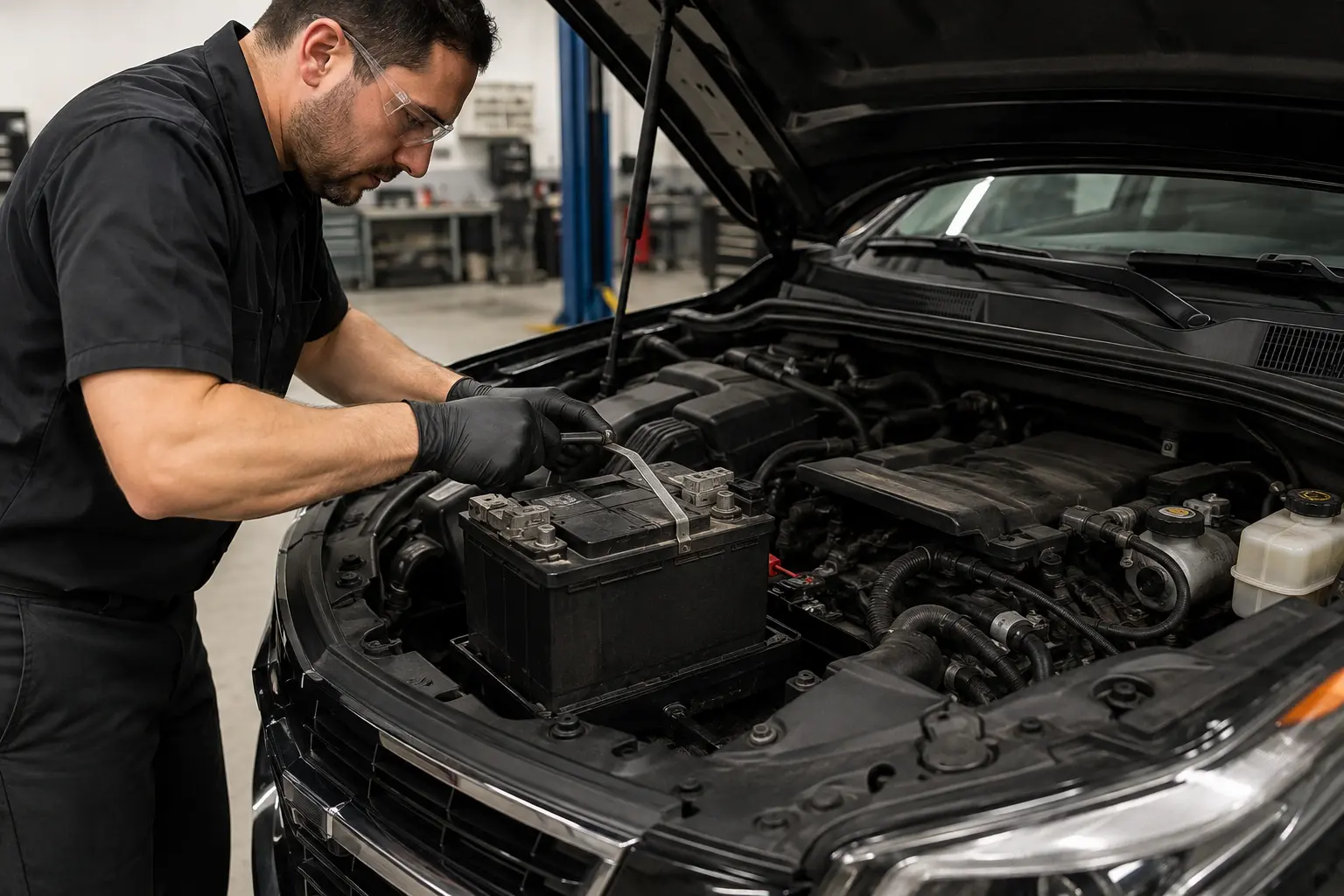
Different battery-related services
This page owns the main vehicle battery replacement intent. It does not treat every small battery or high-voltage component as the same service.
Supports starting, control units and vehicle electrical loads. The precise testing, fitment and power-management steps follow the identified Cadillac.
A small replaceable cell inside the remote. A weak key-fob battery can produce access or key warnings but is not the main vehicle battery.
Some vehicle architectures use an additional low-voltage battery for specific functions. Location and replacement procedure must be verified.
Hybrid and electric propulsion batteries require a different safety, isolation and diagnostic route. A routine starter-battery appointment does not cover them.
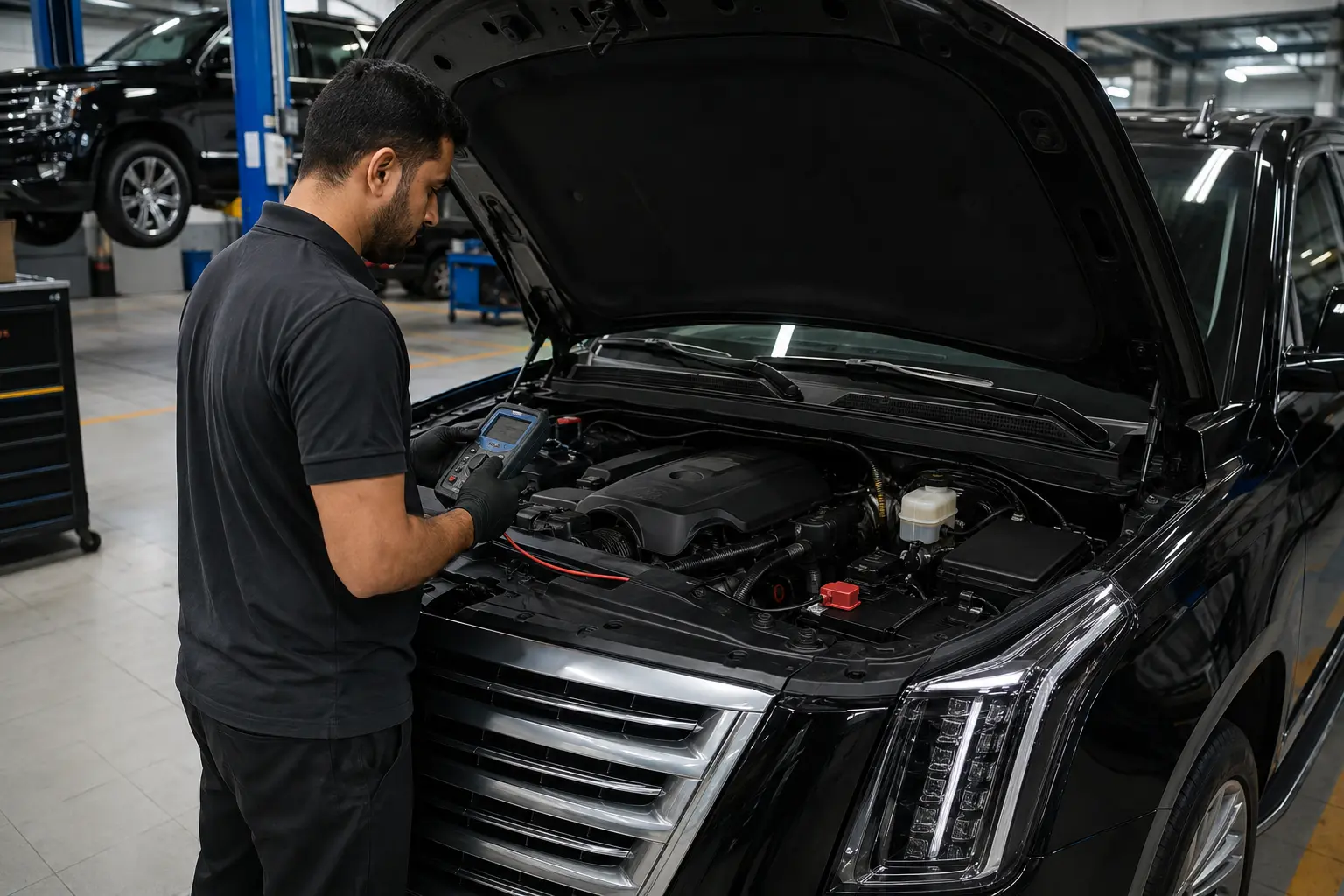
What changes the estimate
The battery type, capacity, location, access, supplier availability and any required electronic procedure can change the estimate. A vehicle that arrives with stable power and an accessible battery differs from one that is locked, deeply discharged or carrying several voltage-related faults.
The estimate should separate the selected battery, fitting work and any additional diagnosis. Supplier warranty terms can vary by product and can include testing, installation or usage conditions. Ask for the terms applicable to the chosen battery rather than relying on a general promise.
We do not advertise an invented percentage discount. The useful comparison is the exact battery proposed, its specification, the work included and what happens if the charging system or key-off draw needs further testing.
Battery life is not measured by age alone
Age can support a decision, but it cannot replace testing. A newer battery can fail after discharge or charging trouble, while an older unit may still pass the checks relevant to the complaint.
Repeated starts followed by brief journeys can leave the battery below a full state of charge. The test should consider state of charge before judging capacity, because a discharged battery and a failed battery are not the same condition.
A car left unused can discharge through normal standby systems, a battery already in poor condition or an abnormal draw. If the replacement also goes flat, repeated battery fitting will not locate the underlying cause.
Heat affects battery life and can expose weakness, but it does not prove every slow start is a battery fault. Terminal condition, cable resistance, starter demand and charging performance remain part of the picture.
Record what happened before and after the jump-start. Warning messages may reflect the voltage event, an interrupted system state or a separate fault. Review them again once the electrical supply has stabilised.
Avoid disconnecting the battery merely to clear a warning. Take a photo of the message, note whether the engine cranks slowly or not at all and tell us if lights were left on, the car was stored or another battery was recently installed. If there is heat, smoke, leakage, a swollen case or a strong unusual smell, stop attempting to start the vehicle and arrange safe assessment.
Bring any previous battery invoice when available. Its specification, installation date and warranty terms can save guesswork. Warranty is assessed under the supplier’s conditions and does not automatically cover discharge caused by vehicle use, a charging defect or an electrical draw.
If roadside assistance has already tested or boosted the car, share the readings and whether the engine continued running. Those details can avoid repeating earlier checks, although workshop testing still needs to confirm the condition under controlled circumstances. Also mention whether the doors, tailgate or remote access behaved differently, since a deeply discharged vehicle can present access problems before ordinary testing begins.
After fitting
The old battery condition, installed specification and fitting date should be recorded. The outgoing unit is handled through an appropriate battery disposal or supplier-return route rather than placed with ordinary waste. If the case is leaking or damaged, handling precautions come before routine removal.
After handover, monitor starting speed and any message that returns. A Cadillac that again needs a boost shortly after a confirmed replacement deserves charging or key-off draw diagnosis. It should not simply receive another battery. Tell the workshop how long the vehicle was parked, whether an accessory was left connected and whether the warning appears during cranking or while driving.
Battery type, capacity, installation date and supplier terms
Secure mounting, clean connections, normal starting and relevant messages
Repeated discharge, changing light brightness, heat or charging warnings
Arrange assessment before the stored charge falls far enough to strand the vehicle
Typical complete quotations
These illustrative quotations show typical complete scopes, not customer records. The final amount depends on the fitted battery, access, vehicle condition and whether another charging or electrical repair is required.
Example quotation 01
AGM starter battery supplied and fitted, terminals checked, charging output tested and applicable battery reset completed.
Estimated total: AED 980
Example quotation 02
Vehicle-matched AGM battery replacement with controlled installation, connection inspection and post-fit starting and charging checks.
Estimated total: AED 1,250
Example quotation 03
Main battery replacement after a free workshop inspection, including fitting, accessible terminal preparation and final electrical verification.
Estimated total: AED 920
Practical answers
Send the Cadillac model and describe the warning or starting problem. That is enough to begin.
An initial reading is possible, but a deeply discharged battery may need controlled charging and a repeat test before its condition can be judged fairly.
No. It shows that additional electrical support helped the vehicle start. The battery, charging system, connections and reason for discharge still need to be checked.
Ask with the key type and warning. The remote cell is a separate small-battery service and should not be confused with the main vehicle battery.
That depends on the model, year and power-management system. The procedure is confirmed against the vehicle rather than promised universally.
Possible reasons include limited charging, a charging-system fault, poor connections, excessive key-off draw or vehicle usage that does not replenish the battery. It needs measurement.
The workshop can review the proposed battery before fitting. Correct type, output, dimensions, terminal layout, age and physical condition should be established first.
Battery access, state of charge, test requirements, retained-power needs and electronic checks change the time. Share the Cadillac model and the current starting problem for a practical estimate.
Start with a battery check
Tell us whether the engine cranks, whether a boost was used, how long the car stood and which dashboard message appeared. If weak cooling or blower behavior appears with the voltage problem, continue with the Cadillac AC repair checks.