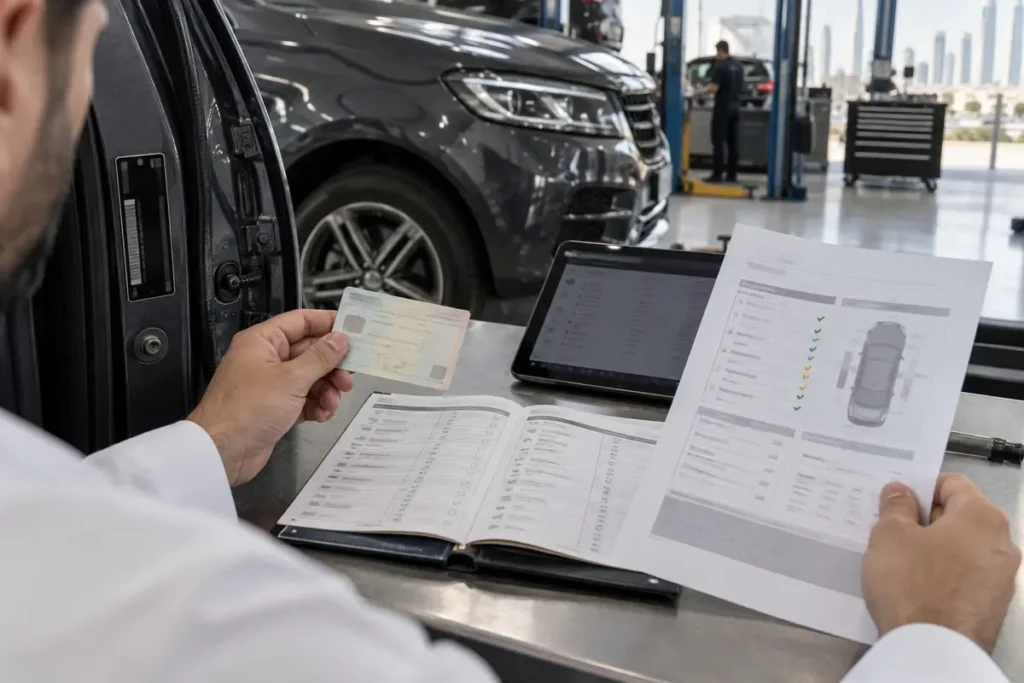
The paint shines. The cabin smells clean. The seller says the car has “no issues,” and the price feels almost too good. That last part should slow you down. A used luxury car can hide a gearbox fault, water-damaged control module, repaired chassis, overdue air suspension work, or a service gap that turns a bargain into a repair budget.
Before you pay
When buying a used luxury car in the UAE, verify the VIN, ownership documents, GCC or import status, accident history, mileage and service records. Then inspect the body, engine, transmission, suspension, brakes, tires, AC and electronic systems. Finish with a cold start, full diagnostic scan, lift inspection and road test. An independent used luxury car inspection in the UAE should happen before a nonrefundable deposit or ownership transfer.
This guide gives you a method, not a magic checklist. The goal isn’t to find a car with zero wear. That car probably doesn’t exist. The goal is to know what you’re buying, what it needs, and what the first year may cost.
Used Luxury Car Buying Checklist
Start here if the viewing is happening today. Save the deeper checks for the workshop, but don’t skip the identity and document checks at the seller’s location.
| Area | What to verify | Reason to pause | Next move |
|---|---|---|---|
| Identity | VIN, chassis stamping and Mulkiya | Any mismatch or altered plate | Stop until the identity is verified |
| Origin | GCC specification or import history | Missing export, auction or repair records | Request documents and inspect the structure |
| History | Accidents, service invoices and recorded mileage | Dates or mileage do not agree | Investigate before discussing price |
| Mechanical | Cold start, fluids, leaks and scan data | Knocking, smoke, overheating or cleared codes | Run directed tests |
| Drivetrain | Engagement, shifts, transfer case and differentials | Delay, shudder, slipping or clunks | Get a transmission diagnosis |
| Chassis | Paint readings, welds, rails and mounting points | Structural repair or missing safety parts | Do not rely on an RTA pass alone |
| Running gear | Suspension, steering, brakes and tires | Sagging, pull, vibration or uneven wear | Price the complete repair |
| Paperwork | Seller identity, finance, fines and transfer status | Unresolved loan, lien or ownership issue | Do not release payment |
Set the Real Budget Before You Inspect the Car
The asking price gets all the attention. It shouldn’t. The useful number is the cost of reaching a condition you can accept.
Asking price + immediate repairs + overdue maintenance + first-year running costs = the real purchase cost.
Suppose two cars are for sale. One costs AED 8,000 less but needs tires, a major service, control-arm bushes and an auxiliary battery. The other has invoices showing those jobs were completed. The “cheaper” car may cost more before you’ve driven it for a month. That isn’t bad luck. It’s incomplete math.
Pay now
Purchase, registration, insurance, inspection and ownership transfer.
Repair soon
Safety faults, leaks, tires, brakes, cooling faults and warning messages.
Plan for later
Age-based service, cosmetic work and components that are worn but still serviceable.
Your repair reserve should reflect the model, engine, mileage and equipment. Air suspension, active anti-roll systems, rear steering, carbon-ceramic brakes and complex driver-assistance hardware change the risk. A generic percentage can’t account for that.
Check GCC Specification and Import History
A GCC-specification car isn’t automatically sound, and an imported car isn’t automatically a mistake. The records decide. The inspection confirms.
How to verify the car’s origin
- Decode the VIN and compare it with the physical chassis number.
- Review the original sales or import documents.
- Check manufacturer and door-jamb labels.
- Compare instrument, lighting and software configuration with the claimed market.
- Ask for auction photographs or export records when they exist.
Why does this matter? An imported car may have a clean repair and complete history. Or it may have arrived after flood exposure or a collision. For water-damaged vehicles, review flood repair costs and when to walk away before treating a low asking price as a saving. You can’t tell from the country label alone. You need the history, paint readings, chassis inspection and diagnostic scan together.
When an imported car can still make sense
Consider it when the identity is clear, previous damage is documented, safety systems are present, repairs can be measured, insurance is available and the price accounts for resale and parts differences. If the seller becomes vague each time you ask for records, that’s your answer.
Verify the VIN, Mileage and Vehicle History
Match the identity in several places
Compare the VIN on the Mulkiya with the windshield plate, door label and chassis stamping. Service invoices and diagnostic records should refer to the same car. One typo can happen. Several conflicts need an explanation before money changes hands.
The same applies to mileage. Compare the dashboard with dated invoices, inspection records, tire dates, prior listings and mileage stored in available control modules.
Look for mileage contradictions
A clean steering wheel doesn’t prove low mileage. Trim can be replaced. What matters is the pattern. A car showing 42,000 km with invoices at 76,000 km has a problem. A driver’s seat with wear at the bolster may simply reflect short trips. Treat physical wear as a clue, then confirm it through records and electronic data.
Check accidents, finance and ownership status
Use available government channels to review recorded accidents and traffic information. Ask the seller to clear outstanding finance, liens and fines before transfer. Insurance should be arranged for the buyer as required for the transaction. Procedures can change, so confirm current requirements with the relevant traffic authority before attending the transfer center.
Read the Service History Like a Technician
A stamped booklet is useful. Invoices are better. They show the date, mileage, parts, fluid specifications and actual work. Vague entries such as “full service” tell you very little.
Compare age and mileage requirements
A low-mileage car can still be overdue. Brake fluid, coolant, rubber parts, tires and batteries age even when the odometer barely moves. A high-mileage highway car may look tidy but be due for a transmission service, cooling work or suspension renewal. Both situations need a different budget.
- Engine oil and filter history
- Transmission fluid and filter or pan service
- Coolant and brake-fluid replacement
- Spark plugs, belts and filters
- Differential and transfer-case fluids
- Battery replacement and registration
- Recall and software campaign records
- Major engine, gearbox or suspension repairs
Inspect Paint, Panels and Chassis Repair
Walk around slowly
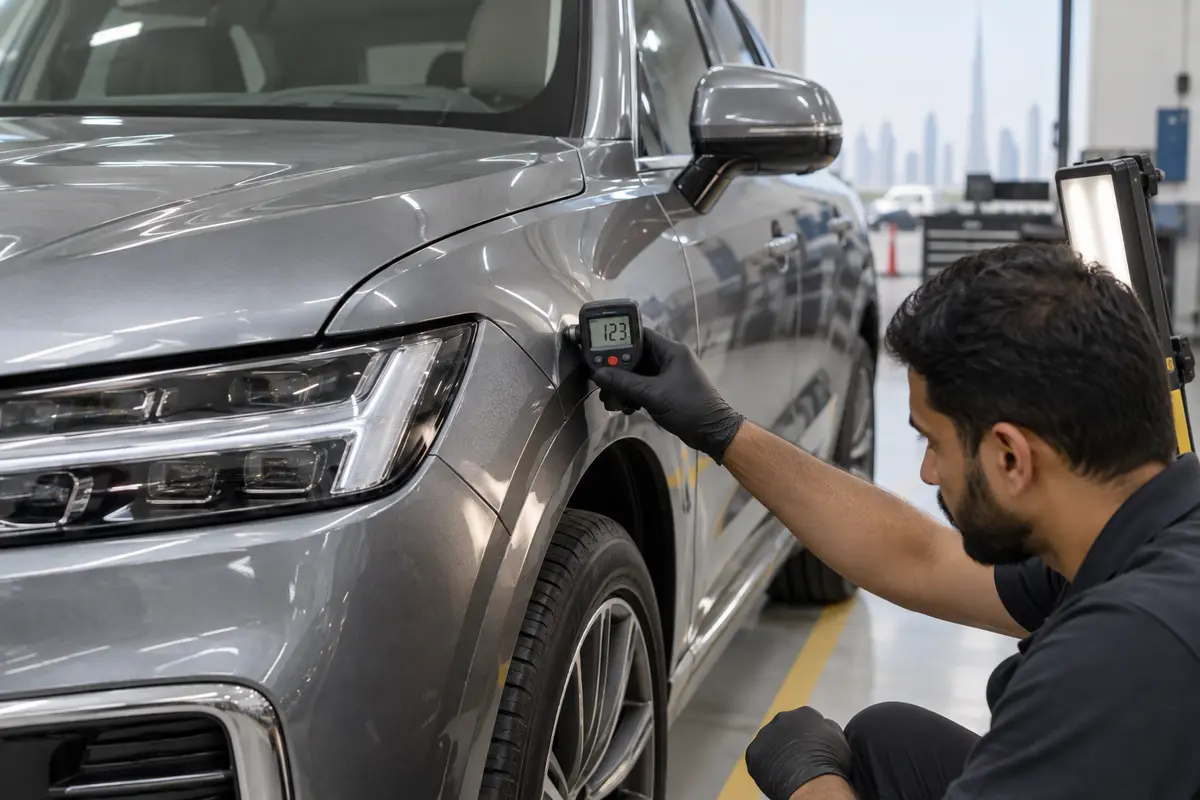
View the paint from more than one angle. Check panel gaps, overspray, tape lines, fastener marks and sealant patterns. Compare glass production dates. A replaced bumper isn’t the same risk as a repaired pillar or chassis rail.
A paint thickness gauge adds evidence, but one number proves little. Read multiple points on each panel and compare the pattern. Aluminum, steel, composite panels and factory processes can produce different readings.
Check structural and safety areas
Inspect chassis rails, crumple zones, pillars, floor sections and suspension mounting points. Look for non-factory welds, distorted seams and fresh sealant. The SRS scan should agree with the physical condition of the airbags and seat-belt pretensioners.
An RTA technical test serves a regulatory purpose. It should not be treated as a substitute for a detailed pre-purchase inspection that assesses repair quality, remaining wear, stored faults and future cost.
Check for water exposure
Lift the carpet edges and inspect seat rails, wiring connectors, the trunk well and low-mounted modules. Watch for corrosion, sediment, damp insulation, moisture in lamps or a musty smell that returns after the AC starts. Water-damaged electronics can behave perfectly during a short viewing and fail later. Annoying? Yes. Expensive? Often.
Start the Mechanical Inspection With a Cold Engine
Begin with a cold start
Ask the seller not to start the car before you arrive. A cold start can expose extended cranking, chain noise, valve-train noise, smoke and unstable idle that fade as the engine warms.
Check fluids without trusting color alone
Inspect oil level, coolant level, visible contamination and leak paths. Look around the valve covers, oil-filter housing, cooling pipes, radiator, water pump area, transmission housing and differentials. Freshly cleaned surfaces aren’t proof of a leak, but they deserve another look after the road test.
Scan all available control modules
A basic OBD reader may show powertrain codes. A luxury car diagnostic inspection should go further and access the transmission, body, chassis, safety, climate and driver-assistance modules supported by the vehicle.
- Current, stored and pending faults
- Readiness-monitor status
- Misfire counters and fuel corrections
- Battery voltage and energy-management data
- Transmission adaptation values
- Air-suspension height data
- Module communication faults
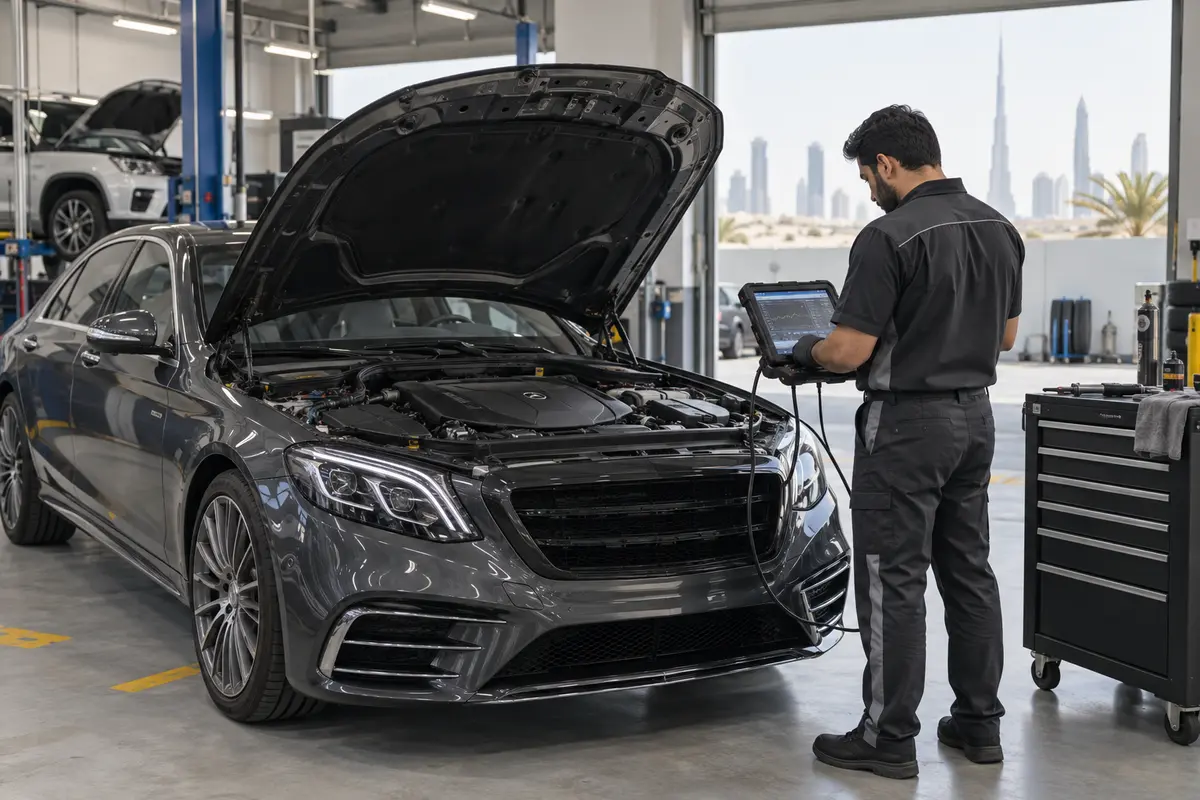
Recently cleared codes aren’t an automatic rejection. Ask why they were cleared, check readiness monitors and repeat the scan after the road test. No explanation plus incomplete monitors is a reason to delay the purchase.
Test the Transmission and Drivetrain
With the brake applied, select Drive and Reverse. Engagement should be consistent. Note any long delay, heavy clunk or shudder. During the road test, use light and moderate throttle, low-speed traffic, manual mode where available and parking maneuvers.
Watch for flare between shifts, slipping, vibration, harsh downshifts or warning messages. On all-wheel-drive cars, include the transfer case, differentials, driveshafts and CV joints. A fluid change cannot repair every internal fault, so don’t accept “it only needs oil” without diagnosis.
If the inspection finds abnormal behavior, arrange a focused transmission diagnosis in Dubai before negotiating.
Put the Car on a Lift
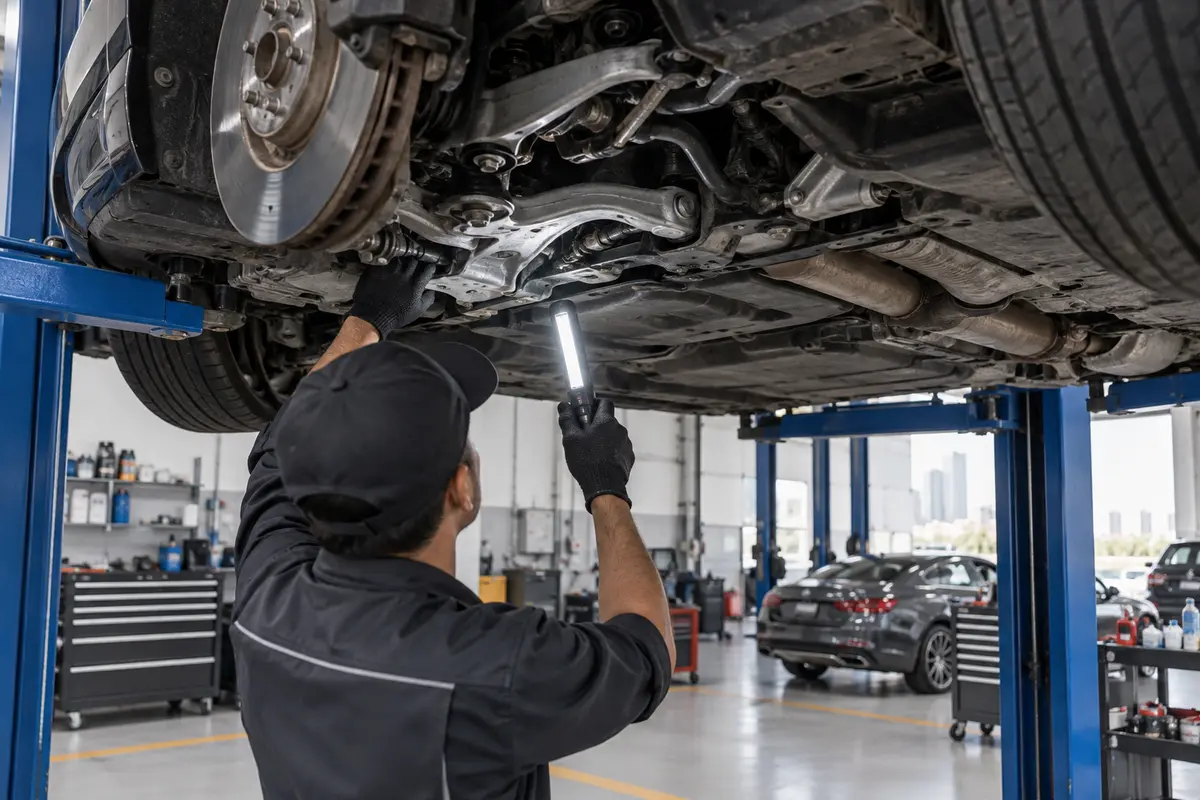
The showroom floor hides the lower half of the story. A lift inspection can reveal fluid leaks, damaged covers, bent arms, tired bushes, corrosion, poor repairs and contact damage.
Check brake hoses, discs, pads, wheel bearings, steering joints, dampers, air springs, exhaust mounts and underbody panels. On air-suspension cars, compare ride height and listen for a compressor that runs too often.
Tire wear is evidence too. Feathering, cupping or heavy wear on one edge can point to pressure, alignment, worn suspension or chassis geometry. Four matching tires with similar production dates are easier to evaluate than a mixed set fitted just before sale.
For measured follow-up, see our car suspension inspection and repair service.
Test Every Cabin and Electronic Function
This part feels fussy until one seat module, camera or infotainment screen stops working. Then it feels sensible.
- Windows, locks, mirrors and both keys
- Seat movement, memory, heating and ventilation
- Sunroof, shades and powered tailgate
- Infotainment, audio, navigation and phone connection
- Cameras, parking sensors and driver-assistance systems
- Digital displays and warning-light self-test
- Electronic parking brake and drive modes
Run the AC long enough to judge it
Test every zone, vent mode and blower speed. Cooling should remain stable at idle and during the road test. Listen for compressor, fan or blend-door noise. A quick burst of cold air isn’t a complete AC test.
Weak cooling can involve refrigerant loss, compressor control, condenser airflow, sensors or internal air-distribution faults. If the cabin doesn’t cool evenly, book a directed car AC diagnosis rather than assuming it only needs gas.
Use a Structured Road Test
Don’t spend the entire test drive admiring the acceleration. Tempting, I know. Use the drive to create repeatable conditions.
- Before moving: watch the warning-light self-test, idle, brake pedal and gear engagement.
- At low speed: listen for steering noise, suspension knocks, drivetrain clunks and brake noise.
- Under load: check engine response, boost delivery where applicable and transmission shifts.
- At road speed: assess tracking, vibration, wind noise and wheel-bearing sound.
- After the drive: rescan the modules and recheck for leaks, odor, fan operation or coolant pressure concerns.
Check the Seller and Documents Before Paying
Ask direct questions
- Why are you selling the car?
- How long have you owned it?
- Has it had engine, transmission or accident repair?
- Does any fault appear only sometimes?
- Are both keys and service invoices available?
- Is finance outstanding?
- Can the warranty or service contract transfer?
- Can we arrange an independent inspection before a deposit?
A seller may not know every detail. That’s possible. Refusing inspection is different.
Verify the transfer documents
Check the seller’s identity, Mulkiya, VIN, insurance arrangements, finance clearance, fines and current transfer requirements. Don’t assume insurance automatically moves to the buyer. Confirm the process with the traffic authority and insurer that apply to the transaction.
Dealer, Private Seller or Certified Pre-Owned
| Source | Possible advantage | Main uncertainty | Inspection approach |
|---|---|---|---|
| Private seller | Direct access to the owner and records | Limited recourse after sale | Use an independent inspection and written terms |
| Used-car dealer | Choice and transaction support | History may still be incomplete | Verify claims outside the selling business |
| Certified pre-owned program | Defined checks or warranty terms | Higher price and coverage exclusions | Read what the certification actually covers |
Used Luxury Car Inspection Cost in the UAE
A useful inspection price depends on access, vehicle systems and test depth. For Auto Repair UAE, a workshop-based used luxury car inspection is typically estimated at AED 450 to AED 950. The lower end suits a mechanical, electronic and road-test assessment on a conventional model. Cars with air suspension, several control networks, performance systems, suspected accident repair or directed engine tests may require more work.
| Inspection level | Typical scope | Estimated price |
|---|---|---|
| Core pre-purchase check | Visual mechanical check, diagnostic scan, road test and condition summary | AED 450 to AED 600 |
| Extended luxury-car check | Core check plus lift inspection, paint readings, system-level testing and repair priorities | AED 650 to AED 950 |
| Directed tests | Compression, leak-down, cooling-pressure, battery or deeper transmission testing when justified | Quoted after the initial findings |
Prices vary by model, condition, access and required test time. Government technical testing, external history-report fees, dismantling and repairs are not included unless stated in the written estimate.
Turn the Inspection Report Into a Decision
A report should do more than list faults. Divide the findings into five groups:
- Safety or legal problems
- Immediate mechanical repairs
- Overdue maintenance
- Items to monitor
- Cosmetic choices
Now recalculate the deal. Add the required repairs and overdue maintenance to the asking price. Compare that adjusted cost with another car that already has the work documented. Sometimes the inspected car still wins. Sometimes the report saves you from a very polished mistake.
When Not to Buy a Used Luxury Car
Walking away isn’t failure. It’s one of the three correct outcomes of an inspection.
- The VIN, chassis or ownership documents do not match.
- Finance, liens or transfer restrictions cannot be cleared.
- The seller refuses an independent inspection.
- Structural repair affects a pillar, rail, crumple zone or mounting point.
- Airbags or pretensioners are missing, bypassed or faulted.
- Water exposure has affected wiring or control modules.
- The engine overheats, knocks or shows unresolved oil-pressure concerns.
- The transmission slips, loses drive or has unexplained adaptation faults.
- Mileage records conflict without a credible explanation.
- The repair total breaks your first-year budget.
Buy, Negotiate or Walk Away
Buy
History is verifiable, ownership is clear, no unresolved safety fault exists, and the adjusted cost fits your budget.
Negotiate
Faults are measurable, repairable and priced. Use the written findings to agree on a lower price or completed work.
Walk away
Identity, legal status, structure, safety systems, overheating, water damage or total cost remains uncertain.
Used Luxury Car Inspection in Al Quoz 4
Auto Repair UAE can complete a pre-purchase car inspection in Dubai before you complete the purchase. The assessment can cover diagnostic scanning, mechanical condition, underbody components, paint and accident clues, road behavior and repair priorities. You receive findings you can use to decide whether to buy, negotiate or leave the deal.
Send the make, model, year, mileage, seller location and any known warning messages before booking. That helps define the inspection scope and price.
Inspect the Car Before the Deal Becomes Yours
Arrange a used luxury car inspection at our workshop in Al Quoz 4. We’ll confirm the scope before the inspection and explain the findings before you make the purchase decision.
How the Powertrain Changes a Used Luxury Car Inspection
A luxury-car inspection should change with the vehicle, because a petrol sedan, plug-in hybrid and battery-electric model do not carry the same risks. On a petrol or diesel car, the inspection should review cold-start behavior, oil and coolant condition, fuel trims, misfire counters, turbocharger response where fitted, and evidence of overheating. A plug-in hybrid adds a high-voltage battery, inverter, charging hardware, cooling circuits and the transition between electric and combustion power. The scan should cover every supported module, not only the engine computer. Battery-electric cars need a battery-health report when the manufacturer’s tools allow it, plus checks of charging performance, thermal management, isolation faults, underbody battery protection and software warnings. A dashboard with no warning light is not enough. Codes may have been cleared shortly before the viewing, and some faults return only after a drive cycle. Match scan data with the road test, service record and physical inspection.
Hybrid and electric systems
Confirm charging on the ports and cable available with the car. Review high-voltage battery condition, cooling performance, stored isolation faults and repairs near the battery enclosure. Ask whether the traction-battery warranty transfers and what conditions apply.
Air suspension and chassis systems
Measure ride height after the car has been parked and again after operation. Listen for a compressor that cycles often. Test adaptive dampers, rear steering, active anti-roll hardware and every drive mode. One warning can involve several linked control units.
Driver-assistance equipment
Check cameras, radar sensors, parking aids, lane functions and calibration records after windscreen, bumper or accident work. A replaced panel may look correct while a sensor remains misaligned or unavailable.
Which findings should change the deal?
Separate a maintenance item from an uncertain system failure. Worn tires, overdue fluids or brake pads can usually be measured and priced. Intermittent high-voltage faults, repeated overheating, air-suspension pressure loss, structural repair near sensor mounts or missing calibration records carry more uncertainty. Ask the workshop to state what was tested, what could not be tested and which diagnosis needs more time or dismantling. Then compare the repair estimate with the seller’s discount. If the price reduction covers only the visible fault but not the diagnostic uncertainty, the deal has not been adjusted enough. This matters in the UAE, where heat places extra demand on cooling systems, batteries and cabin AC. It does not prove a car is damaged, but it makes temperature-related evidence worth checking. If a seller will not allow the required scan, lift check or charging test, do not guess. Choose another car with a verifiable condition.
Key Takeaway
When buying a used luxury car in the UAE, don’t judge the deal by paint, mileage or asking price alone. Verify the car’s identity and history, inspect it cold, scan all supported modules, put it on a lift and complete a structured road test. Then add immediate repairs and overdue maintenance to the purchase price. That adjusted number is what you’re really paying. A proper used luxury car inspection in the UAE should leave you with one of three defensible choices: buy, negotiate or walk away.
Frequently Asked Questions
Is it worth buying a used luxury car in the UAE?
It can be, provided the history is verifiable, the inspection does not reveal unresolved safety or structural faults, and the first-year ownership cost fits your budget. Depreciation may reduce the purchase price, but parts, labor and complex systems still belong to the original vehicle class.
Should I buy a GCC-specification or imported luxury car?
Judge the individual car. A GCC-specification vehicle can still have poor maintenance or accident repair. An imported car can be viable when its history, repair quality, insurance eligibility and parts support are clear and reflected in the price.
How can I check accident history in the UAE?
Use the vehicle’s chassis number with available government accident-inquiry services, then compare the record with paint readings, panel condition, chassis inspection and seller documents. No single database should replace physical inspection.
How do I verify the mileage?
Compare the odometer with dated service invoices, inspection records, earlier listings and mileage stored in supported modules. Interior wear is only a clue. Records and electronic data carry more weight.
What should a pre-purchase inspection include?
Use our car inspection in Dubai checklist to plan the scope. It should cover identity, history, body and chassis clues, engine, transmission, drivetrain, suspension, steering, brakes, tires, electronics, AC, diagnostic data, underbody condition and a road test. Directed tests should be added when initial findings justify them.
How much does a used luxury car inspection cost in Dubai?
Our estimated workshop price is AED 450 to AED 950, depending on the model, systems, condition and test depth. Compression testing, dismantling, government testing and external reports may be separate.
Can I buy a car without service history?
You can, but the uncertainty must be priced. Use a deeper inspection, assume overdue age and mileage services until proven otherwise, and compare the adjusted cost with a car that has complete records.
Should I buy from a dealer or a private seller?
Either can work. A private seller may provide clearer ownership history. A dealer may simplify the transaction. In both cases, verify claims independently and put deposit conditions in writing.
What faults should make me walk away?
Identity conflicts, unresolved finance, structural damage, missing airbags, water-damaged electronics, overheating, serious transmission failure and unexplained mileage conflicts are strong reasons to stop.
Sources and Official Checks
- UAE Government service and registration guidance
- Abu Dhabi Police vehicle accident and certificate inquiry services
Service steps and document requirements can change. Confirm the current process with the authority responsible for the vehicle’s registration and transfer.