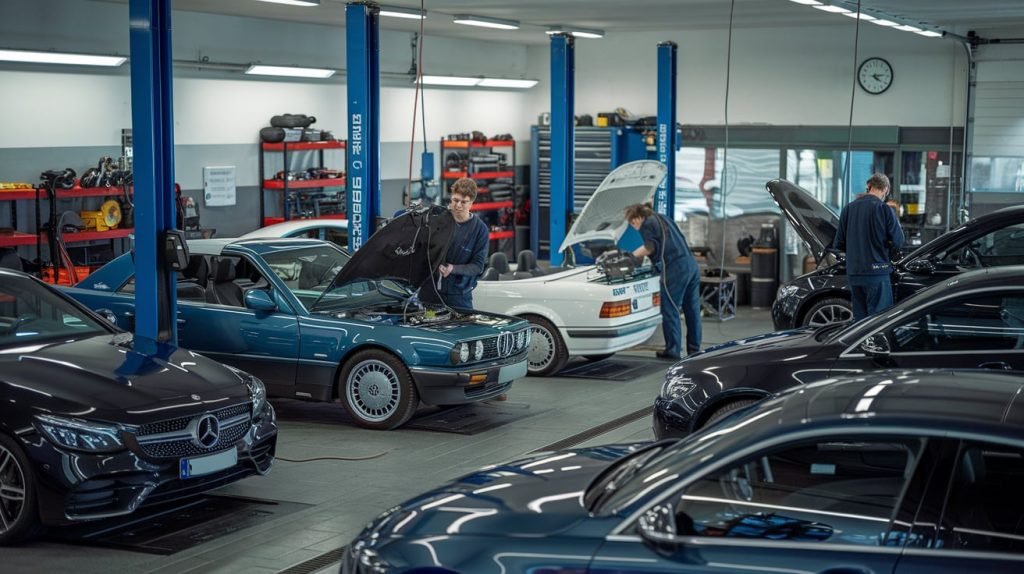
A German badge does not make every repair complicated, but guessing can make it expensive. The wrong oil approval, a generic scan that misses control-module data, an incomplete transmission service, or a battery replacement without the required registration can create problems that were not present before. Choosing a workshop is less about the sign above the door and more about the process behind the quote.
Choose a German car service in Dubai that identifies your vehicle by VIN, checks the manufacturer schedule and current condition, uses tools that can communicate with its installed systems, explains genuine and OEM-equivalent part choices, records measurements, and provides an itemized estimate before work. Avoid workshops that promise one universal service package for every BMW, Mercedes-Benz, Audi, Porsche, or Volkswagen. The correct plan depends on model, engine, gearbox, mileage, history, software, and use.
What Makes German Car Service Different
Integrated vehicle systems
German vehicles use the same basic principles as other cars, but their systems are often closely integrated. A low-voltage event may affect battery management, electronic steering, transmission control, driver assistance, comfort modules, and stored fault history.
Faults can travel
An oil leak may spread across undertrays and appear far from its source. An air-suspension complaint may involve a leak, compressor duty cycle, valve block, ride-height data, wiring, or calibration. The visible symptom is not always the failed part.
Specifications before parts
The answer is not to replace more components. It is to use the correct service information, test sequence, specifications, and tools. Brand familiarity helps a technician recognize model patterns without turning those patterns into assumptions.
How to Judge a German Car Workshop
Ask for evidence that can travel with the car. A scan report, inspection photos, fluid specification, alignment printout, battery test, measurements, and invoice make future decisions easier. “We checked everything” is not a useful record.
German Car Maintenance by System
Engine oil and filters
Use the exact manufacturer approval, viscosity permitted for the engine and climate, correct fill quantity, and a suitable filter. Resetting the service display is the final step, not proof that the service was completed correctly.
Cooling system
Inspect coolant condition, leaks, expansion tank, cap, pump, thermostat, radiator, hoses, fan operation, and temperature data. Do not mix coolant solely by color. Chemistry and approval matter.
Transmission and driveline
Identify the gearbox before choosing fluid and procedure. Fluid level can depend on temperature, engine state, selector sequence, and diagnostic data. Transfer cases and differentials may have separate schedules.
Brakes and stability systems
Measure pad and disc condition, inspect hoses and calipers, use the correct brake-fluid procedure, and check electronic parking-brake requirements. Warning lights require diagnosis, not just pad replacement.
Battery and charging
Match technology, capacity, size, polarity, venting, and electrical specification. Some vehicles require registration or coding so charging strategy reflects the replacement battery.
Suspension and steering
Inspect bushes, joints, arms, dampers, springs, air lines, ride-height data, wheels, tires, and alignment together. Replacing one worn part may require geometry measurement and calibration.
Service Schedule Versus Condition-Based Maintenance
A dashboard reminder is useful, but it does not replace the maintenance schedule. Some vehicles calculate service needs from time, mileage, fuel use, temperature, driving profile, or sensor data. Other items have fixed intervals. A used car may also have missing history, incorrect reset dates, or service entries completed without the specified work.
| Trigger | What it can tell you | What it cannot prove | Action |
|---|---|---|---|
| Time or mileage | A scheduled inspection or replacement is due | That every component will last until the interval | Follow the model schedule and inspect current condition |
| Dashboard service message | The vehicle has calculated or recorded a service event | That the reminder was set correctly after previous work | Compare with invoices and digital service history |
| Fault code | A monitored condition crossed a threshold | Which part must automatically be replaced | Use test plans, live data, and physical checks |
| Wear measurement | Remaining material, play, leakage, or performance | The cause of abnormal wear by itself | Correct the cause and record the baseline |
| Driver symptom | When and how the problem appears | Its source without diagnosis | Reproduce the symptom and measure the related system |
What a Good German Car Inspection Covers

- Confirm history. Mileage, previous invoices, repairs, modifications, warning lights, fluid use, and recent symptoms.
- Run a physical inspection. Leaks, tires, brakes, underbody, belts, hoses, mounts, suspension, and visible damage.
- Scan installed modules. Read current, stored, intermittent, communication, and low-voltage faults with freeze-frame data where available.
- Measure the suspect system. Pressure, voltage, current, temperature, vacuum, wear, play, fluid level, or adaptation values.
- Prioritize findings. Separate safety work, breakdown risks, maintenance due, monitoring items, and optional improvements.
- Verify after work. Clear only relevant faults, run required adaptations, road test, and confirm the original complaint is resolved.
German Car Service Costs in Dubai
These ranges help with planning. Actual prices depend on model, engine, fluid approval, part choice, access, fault depth, software procedures, and current condition. An itemized inspection should confirm the scope before work.
| Service | Estimated range | Normally considered | Possible extras |
|---|---|---|---|
| Oil and filter service | AED 650 to 1,450 | Approved oil, filter, basic checks, and service reset | Large capacity, specialist oil, leaks, or additional filters |
| Diagnostic assessment | AED 250 to 650 | Complaint review, scan, inspection, and directed testing | Intermittent faults, dismantling, programming, or extended measurement |
| Brake service | AED 900 to 4,500+ | Varies by axle, disc size, electronic procedures, and part level | Calipers, sensors, hoses, fluid, or performance brakes |
| Transmission service | AED 1,000 to 3,500+ | Correct fluid, filter or pan where applicable, level setting, and checks | Adaptation diagnosis, leaks, mounts, cooler, or internal repair |
| Battery replacement | AED 650 to 2,500+ | Correct battery type, fitment, testing, and registration where required | Auxiliary batteries, coding, charging faults, or access labor |
| Major scheduled service | AED 1,500 to 6,000+ | Model and mileage-specific fluids, filters, plugs, checks, and resets | Wear repairs and items not included in the scheduled scope |
Be careful with package prices that omit the vehicle specification. “Major service” is not a universal shopping basket. Ask which schedule items, approvals, quantities, tests, and exclusions apply to your VIN and mileage.
Genuine, OEM-Equivalent, or Aftermarket Parts
The logo on the box is only one part of the decision. The component must match the exact application, revision, material, electrical rating, calibration, and installation procedure. Genuine parts come through the vehicle brand’s supply chain. OEM-equivalent parts may come from a manufacturer that supplies similar systems but need application verification. Aftermarket quality ranges from capable to unsuitable.
Use genuine when integration risk is high
Security components, some control modules, trim-specific parts, complex sensors, software-linked units, and safety-related assemblies may justify the clearest traceability and compatibility.
Consider OEM-equivalent with evidence
Filters, ignition parts, belts, bearings, brake components, cooling parts, and suspension items may have established manufacturers. Confirm the exact number and specification rather than relying on brand reputation alone.
Avoid price-only selection
Incorrect rubber compound, sensor response, connector fit, friction material, fluid approval, or electronic behavior can create noise, warning lights, poor life, or repeat labor.
Ask the estimate to name the proposed part level before approval. If more than one option is suitable, compare expected use, traceability, availability, labor risk, and coverage. A low-cost part is poor value when replacement requires the same eight hours of access again.
Brand Differences That Change the Job
BMW and MINI
Condition-based service displays, battery registration, electronic parking brakes, xDrive transfer cases, cooling systems, and model-specific oil approvals require correct identification. A stored adaptation is evidence to interpret, not a reason to reset everything.
Mercedes-Benz
ASSYST service information, transmission variants, air suspension, auxiliary batteries, electronic steering, and model-specific fluid sheets can change the scope. Service letters such as A or B do not describe every additional time or mileage item.
Audi and Volkswagen
Engine codes, DSG variants, quattro or 4MOTION systems, electronic service history, timing components, and oil approvals matter. Two vehicles with the same badge and year can use different procedures.

Porsche
Performance brakes, cooling, PDK service, transfer cases, air suspension, tire specification, and model access affect cost and procedure. A sports-car layout can turn a small component into a larger labor job.
German EVs and plug-in hybrids
High-voltage isolation, trained personnel, battery cooling, charging faults, electric compressors, brake blending, software, and lift points require a different safety plan. Ordinary low-voltage service remains important.
Modified vehicles
Wheel size, suspension height, engine software, exhaust changes, wiring accessories, and nonstandard parts can alter diagnosis. Tell the workshop what changed, even when it seems unrelated.
Common Misdiagnoses on German Vehicles
- Replacing a component named in a fault code. The code describes what the control unit observed. Wiring, voltage, leaks, mechanical faults, software, and another system may have caused it.
- Calling every oil leak the visible gasket. Airflow and undertrays move fluid. Clean the area, inspect above it, and confirm the highest active source.
- Treating vibration as wheel balance alone. Tires, rims, hub fit, brakes, bearings, suspension, engine mounts, driveshafts, and driveline angles can produce different patterns.
- Refilling refrigerant without leak and pressure diagnosis. Charge by the specified type and weight after identifying why cooling declined.
- Changing transmission fluid without identifying the gearbox. Fluid, filter, pan, temperature, fill method, and adaptation checks vary.
- Replacing the main battery while ignoring an auxiliary battery or charging fault. Test the complete power-supply history and perform required registration.
- Resetting adaptations to chase a mechanical problem. A reset can remove useful evidence and create a poor learning state if the underlying fault remains.
What to Bring to the Workshop
Good information shortens diagnosis. Bring the registration card or VIN, current mileage, previous invoices, the date the symptom began, dashboard messages, and a note describing when it happens. A phone video can capture a noise or warning that disappears at the workshop. Mention recent battery replacement, tire work, accident repair, software updates, water exposure, jump-starting, towing, or modifications.
Do not clear fault codes before the visit unless safety requires another action. Do not top up every fluid before a leak inspection. The level, color, location, and rate of loss are clues. If the vehicle overheats, loses oil pressure, has a red brake warning, smells of fuel, develops unstable steering, or shows a high-voltage warning, stop and ask whether recovery is safer than driving.
When Not to Approve the Repair
Pause when the quote does not identify the failed condition, combines unrelated work without priorities, uses a generic fluid description, promises coding that the vehicle does not require, or recommends many modules after a low-voltage event without retesting. Also wait if a large mechanical repair is proposed without compression, pressure, leak, wear, or internal inspection evidence appropriate to the fault.
Second opinions are useful when the repair value is high, the diagnosis changes each visit, a transmission or engine replacement is proposed, a safety system requires calibration, or parts are being ordered before the fault is reproduced. A second opinion is not about distrusting every workshop. It is about matching the financial decision to the strength of the evidence.
A good estimate separates three decisions: what must be done for safety, what should be done to prevent a likely breakdown or added damage, and what can be monitored or scheduled later.
Dealer, Independent Specialist, or General Garage
| Workshop type | Can suit | Check carefully |
|---|---|---|
| Authorized dealer | Warranty work, recalls, brand campaigns, software access, new-car history, and brand-specific processes | Scope, price, appointment time, and whether every recommended item is currently required |
| Independent German-car specialist | Out-of-warranty maintenance, diagnostics, repair choices, and owners seeking brand familiarity with different pricing | Actual tool access, technician experience, service information, part traceability, and documentation |
| General repair workshop | Basic mechanical work when the team has the correct specification and tools for that vehicle | Whether complex network, programming, high-voltage, air-suspension, or transmission work is within its capability |
No category guarantees a correct diagnosis. Judge the specific workshop by evidence, equipment, training, communication, and the repair in front of you. For direct booking and the available repair scope, visit our German car repair workshop in Dubai. For broader multi-brand support, see our European car repair services in Dubai.
German Car Service Near Me in Dubai
“Near me” should mean more than the shortest drive. A workshop in Al Quoz 4 can be practical for owners across Dubai, but access, communication, diagnosis, part lead time, pickup arrangements, and the ability to complete the job correctly matter more than a few saved minutes. Ask whether the first visit is an inspection, whether the vehicle must stay, and what information is needed before arrival.
If the car cannot be driven safely, share the warning message, location, ground clearance, transmission state, and whether it can roll or steer. This helps arrange the correct recovery method. Free pickup and delivery may be available for suitable workshop jobs, while a mobile check can help decide whether roadside work or recovery is appropriate.
Service Planning for Low-Mileage and High-Mileage Cars
Mileage alone does not describe how a car has aged. A vehicle driven 7,000 km per year may still need time-based brake fluid, coolant, filter, battery, tire, seal, and inspection work. Short journeys can prevent full warm-up, increase moisture in oil and exhaust systems, and cause frequent cold starts. Long parking periods can flatten batteries, mark tires, dry seals, and let brakes corrode.
A car covering 100,000 km per year presents a different pattern. Fluids, filters, brakes, tires, wheel bearings, suspension joints, driveline components, and cooling systems accumulate operating cycles quickly. Highway use may be easier on some items than repeated city trips, but the mileage-based schedule arrives sooner. Build a plan across the year instead of waiting for one large annual visit.
| Driving pattern | Likely attention | Planning approach |
|---|---|---|
| Low annual mileage with long parking | Battery state, tire age and flat spots, fluid time limits, seals, brakes, and rodents or moisture | Use time-based maintenance and periodic condition checks |
| Short urban journeys | Battery charge, oil contamination, cooling fans, brakes, filters, and regeneration needs on applicable diesels | Inspect by time and operating pattern, not odometer alone |
| Highway commuting | Mileage-based fluids and filters, tires, stone damage, wheel alignment, and cooling performance | Schedule services before the calculated mileage is reached |
| High annual mileage | Transmission, driveline, suspension, wheel bearings, cooling, belts, and repeated wear items | Use a rolling 12-month plan with budget checkpoints |
| Performance or track use | Oil temperature, brake fluid, pads, tires, alignment, cooling, and drivetrain fluids | Follow the use-specific inspection and replacement guidance |
How Service Records Protect Resale Value
A stamped book can help, but a useful history contains more detail. Keep invoices that show the date, mileage, VIN, fluid approvals, quantities, part numbers, diagnostic findings, and work completed. Save alignment printouts, battery tests, compression or leak results, and before-and-after photos when they matter. Digital service entries should match the paper record.
Good records stop the next workshop from repeating work or guessing when a fluid was changed. They also help a buyer distinguish a maintained car from one with a recently reset dashboard. If a repair was declined, keep that recommendation with its measurement and date. Conditions change, and an old estimate should be reassessed rather than copied into a new quote without inspection.
When buying a used German car, compare the history with visible condition and a pre-purchase inspection. A thick folder is useful only when the entries match the car. Check mileage progression, workshop identity, part descriptions, accident work, recurring oil or coolant loss, repeated warning lights, and whether major repairs were verified afterward.
What Should Happen When the Car Is Returned
Collection should not begin with a payment request and end with the keys. Ask what was found, what was changed, which recommendations remain, and how the result was verified. The invoice should identify the vehicle, mileage, parts, fluids, labor, and any programming or calibration. If a replaced component is available and safe to retain, the workshop can show why it failed.
For a diagnostic repair, compare the original complaint with the final condition. Was the warning light checked after a complete drive cycle? Was a hot-start fault tested when the car was hot? Was the air suspension left at the measured ride height? Was the alignment printout reviewed? Was the cooling system pressure-tested after repair? Verification should match the problem instead of relying on a short idle in the workshop.
Check the dashboard before leaving. Service reminders, tire-pressure messages, clock settings, window initialization, radio functions, steering warnings, and stored customer preferences can be affected by low-voltage or battery-disconnection work. Not every stored code should be erased blindly. Relevant history may need to remain documented even after the current fault is resolved.
During the first drive, listen for new noises and confirm the controls related to the job. Stop if a red warning, fluid leak, overheating, brake concern, unstable steering, smoke, or strong burning smell appears. For a minor concern, record when it happens and contact the workshop with the invoice number. A clear handover makes that follow-up faster because both sides know the approved scope and final test.
Key Takeaway
The best German car service is not the one that replaces the most parts. It is the one that identifies the exact vehicle, follows the relevant service information, measures before deciding, explains priorities, specifies parts and fluids, records the work, and proves the original complaint is resolved. Choose the process, not just the logo or the lowest package price.
Plan Your German Car Service in Al Quoz 4
Send the brand, model, year, VIN or engine details, mileage, dashboard message, service history, and current symptom. We can review the required maintenance, inspect the vehicle, prioritize findings, and provide an itemized estimate before approved work begins.
German Car Service FAQs
How often should a German car be serviced in Dubai?
Use the exact model schedule, time and mileage limits, dashboard information, and current condition. Heat, short journeys, idling, dust, track use, towing, and high annual mileage can justify earlier inspection of some items.
Is an independent workshop suitable after the warranty ends?
It can be when it has the service information, tools, trained staff, approved fluids, traceable parts, and documentation needed for the job. Keep invoices and confirm any remaining warranty requirements before choosing.
Why is German car diagnosis sometimes expensive?
Complex symptoms may require module scans, wiring tests, pressure or voltage measurements, dismantling, road testing, and research by VIN. Paying for evidence can prevent a much larger parts bill based on guessing.
Does every battery replacement need coding?
No. Requirements vary. Some vehicles require registration, coding, or both; others do not. Match the battery specification and follow the procedure for the exact power-management system.
Can I use aftermarket parts?
Sometimes. Suitability depends on manufacturer, application, material, specification, traceability, and the consequence of repeat labor. Ask the workshop to name the part level and explain the tradeoff.
Should sealed transmission fluid be changed?
Follow the vehicle and gearbox information, operating conditions, history, fluid condition, and repair context. “Sealed” does not mean every transmission shares the same lifetime plan or fill procedure.
Why did a warning return after the part was replaced?
The original cause may remain, the wrong part may have been fitted, wiring or software may be involved, or the system may need calibration. Recheck the original evidence and post-repair measurements.
What should an inspection report contain?
It should identify the vehicle, complaint, observed condition, measurements, fault data, priority, recommended action, part or fluid specification, quote limits, and post-repair verification where work is approved.
Can the workshop collect my German car?
Pickup and delivery can be arranged for suitable jobs. Share the location, vehicle condition, warning messages, ground clearance, and whether it can start, steer, roll, and select Neutral.
Which German brands can be inspected?
BMW, MINI, Mercedes-Benz, Audi, Volkswagen, and Porsche are common. The useful question is whether the workshop supports your exact model, engine, transmission, software, and requested procedure.