Chevrolet tire service Dubai · Al Quoz
Chevrolet tire shop in Dubai
Buy replacement tires for your Chevrolet with fitting at our Al Quoz 4, Dubai workshop. Send your model, year and tire-size photo for suitable options and an itemized quote. Start with a free tire inspection and confirm stock before your visit.
When your Chevrolet may not need a new tire
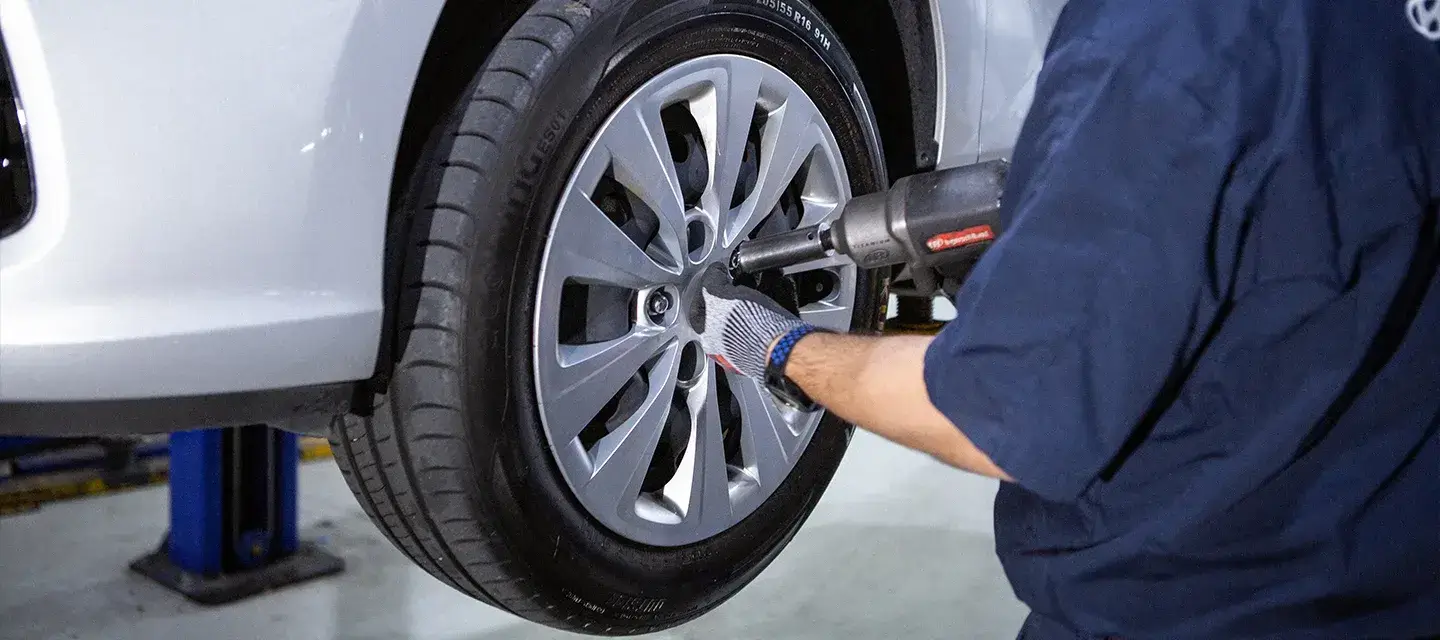
Replacement is not the automatic answer to every pressure warning, visible nail or vibration. The tire, wheel and valve need to be checked together because several faults can produce the same symptom. We recommend a new tire only when its condition, damage or specification makes replacement the appropriate option.
A repair may be possible
Some tread punctures can be repaired, but only after removing the tire to examine its inner liner and the complete damage path. Repair still depends on the damage size and location, remaining tread, previous repairs and whether the tire was driven while underinflated. A plug-only decision from the outside is not enough.
The tire may be serviceable
A pressure warning can come from normal pressure loss, a leaking valve or a reset issue. Vibration can come from wheel imbalance, hub contamination or a bent rim. Confirm the actual cause before ordering a tire that may not solve the concern.
Replacement is the safer choice
Sidewall bulges, exposed cords, severe cracking, structural impact damage and a tire that cannot hold pressure are replacement concerns. Stop driving when the tire appears unsafe or vehicle control is affected. Call us to discuss recovery instead of risking further wheel or body damage.
If replacement is needed, we compare the other tires on the same axle and the vehicle as a set. This prevents an unnecessary four-tire sale while also avoiding a mismatched single tire where tread difference, construction or drivetrain requirements make that choice unsuitable.
Get the right tires for your Chevrolet
Send your model, year, trim, quantity and a clear photo of the complete tire sidewall. If the front and rear sizes differ, photograph both. Mention modified wheels, towing or heavy loads. We check the size and load/speed ratings against your vehicle specification before recommending a replacement.
Not sure of the size? Look for a code such as 265/65 R18 114H on the sidewall. This code illustrates the format and is not a size recommendation. A photo of the vehicle tire-information label helps confirm the fitment.
Chevrolet tire prices per tire and set of four
Use these Auto Repair UAE estimates as a starting budget. Prices vary by brand, tire model, size and specification. All displayed estimates include tire fitting, balancing, old-tire disposal and 5% VAT. VAT has been added to the base estimates below. The final price depends on your selected tire and confirmed specification.
Illustrative size only
225/55 R17
- One tire fitted, including VAT
- AED 341.25–1,023.75
- Four tires fitted, including VAT
- AED 1,365–4,095
Estimates cover selected budget and premium options. Exact brand, model, ratings and availability are confirmed in your quote. Fitting, balancing, disposal and 5% VAT are included.
Illustrative size only
275/55 R20
- One tire fitted, including VAT
- AED 393.75–971.25
- Four tires fitted, including VAT
- AED 1,575–3,885
Estimates cover selected budget and premium options. Exact brand, model, ratings and availability are confirmed in your quote. Fitting, balancing, disposal and 5% VAT are included.
Other tire services: Initial inspection is free. Repairable tread puncture: estimated AED 63–147 per tire after inspection. Standard alignment: estimated AED 183.75–288.75 per vehicle; including 5% VAT; related repairs or calibration are extra.
These estimates are not fixed prices or a measured market average. Run-flat tires, staggered fitments, performance specifications, wheel damage and TPMS work can change the total.
Get an itemized fitted quoteTell us whether your priority is purchase price, everyday comfort, highway driving or load carrying. Compare only options that meet your Chevrolet’s required size and ratings.
Budget-focused choice
Request the lowest-priced suitable option with its brand, tire model, production date. Compare the complete fitted total rather than the tire price alone.
Everyday comfort
Compare road-oriented options for noise, ride comfort and wet-road behavior. Ask for two suitable quotes within your budget.
SUV, pickup or performance
Tell us about towing, loads, road or off-road use and front/rear sizes. Confirm the exact tire construction and run-flat compatibility where applicable.
Leading international brands
Pirelli, Continental, Michelin, Bridgestone, Goodyear, Dunlop, Yokohama, Toyo and Firestone.
More brands for your budget
Hankook, Kumho, Nexen, Sailun, Linglong, Triangle, Goodride, Westlake, Giti, Double Coin, Silverstone and Viking.
We sell and source all these brands. Send your preferred brand and tire-size photo so we can confirm the suitable tire model, price and availability. Availability varies by size and specification.
Know the complete fitted cost before you approve
Tires and installation
Tire prices include fitting and balancing. Your quote identifies the brand, tire model, size, ratings and quantity.
Valves, disposal and VAT
Old-tire disposal is included. The displayed estimates include 5% VAT added to the base price. Standard valves, TPMS valves, sensors or relearn work are confirmed and quoted separately when needed.
Alignment and other work
Alignment, rim repairs and suspension repairs are separate unless expressly included. Any additional work needs its own findings and price.
Our workshop pricing can be 65% to 70% lower than agency pricing. The comparison depends on the selected job and equivalent tire brand, model, size and fitting scope; it does not apply automatically to every tire.
Confirm stock and your fitting time
Before you travel
Request availability for the exact tire, quantity and production date. For fitting today, call first: stock and the workshop schedule must both be confirmed. Ask for the expected fitting duration when your job is agreed.
Confirm your fitting slot and payment method before traveling. A quote request does not reserve stock or an appointment.
Production dates and order changes
Ask for a photo of the selected tire’s production-date marking before purchase. Keep the invoice and tire specification after fitting.
Confirm the selected tire, quantity, production-date information, fitted total and any order terms before payment. If your plans change, contact us before fitting starts so we can explain the available options for that order.
Workshop process
What happens during tire fitting
- 01
Send the specification
Share the Chevrolet model, year, trim, current size and a clear sidewall photo.
- 02
Inspect all four tires
Use the free inspection to review pressure, tread, sidewalls, matching, previous repairs and the wear pattern.
- 03
Review tire options
Confirm the tire brand, model, ratings, date information, quantity, fitted total and any separately priced work before approval.
- 04
Fit and verify
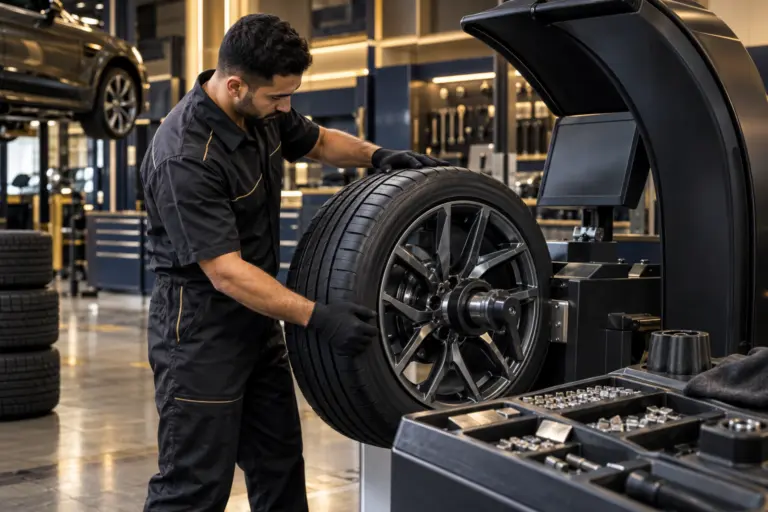
Remove and fit the agreed tires, balance the assemblies as quoted, set pressures and check wheel fastening and TPMS status. Confirm disposal and any follow-up advice at handover.
Chevrolet tire planning costs
Typical Chevrolet tire job estimates
Use these figures to plan a budget. They are not records of previous repairs. Tire availability, the full sidewall specification, production information and any wheel, valve or sensor fault can change the quote.
Typical job estimate AED 1,680
2021 Chevrolet Malibu
Four suitable 225/55 R17 mid-range touring tires with standard fitting, balancing and old-tire disposal. This estimate assumes straight wheels, reusable standard valve hardware and no TPMS sensor replacement. Premium tire models, alignment or damaged-wheel work are separate.
Typical job estimate AED 3,360
2020 Chevrolet Tahoe
Four road-focused 275/55 R20 SUV tires matched to the required load capacity and speed specification. The total covers fitting, balancing and disposal. Reinforced construction, premium brands, towing needs, alignment, TPMS parts and rim repairs can change the final total.
Typical job estimate AED 5,250
2022 Chevrolet Corvette
Four staggered performance tires matched by axle in the confirmed front and rear specifications, with careful fitting, balancing and disposal. Run-flat construction, original-equipment markings, valves, sensors and the selected tire family can move the quote above or below this estimate.
Send the model and a short description to start. When exact sizing must be checked, we may ask for a clear photo of the sidewall marking. Your written quote identifies the tire brand and model, quantity, fitting, balancing, disposal, exclusions and VAT treatment before approval.
Clear choices and easier booking
Why Chevrolet owners choose our tire service
- Free workshop inspection
- We check tire condition, wear, pressure, fitment and visible wheel concerns before advising whether repair, adjustment or replacement is appropriate.
- Itemized fitted prices
- Your quote identifies the tire, quantity, fitting, balancing, disposal, VAT treatment and separately priced extras.
- Free pickup and delivery
- Ask us to arrange transport when bringing the Chevrolet to Al Quoz 4 is inconvenient.
- Dedicated on-site inspection
- Our mobile van can assess suitable concerns at your location. Any visit terms are confirmed before dispatch, and fitting or balancing may still require the workshop.
- Independent workshop value
- Equivalent work can cost 65% to 70% less than agency pricing, depending on the selected tire, specification and complete fitting scope.
Model and use matter
Tires for Chevrolet SUVs, pickups and performance cars
A Chevrolet Tahoe, Suburban or Silverado may have different load, wheel and use considerations from a Malibu, Spark, Groove or Equinox. A Corvette or another performance-oriented model can require a different axle-matching and tire-specification discussion. Captiva and Trailblazer variants also need exact identification rather than a model-name-only quote.
- SUV and pickup useConfirm passenger load, towing or load use, current wheel size and whether the wheels or suspension have been changed.
- Passenger-car useReview comfort, noise, wet-road behavior and wear without changing the required size, load or speed capability by assumption.
- Performance useConfirm front and rear fitment, tire family and tread difference before replacing only one or two tires.
- Modified wheelsCheck clearance, wheel width, offset and the actual vehicle setup before recommending a tire solely from the existing sidewall.
Tire damage, alignment and TPMS checks
A new tire does not correct a bent rim, valve leak or suspension fault. Our free inspection helps identify the next step.
- Pressure loss or puncture
- Check the tire, valve and rim. Repair suitability depends on the damage location and internal condition; inspection may require tire removal.
- Uneven wear or vibration
- Check pressure, wheel condition and balance. Wheel balancing and alignment address different issues; related suspension or rim work is quoted separately.
- TPMS warning
- Check actual pressure first, then leakage, sensor communication and any model-specific reset or relearn. A warning alone does not prove a failed sensor.
- Bulges, cuts or exposed cords
- Do not drive on a tire that appears structurally unsafe. Call to discuss vehicle recovery.
Should you replace one, two or four tires?
When one Chevrolet tire cannot be repaired, measure the tread condition and confirm the specification of all four tires before deciding whether to replace one, a pair or a full set. A single replacement must be compatible with the tire on the same axle and with the vehicle’s drive system. A pair should use a consistent specification across the axle, with placement decided from vehicle and tire guidance. Four-tire replacement is appropriate when age, wear, mismatch or condition makes a complete set the clearer solution; not simply because four is easier to quote.
Include the spare in the inspection where the Chevrolet carries one. Confirm its type, size, pressure, age, mounting condition and operating limits. A compact temporary spare is not equivalent to a full-size road tire, while a full-size spare may still differ in tread depth or age from the tires in use. Owners of vehicles without a conventional spare should know the condition and limits of any mobility kit or sealant and disclose its use before tire or TPMS work.
After replacement, retain the tire invoice and full specification. Recheck cold pressures after the first period of use and before a long journey or heavy loading. If a new tire develops unusual wear, vibration or pressure loss, return for inspection while the symptom is current rather than waiting for the tread pattern to become severe.
Chevrolet tire questions
Chevrolet tire questions
Can a Chevrolet tire quote be based on the model name alone?
No. The exact year, trim, wheel and sidewall specification are needed because tire sizes and ratings can vary within the same model range.
Do I always need four new tires?
Not always. The condition, age, fitment and tread difference across each axle and the vehicle should be reviewed. The correct decision depends on the drivetrain and existing tire setup.
Can every puncture be repaired?
No. Repair suitability depends on the puncture location and extent, internal damage, previous repairs and tire condition. The tire should be removed and inspected when a proper internal assessment is required.
Does a TPMS warning always mean the sensor failed?
No. Low pressure, a leak, valve damage, temperature-related pressure change, a reset or relearn requirement, and a sensor fault can produce a warning. Actual pressure and tire condition should be checked first.
Where is the Chevrolet tire service carried out?
Book with Auto Repair UAE at Al Quoz 4, Dubai, and confirm the vehicle and tire details before traveling.
Can I get a quote before bringing my Chevrolet?
Send the model, year, trim, tire-size photo and quantity. We can discuss suitable options and the quote; wheel damage or unexplained wear may need inspection before additional work is priced.
Are the four-tire prices fitted package prices?
Yes. The displayed estimates include fitting, balancing, old-tire disposal and 5% VAT. Prices vary by the selected tire. Valves, TPMS work, alignment and any additional repairs are confirmed separately.
Can I request fitting today?
Yes. Call to confirm the exact tire stock and an available fitting time before traveling. A message alone does not reserve tires or a slot.
For pressure checks, use your vehicle label and the model-specific manual. Chevrolet also explains tire-pressure monitoring and signs of wear.
Visit our Chevrolet tire workshop in Al Quoz 4
Find us at FCP, Al Quoz 4, Dubai. Call +971 50 608 7150 to book your fitting time, or request the workshop entrance pin on WhatsApp.
Free pickup and delivery are available. If reaching the workshop is difficult, ask about a remote car checkup using our van. We confirm suitable on-site checks; tire fitting and balancing may still require the workshop.
Send your model, year, tire-size photo and quantity for a fitted quote. Request the workshop location pin. Visible wheel damage or runout should follow the Chevrolet rim repair assessment. Pulling or steering-control changes should use the Chevrolet steering repair route.