2019 SEAT Leon DSG service
Final invoice: AED 1,350. Gearbox identification, applicable DSG fluid and filter replacement, leak check, scan and road verification. The road check found no clutch or mechatronic fault.
Arrange SEAT repair in Dubai for scheduled maintenance, warning lights, engine and cooling concerns, DSG or manual transmission behaviour, electrical faults, brakes, suspension and air conditioning. The useful starting point is the exact model, engine, transmission, mileage, service history and symptom—not a generic package applied to every SEAT.

You do not need to diagnose the car before booking. Describe what changed and the conditions that make it appear.
Include the exact dashboard message and whether the concern is cold, hot, at idle, under load, during a gear change, while braking or only with the AC running.
A modern SEAT may need scan-assisted testing, underbody access and direct measurement during the same visit. These are separate evidence sources that should lead to one understandable repair decision.
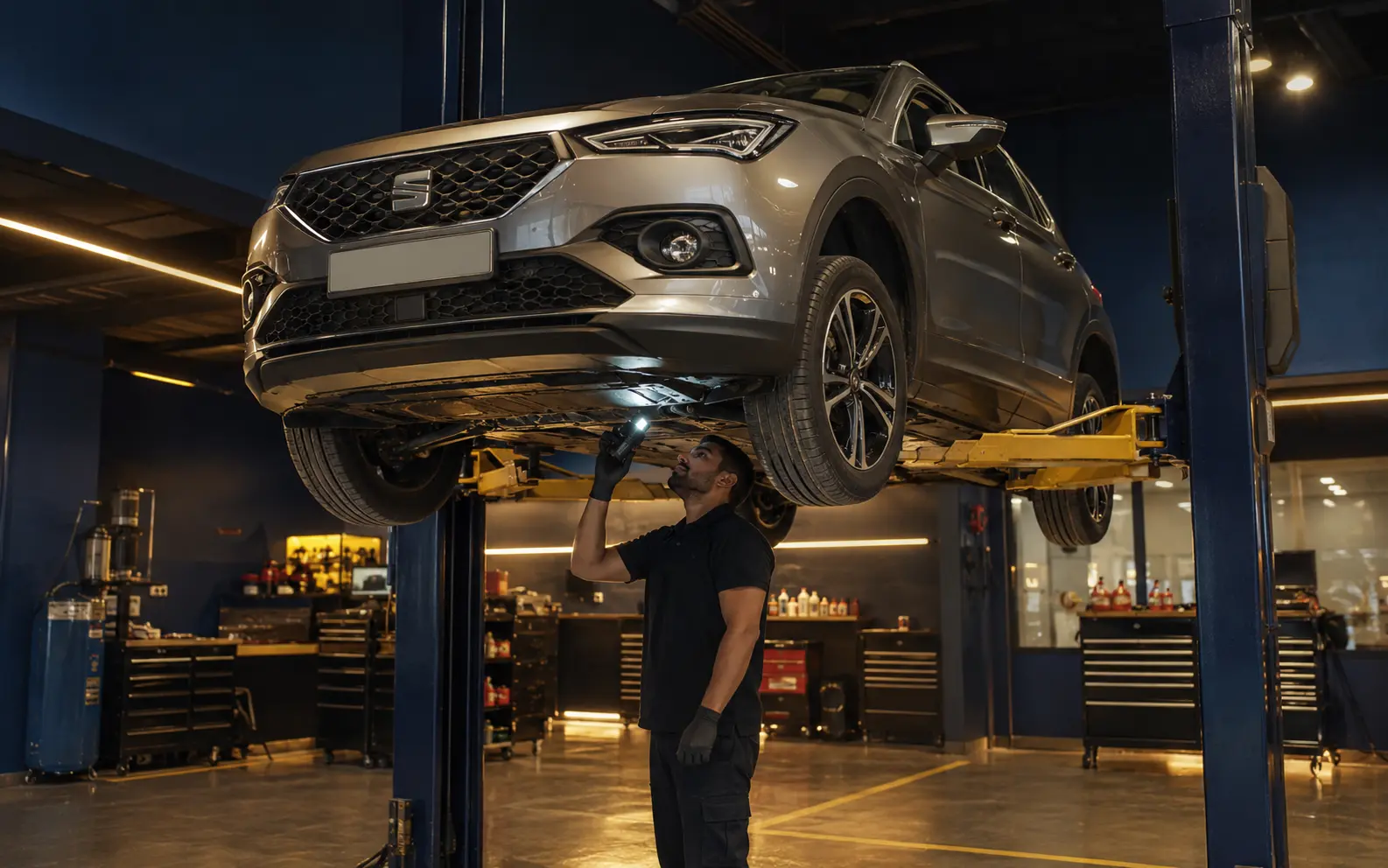
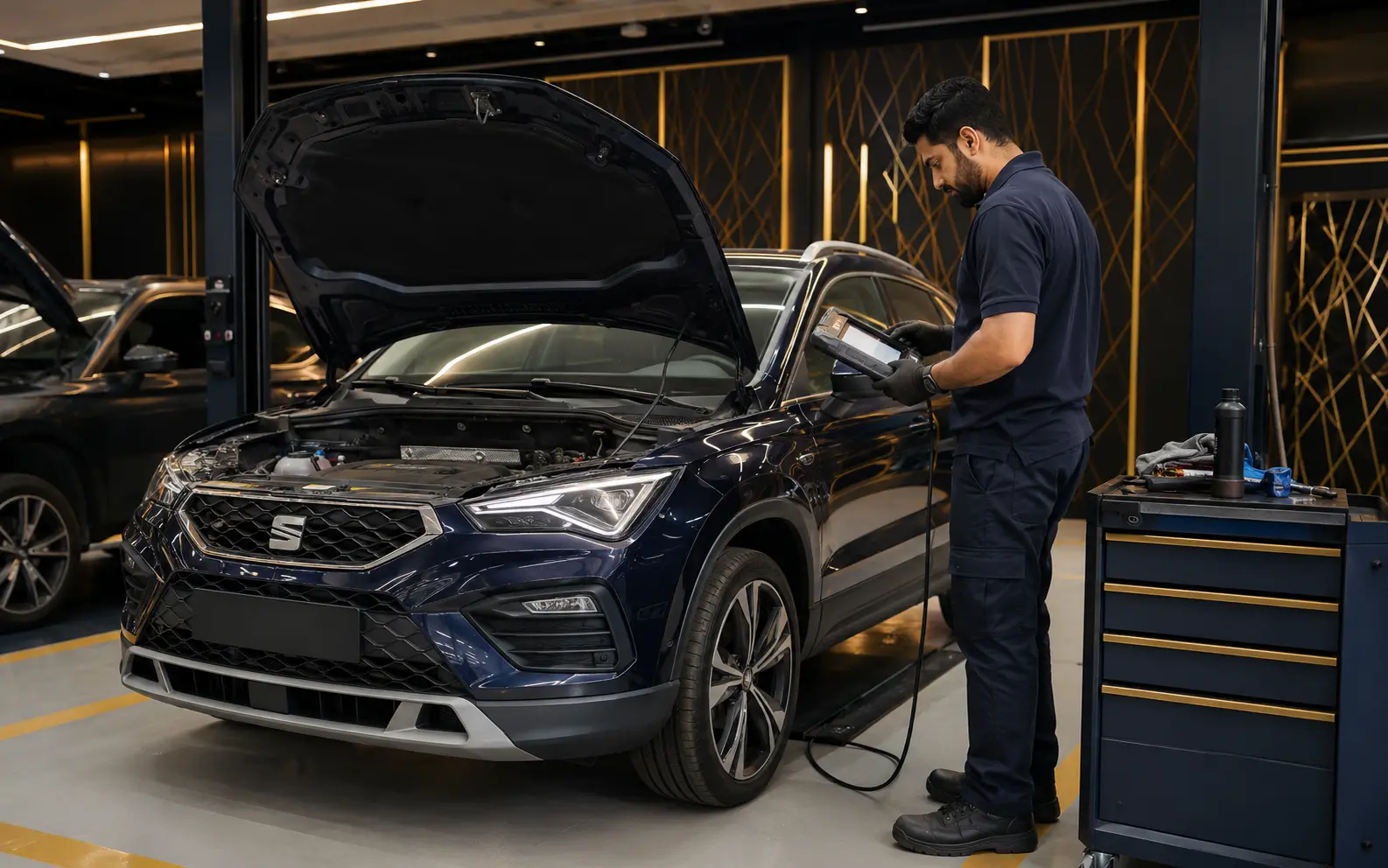
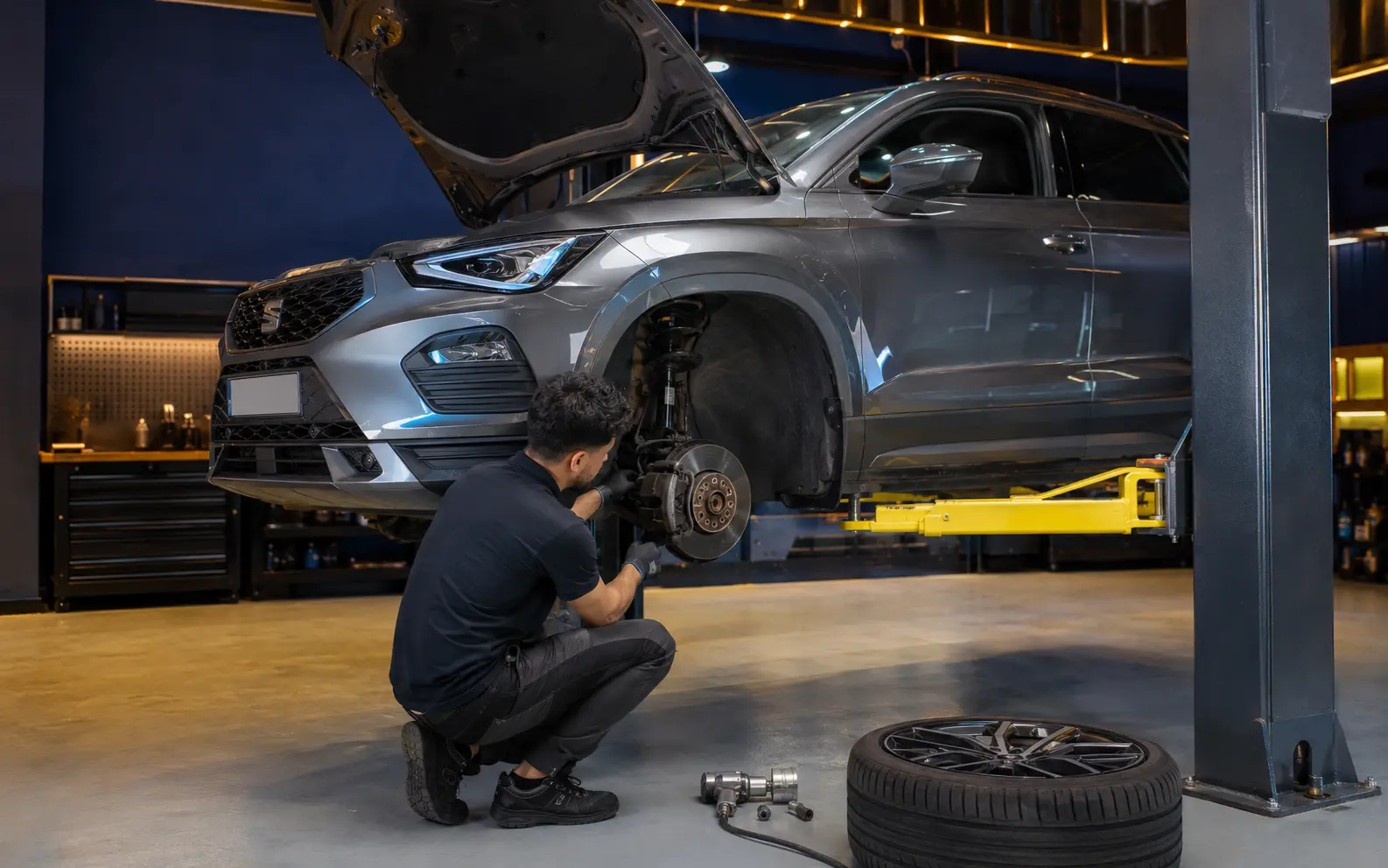
Use these AED ranges to plan a visit for an Ibiza, Leon, Arona, Ateca, Tarraco, Toledo or Alhambra. They are market-based estimates, not fixed quotes. The free workshop inspection confirms the exact variant, fitted components and fault before work begins. Parts grade, engine, gearbox, access and related damage can change the total. VAT treatment is stated on the written quote.
| SEAT work | Estimated price | What the range covers |
|---|---|---|
| Oil and filter service | AED 320 to 520 | Approved-specification oil, filter, installation, basic checks and service reset where supported. |
| Minor scheduled service | AED 500 to 850 | Oil service, selected filters, fluid checks, brake and tire inspection and a fault scan when relevant. |
| Front pads and discs | AED 1,150 to 2,100 | Model-matched front pads and discs, installation, brake inspection and road test. |
| Ignition coil and spark-plug repair | AED 750 to 1,650 | Diagnosis plus the approved plugs and affected coil or coils. Price depends on engine and parts selected. |
| Water pump or thermostat repair | AED 1,200 to 2,800 | Confirmed cooling component, labor, coolant refill and temperature verification. Additional leaks are separate. |
| DSG service | AED 950 to 1,650 | Correct fluid and filter where applicable, labor, checks and reset procedure required for the fitted gearbox. |
| DSG fault repair | AED 1,800 to 8,500 | Control, clutch or internal repair after diagnosis. The fitted gearbox and failure depth determine the total. |
| AC diagnosis and repair | AED 250 to 1,600 | Cooling-performance diagnosis and approved minor repair. Major compressor or evaporator work is quoted separately. |
Equivalent SEAT work may be priced 65% to 70% below agency pricing when the same parts grade and repair scope are compared. Free pickup and delivery are available. The workshop inspection is free.
These three SEAT repairs show the difference between scheduled gearbox service, cooling-system work and an ignition repair.
Final invoice: AED 1,350. Gearbox identification, applicable DSG fluid and filter replacement, leak check, scan and road verification. The road check found no clutch or mechatronic fault.
Final invoice: AED 2,250. Pressure testing, water-pump and thermostat assembly replacement, suitable coolant refill, system bleeding and operating-temperature check. Final testing confirmed normal operating temperature after the repair.
Final invoice: AED 980. Misfire diagnosis, spark-plug set and one failed ignition coil replaced, stored faults cleared and the engine retested. The remaining coils tested correctly and were not replaced.
The same warning or noise can cross several systems. Use the closest route for the booking, then allow inspection to define whether another test is justified.
| Service route | Useful owner information | Decision the visit should produce |
|---|---|---|
| Computer diagnostics | Exact warning, starting behaviour, recent battery work, conditions that trigger the fault and any reduced-power mode. | Identify the affected system, confirm the power supply and decide which test or repair is supported. |
| Engine and cooling | Leaks, smoke, rough running, oil or coolant changes, temperature behaviour, noise and previous repairs. | Separate maintenance, leakage, control, combustion and mechanical findings before major work is approved. |
| Transmission inspection | Gearbox type, service history, delayed engagement, shudder, warning message, noise and fluid leakage. | Clarify whether diagnosis, maintenance, software, clutch, mounting or internal work is indicated. |
| Brake and chassis | Pedal feel, noise, pull, vibration, road surface, steering angle, tyre age and wear pattern. | Measure the brakes and suspension, inspect tyres and decide whether alignment follows a mechanical repair. |
| Air-conditioning repair | Vent temperature, airflow, noise, odour, cooling at idle versus speed and any previous refrigerant refill. | Find whether the concern involves leakage, airflow, pressure, controls, fans or compressor performance. |
| Battery and charging | Battery age, jump-start history, parking duration, accessory changes and multiple warning messages. | Test state of health, charging, terminals, grounds and discharge before unrelated modules are replaced. |
Use the maintenance information for the exact model, engine, transmission, age and market specification. A single mileage headline is not a safe substitute for the applicable schedule, time-based items and condition found on the car.
Confirm the required oil information, filter scope and inspection items from the exact vehicle. Check for leakage, level changes and evidence of delayed servicing. A reset reminder is not proof that all due work was completed.
Timing components and intervals depend on the engine. Cooling maintenance also follows the specified fluid and history. Verify the engine and records before quoting a belt, pump or coolant package.
Identify the transmission and applicable service information. Do not assume that every DSG uses the same fluid, interval or procedure. For symptoms, diagnosis comes before a generic flush.
Measure pad and disc condition, inspect hydraulics and record tyre pressure, age and wear. Repair looseness or damage before alignment, then verify the road behaviour.
Dubai heat, short journeys and long storage can expose a weak battery or connection. Test supply and charging, and confirm any battery adaptation or configuration requirement for the exact model.
Where a SEAT uses a plug-in hybrid or another high-voltage system, send the VIN and requested work first. High-voltage battery, charging and propulsion work requires a separate capability confirmation.
SEAT vehicles can use different manual and dual-clutch transmissions. A driver may describe hesitation, shudder, harsh engagement, delayed drive, slipping sensation, vibration or a warning. Those descriptions do not prove one common failure.
Before repair approval, identify the gearbox, record the conditions that reproduce the symptom and check fault information, leakage, mounts and relevant operating data. Service history matters, but a maintenance procedure should not be sold as a guaranteed repair for an unverified fault.
If the car displays a serious transmission warning, cannot select or hold a gear, leaks heavily or moves unpredictably, stop safely and ask about recovery. Continued driving can increase risk or damage.
SEAT Ibiza, Leon, Arona, Ateca, Tarraco and older vehicles can use different engines, transmissions, brakes, electronic systems and parts. Provide the VIN when available. The model badge alone may not define the parts or workshop procedure.
A clear identification also reduces the risk of ordering an incompatible sensor, filter, brake component or transmission service item. If the registration card does not show enough detail, send a VIN photo and images of the dashboard message. Do not include personal documents or owner information that the workshop does not need for the enquiry.
State the model year, engine, transmission and body style. For warning lights or drivability issues, include starting, idle, acceleration and temperature behaviour. For a Leon e-HYBRID or another high-voltage variant, request a capability check before booking.
Report cooling, turbo, shift, brake, suspension, steering, battery and AC symptoms with the conditions that reveal them. Tyre size and wear pattern are useful when the owner reports vibration, pulling or road noise.
Share the powertrain, gearbox, seating or load use and any towing history. For plug-in hybrid enquiries, distinguish normal mechanical or low-voltage work from battery, charging and electric-propulsion concerns.
Parts availability, previous repairs, non-standard suspension, wheels, intake, exhaust or calibration can change the diagnostic route. Share modifications and the date the current symptom began.
Auto Repair UAE is an independent multi-brand workshop. This page does not claim authorised SEAT dealer status, manufacturer certification or control over manufacturer warranty decisions.
Driving conditions provide diagnostic context; they do not replace testing.
Note whether temperature, AC, idle quality or transmission behaviour changes in slow traffic or only after a long drive. Describe fan noise, coolant top-ups, vent temperature and any warning that clears after the car cools. This context can help reproduce the concern without assuming that heat alone identifies the failed part.
Repeated short trips can leave the battery undercharged and may make some engine or emissions symptoms more visible. Share weekly mileage, parking duration and jump-start history. Test the battery and charging supply before replacing a module that may only be reacting to low voltage.
Before returning a stored car to daily use, inspect battery, tyres, brakes, fluids, visible leaks and warning status. Tyre flat-spot sensation, surface corrosion on brakes and a stale fuel or fluid concern need different responses. Ask for a condition baseline instead of automatically approving every age-related replacement.
Collect invoices and separate immediate safety or drivability work from maintenance that can be planned later. Verify the engine and gearbox, check whether reminder resets match supporting invoices, and record modifications or non-standard wheels. A written baseline makes later diagnosis and budgeting easier to compare.
Confirm the verified finding, supporting test, proposed parts basis, labour, fluids, seals, programming or adaptation work, expected timing, warranty terms and exclusions. Ask which items are required now, which are preventive and which remain observations. If access reveals another problem, review the evidence and revised scope before authorising more work.
A controlled process keeps the original concern and any later findings understandable.
Send the VIN, model, year, engine, transmission, mileage, history and main symptom.
Confirm what the initial inspection covers and any recovery, hybrid or parts boundary.
Separate verified faults, observations and additional tests that still require approval.
Repeat the relevant check, review warning status and retain the repair documentation.
Final recommendations depend on the exact vehicle, applicable maintenance information and workshop findings.
Use the maintenance information for the exact model, engine, transmission, age and market specification. Time-based items, mileage and operating conditions can all matter. Bring the VIN and service history when the schedule is uncertain.
Yes, the enquiry can begin with scan-assisted diagnosis. Fault and freeze-frame information should be combined with battery supply, live data, the driver’s symptom and physical inspection before a part is approved.
Possible causes depend on the gearbox and conditions. Control, clutch, fluid, software, mounts, driveline and internal mechanical issues may need to be separated. A fluid service is not a guaranteed repair for every shudder.
Send the VIN, exact model and requested work first. Routine mechanical or low-voltage work and high-voltage battery, charging or propulsion concerns require different workshop capability. Acceptance must be confirmed before arrival.
The proposed parts route should be stated for the specific repair. Availability, condition, compatibility, budget and written terms affect the decision. Ask what brand and basis are included before approval.
No. Auto Repair UAE is an independent multi-brand workshop. Check any manufacturer, dealer or extended-warranty terms before authorising independent work on a covered car.
Cost depends on diagnosis, access, parts, labour, fluids, programming or adaptation and related damage. Request a finding-led estimate with inclusions and exclusions instead of relying on a headline price.
SEAT repair enquiries are received at FCP, Al Quoz Industrial Area 4, Dubai. Confirm the appointment, the first inspection and whether the car can be driven safely before travelling.
Start with your SEAT model and what you need repaired. A VIN, mileage, warning photo or service record can be supplied later if it helps match parts or understand the fault. You do not need to diagnose the car before contacting us.
We provide free pickup and delivery. The inspection at our Al Quoz 4 workshop is free. Our dedicated van can attend suitable on-site inspections after the location, availability and visit fee are confirmed. Repairs that require a lift, workshop equipment or extended testing are completed at the garage.
Book a normal inspection for scheduled service, stable warning lights, mild noises or weak AC cooling. Stop and arrange recovery if the car overheats, loses oil pressure, has unsafe steering or brakes, leaks fuel, produces heavy smoke or cannot engage a gear safely.
A clear quote separates diagnosis, parts, labor and any work that may become necessary only after access or dismantling. It should identify whether the proposed component is genuine, OEM-equivalent, aftermarket, rebuilt or used when that choice affects cost and expected service life. The quote should also state which tests or resets are included after installation.
For brake work, check whether the price covers pads only or pads and discs for one axle. For cooling repairs, confirm the component, coolant and bleeding procedure. For DSG work, the quote should distinguish routine fluid service from clutch, mechatronic or internal repairs. For AC work, a performance test and leak decision are more useful than repeatedly adding refrigerant.
We review the findings with you before repair approval. If another fault is discovered, it is added to a revised quote rather than treated as automatic permission to continue. Keep the invoice and diagnostic notes after handover because they help with future service planning and avoid repeating work. A short road test or operating check confirms the original symptom has changed as expected.
Share the VIN or model, year, engine, transmission, mileage, warning message and main symptom. The workshop can confirm the suitable first check before arrival.