Independent workshop · Al Quoz 4

HiPhi Repair in Dubai

HiPhi won’t charge, a powered door has stopped, or warning messages keep returning? Contact Auto Repair UAE in Al Quoz 4, Dubai. We’ll explain the initial checks and confirm the equipment, parts, and software access needed before proposing specialist work.

Silver HiPhi SUV parked in a mountain setting
Free workshop inspectionAn initial check before paid tests.
Free pickup and deliveryTell us where the vehicle is parked.
Separate specialist quoteReview access and parts needs first.
Paid on-site checksA dedicated van visit by arrangement.

Common HiPhi problems we inspect

A dark screen, interrupted charge, or stuck door can be worrying. The first step is to separate an electrical supply problem from a fault in the affected system. You do not need to identify the failed part before contacting us.

Vehicle will not reach drive-ready

A no-ready condition can involve the 12-volt battery, high-voltage interlock, charging state, communication, key recognition, contactor control, or a recorded safety event. Repeated reset attempts can erase useful history or drain the low-voltage battery further.

Charging stops or will not begin

Record the charger type, connector behavior, state of charge, displayed message, and whether another compatible charger was tried safely. The cable, external supply, charge inlet, locking mechanism, thermal limits, control modules, or high-voltage system may be involved.

Powered door or latch fault

Doors that stop, reverse, fail to present, or report an obstruction need checks for 12-volt stability, sensors, latch condition, alignment, wiring, control data, and physical resistance. Forcing a powered door can create additional damage.

Display, lighting, or network warnings

Several screens or functions failing together may indicate supply or communication loss rather than several defective modules. Battery capacity, grounds, protection, connectors, water entry, and accessory installation should be checked before module replacement.

Range loss or thermal warning

Range changes with temperature, speed, tires, climate-control use, charging habits, and battery condition. A thermal warning or rapid drop needs the exact message, operating conditions, cooling-system checks, and suitable high-voltage assessment.

Suspension, brake, or tire concern

Heavy EV weight and high torque can expose tire wear, brake vibration, wheel damage, alignment change, bushing wear, or suspension faults. Physical measurement is required even when the vehicle also displays an electronic warning.

What you can book for your HiPhi

The free initial workshop inspection helps establish the next step. It does not include unlimited computer diagnosis, high-voltage work, dismantling, or software programming.

Mechanical and routine checks

Book inspection of brakes, tires, wheels, suspension, steering, body seals, and visible leaks. Repair recommendations depend on measurements and parts availability. Electric drive does not eliminate ordinary wear or damage from potholes and impacts.

Electrical and charging assessment

Initial checks can examine the 12-volt supply, accessible wiring, door operation, and charging symptoms. Available scan functions and the next test are established for the actual vehicle. You receive an explanation of paid testing before it starts.

Specialist EV and software work

Battery-pack opening, high-voltage repairs, protected programming, and calibration are not included in a routine booking. We confirm the relevant procedure, equipment, access, parts, and specialist support before proposing any of these operations.

HiPhi assessment and repair prices

Choose the concern you need investigated. A paid assessment identifies the next repair decision; it does not promise that every component or online function can be restored.

Computer and network diagnosis

AED 350–850

An agreed initial scan, low-voltage checks, and focused tests using available access. Extended wiring work and programming are separate.

Charging assessment

AED 450–1,200

Inspection of the inlet and locking operation, charging observations, and available vehicle data. Replacement inlet parts, charger repairs, and high-voltage dismantling are excluded.

12-volt battery replacement

AED 900–2,400

A compatible battery, normal replacement labor, and agreed checks. Any special access or setup is listed before approval; a recurring drain requires separate diagnosis.

Powered-door diagnosis

AED 400–1,500

Checks of the affected door’s supply, latch, sensors, alignment, and accessible controls. Motors, hinges, modules, and body repairs are separately quoted.

Front pads, one axle

AED 1,400–2,200

Matched pads, replacement labor, mounting-surface preparation, and braking checks. Rotors, calipers, and hydraulic repairs are excluded.

Front pads and rotors, one axle

AED 2,200–3,800

Matched pads and rotors, fitting, and final checks. The installed brake specification and supply determine the quote.

When your HiPhi will not charge

Check the pattern

A failed session at one charger does not establish an onboard-charger fault. Note whether charging never begins or stops after starting. A photo of the message helps if it is easy to capture while parked. Avoid repeated attempts with a damaged or unusually hot connector.

Compare only compatible equipment

If there is no warning or visible damage that makes another attempt unsafe, an available compatible charger may help distinguish a station issue from a vehicle problem. Never improvise adapters, bypass protection, or force a connector. Connector and market compatibility must be checked.

Test before replacing components

The inspection may involve the inlet lock, cable condition, low-voltage supply, communication, or thermal controls. AC and DC charging complaints can involve different equipment. Any protected tests, specialist access, or deeper work must be available before a replacement is proposed.

Three typical HiPhi job estimates

These describe estimated work, not completed customer repairs. Each assumes a confirmed fault, compatible parts, and an available repair procedure. Specialist access, additional damage, VAT, and the final payable total are addressed in the written quote.

Typical job estimate

2022 HiPhi X 12-volt and door fault

Problem: Slow wake-up, repeated warnings, and a powered door that stopped during operation.

Work: Test battery capacity and voltage drop, inspect grounds and door wiring, replace the confirmed weak battery, then perform supported setup, if required, and test the door system.

Parts: Correct replacement battery and normal connection materials. Door motor replacement is excluded unless separately proven.

Total: AED 1,200 to 2,400.

Final checks: Sleep and wake cycle, charging voltage, warning status, latch operation, obstruction response, and repeated door cycles.

Typical job estimate

2023 HiPhi Z charging interruption

Problem: Charging stopped shortly after connection with an inlet warning.

Work: Compare a compatible charger safely, inspect the cable lock and inlet, scan charging and thermal modules, check low-voltage supply, and repair the confirmed inlet-lock or wiring fault.

Parts: A compatible lock actuator or localized wiring repair items, subject to supply. A complete inlet assembly is separately quoted if needed.

Total: AED 1,500 to 3,800.

Final checks: Stable charge start, locking, current acceptance, temperature behavior, controlled stop, and warning-status review.

Typical job estimate

2022 HiPhi X tire wear and suspension noise

Problem: Front-edge tire wear, steering pull, and a knock over small bumps.

Work: Inspect tires and wheels, measure suspension play, check ride height and steering, replace confirmed worn links or bushings, then align the vehicle.

Parts: Quality suspension links or bushings matched to the installed assembly. Tires are separate unless included in the written quote.

Total: AED 1,800 to 4,200.

Final checks: Fastener torque, ride-height comparison, alignment report, steering-center check, and road test.


Powered doors and displays need more than a reset

HiPhi vehicle with its doors open

Start with power and physical movement

A door that stops or reverses may have an obstruction, misalignment, latch fault, wiring problem, or unstable electrical supply. Repeatedly forcing it can damage the mechanism. Tell us which door is affected and whether the problem started after impact, water entry, or body work.

Several screens or functions failing together can point to a shared power or communication issue. We assess accessible supply and connections before recommending a screen or controller. A restart that temporarily restores a function does not prove the underlying fault is repaired.

Keep your available keys and ownership information accessible. Passwords should never be sent in an open message. Any account action needed for the repair is explained separately.

Repair choices for an imported HiPhi

Repair the identified fault

Localized wiring damage, a poor connection, a leaking hose, latch alignment, or a worn suspension joint may allow a focused repair. We explain the proposed work and the test that will check its result. A complete assembly should not be ordered merely because its name appears in a fault description.

Rebuild only with suitable support

Some mechanical or low-voltage assemblies may be repairable internally when dependable parts and testing are available. That does not establish that a sealed high-voltage assembly or configured electronic module can be rebuilt. The proposed procedure and verification must be defined first.

Match a replacement completely

Appearance alone does not establish fitment. Hardware revision, connector, part reference, software, and setup requirements can matter. The estimate should identify whether the component is new, remanufactured, or used, together with supplier terms and any applicable written warranty.

HiPhi X, Z, and Y service considerations

The model is enough to begin the conversation. Source-market differences can affect charging equipment, software functions, parts, and account services, so additional details are collected only when relevant.

HiPhi X

Powered access and body systems may need attention alongside the driving concern. Seating and door equipment vary, so a replacement must match the actual vehicle. Report any earlier hinge, seal, latch, or collision work if it relates to the fault.

HiPhi Z

For vibration, steering pull, or warning messages after wheel or body work, the fitted equipment matters. Tires, wheel condition, sensor mounting, and wiring should be considered together. A software reset cannot correct a damaged mechanical component.

HiPhi Y

Charging behavior, powered openings, climate control, and assistance features should be checked against the correct owner information. We may request a software-screen photo or market details later when it helps identify an available procedure.

EV maintenance still protects the parts that wear

Brakes and tires

Regenerative braking does not remove the need to inspect mechanical brakes. Pad and rotor condition, corrosion, hydraulics, tire load rating, tread, and pressure remain important. Brake vibration or a change in pedal feel needs assessment rather than an assumption that regeneration caused it.

Cooling and cabin AC

Cabin comfort and EV thermal systems need the correct circuit information, fluids, and procedures. A leak, temperature warning, or cooling change while charging should be investigated. Do not mix coolants or repeatedly top up an unidentified circuit to keep driving.

Suspension, seals, and underbody

A pothole or curb impact can affect tires, wheels, steering, or the underbody. Visible tire condition does not rule out internal damage. Water entry also deserves prompt attention around seals, drains, wiring, and body modules.

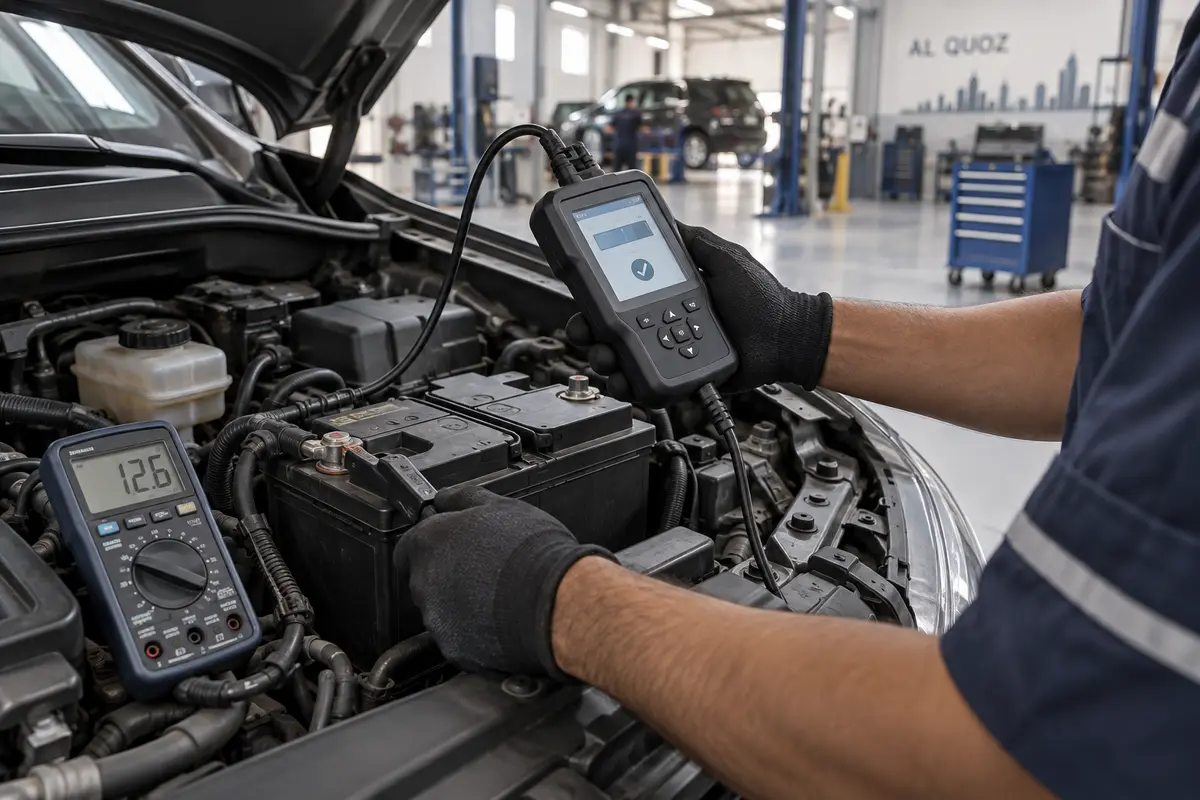
Technician testing a car battery with a diagnostic meter

A 12-volt fault can affect a much larger system

A car that will not wake up does not automatically need a traction battery. Low-voltage supply supports control and access functions. Battery condition, connections, charging behavior, and parked current draw may need investigation.

If a replacement battery repeatedly goes flat, replacing it again without checking the cause may repeat the expense. Our car electrical repair service explains checks for supply and current-draw concerns.

When your HiPhi needs transport

Do not continue driving after a significant underbody impact, repeated temperature warning, or loss of safe steering or braking. A damaged high-voltage area can be hazardous even when the display looks normal. Do not touch orange cables, exposed connectors, or a damaged battery enclosure.

Tell us where it is parked

Share the location and whether the vehicle can unlock, select a gear, roll, steer, and brake. Underground parking clearance or blocked access affects collection arrangements. You do not need to test a function that appears unsafe.

Use vehicle-specific loading instructions

A disabled EV may need special handling for wheel movement, parking-brake release, and loading. The collection plan should follow the applicable vehicle information. Do not drag the car or lift it from an unconfirmed point.

Keep checks simple and safe

While parked, photograph a warning and note what happened before it appeared. Do not open high-voltage covers or attempt repeated resets after impact, water damage, or a severe warning. Emergency symptoms take priority over workshop booking.

Arrange HiPhi service in Al Quoz 4

Start with the problem

Contact our independent Al Quoz 4, Dubai workshop with your model and a brief description. Free pickup and delivery are available. We arrange the initial inspection and explain whether the concern needs paid diagnosis or specialist involvement.

Decide with a written estimate

You receive the proposed tests or repair, parts assumptions, exclusions, and expected timing. Routine mechanical work may be quicker when parts are available. Imported components and protected software access can extend the schedule; completion dates are not promised before those checks.

Collect a useful repair record

The invoice should identify the approved work, installed parts, and relevant final checks. Any unresolved function or further observation is explained. Keep the record, especially if another provider or supplier may need to assess related coverage.

Official HiPhi owner references

The official HiPhi website provides manufacturer model information. The HiPhi Y owner’s manual, in Chinese covers that model’s operation and safety. Use the document for your exact model and market; Y instructions should not be assumed to apply to an X or Z.

For other brands, see our Chinese car workshop services.

HiPhi repair FAQs

How much does a HiPhi diagnostic assessment cost?

Computer and network diagnosis is estimated at AED 350–850. Charging assessment is AED 450–1,200. The scope and available access are agreed first. The written quote confirms VAT and the final payable amount.

Is the initial HiPhi inspection free?

Yes. The initial workshop condition check is free. Extended scans, electrical tracing, dismantling, software work, and specialist EV tests are separate paid services explained before they begin.

Can you arrange pickup for a disabled HiPhi?

Free pickup and delivery are available. Tell us the location and whether the car can unlock, roll, steer, and brake. We use that information to plan collection without asking you to force an unsafe operation.

Do you repair HiPhi traction batteries?

Battery-pack repair is not promised as part of an initial booking. Vehicle condition, isolation procedures, qualified specialist support, diagnostic access, and compatible parts must be confirmed before any such work is proposed.

Will a replacement module restore every app feature?

Not necessarily. Some functions depend on accounts, regional services, servers, or protected access. A replacement module can only be proposed once compatibility and required setup are understood.

Do I need technical details to contact you?

No. Your HiPhi model and the problem are enough to start. Photos, VIN, software information, and earlier invoices can be requested later if they help with the assessment or parts matching.

How long do HiPhi repairs take?

The schedule depends on the fault, procedure access, and parts supply. Routine work may be possible sooner than special-order or software-dependent repairs. You receive an expected timeline after the initial checks.

Is an on-site inspection free too?

No. A dedicated mobile van inspection is a separate paid service. The visit fee and possible checks are explained before booking; some concerns still require workshop equipment.

Talk to us about your HiPhi

Tell us what stopped working and where the vehicle is located. We’ll help arrange the first inspection and explain the available next step.