Audi battery replacement in Dubai
Book Audi battery replacement in Dubai when starting is slow, the battery warning appears, electrical systems reset or the vehicle repeatedly loses charge. This page covers the 12-volt supply, charging, current draw, correct replacement selection and post-installation verification, not high-voltage traction-battery repair.

Separate battery failure from supply faults
A flat Audi battery can be the failed component, the result of long storage, a charging problem, poor connections or excessive current draw. The first check should identify which explanation is supported.
We test the battery and supporting electrical supply, then explain whether replacement or another repair is needed. Your written estimate identifies the battery specification, installation, setup and any additional diagnosis.
- The starter turns slowly
- State whether the concern follows an overnight park, long storage or a hot restart. Battery reserve, terminal condition, starter draw and charging output require different measurements.
- Several warnings appear together
- Low voltage can affect multiple control units during startup. Record the complete messages before clearing them. After supply repair, the vehicle may need a rescan and functional verification.
- The battery goes flat after parking
- Explain the parking duration, locking state, accessories, dash cameras and recent electrical work. Current draw should be assessed only with the vehicle allowed to enter its correct sleep state.
- The battery warning stays on
- A warning can involve charging output, belt or drive condition, converter operation, wiring, terminals or battery state. Do not assume the battery alone is responsible.
- Start-stop is unavailable
- Battery charge, temperature, vehicle demand and system conditions can temporarily prevent start-stop operation. Test the battery and supporting system instead of using the feature alone as proof of failure.
- An e-tron will not wake up
- Electric Audis still use a low-voltage supply for control and wake-up functions, but charging and traction-battery warnings are separate. Confirm which system is involved before recovery or service.
Audi battery replacement prices
These estimated ranges cover common 12-volt battery work. The final price depends on battery size and technology, Audi model, location, access, registration requirements and whether a charging or current-draw fault is also present.
Battery and charging test
AED 150–250Battery condition, basic charging output and terminal checks before replacement.
Standard battery replacement
AED 450–850Suitable battery, installation and basic post-fit checks for applicable models.
EFB battery replacement
AED 650–1,150Enhanced flooded battery, installation and supply-system verification.
AGM battery replacement
AED 850–1,650Correct-capacity AGM battery, installation and relevant final checks.
Battery registration
AED 150–350Registration or adaptation when required and not already included with fitting.
Parasitic-drain diagnosis
AED 350–900Controlled sleep-state testing when the battery repeatedly discharges while parked.
What is included: Your written quote states the battery brand, type and capacity, installation labour, applicable registration, testing and VAT treatment. Cable repairs, alternator or converter faults, modules, programming and extended current-draw diagnosis are separate when required. For equivalent parts and work, our price can be 65% to 70% below an agency quotation.
Choose the correct Audi battery
Battery location, type, capacity, charging strategy and setup can vary by model year and powertrain. Confirm the exact Audi before a battery is supplied.
What the replacement quote includes
Ask the Audi battery estimate to identify whether a new original, aftermarket, remanufactured, repaired, used or customer-supplied component is proposed. Confirm compatibility, availability, coding or calibration needs, lead time and the written terms that apply to that exact part.
Do not approve a Audi battery special order from appearance alone. A similar component can differ by market, model year, powertrain or option. Keep part references and the final invoice with the vehicle history so later maintenance and diagnosis have a reliable record.
- 2026 Q5State the engine or hybrid type, battery warning, storage history and whether start-stop has changed.
- 2026 A5Describe slow starting, warning clusters, recent accessory work and the installed battery specification.
- Q6 e-tronSeparate low-voltage no-wake behaviour from charge-port, traction battery and propulsion warnings.
- A6 e-tronConfirm the exact low-voltage request and do not open or diagnose high-voltage systems without specific capability.
- Q7, Q8 and earlier Audi modelsProvide model year, powertrain, battery age, parking pattern and any repeat-discharge history.
Audi not starting or losing charge?
Send the model and a short description of what happens. We can arrange a free workshop inspection, free pickup and delivery, or discuss a dedicated on-site assessment when the vehicle cannot be brought to Al Quoz easily.
Choose the battery service you need
Start with the observed behaviour. The workshop can then decide whether the first action is a battery condition test, charging check, connection inspection, current-draw investigation, replacement or post-installation verification.
Battery condition test
Measure battery state and performance using a method suitable for the installed type and vehicle condition. Interpret the result with age, use and recent charging.
View the related serviceCharging-system check
Assess charging voltage and behaviour under relevant loads. Combustion, hybrid and electric Audi low-voltage systems may use different supply arrangements.
View the related serviceTerminal and ground inspection
Check connections, corrosion, mechanical security and relevant grounds. A high-resistance connection can imitate a weak battery or create intermittent warnings.
View the related serviceCurrent-draw investigation
When discharge repeats, identify accessories, modules or circuits that remain active after the vehicle should sleep. This requires a controlled test period.
View the related serviceReplacement selection
Match capacity, physical fit, terminal layout, battery technology and vehicle requirement. Confirm the proposed brand and written terms before installation.
View the related serviceSetup and final verification
Where the exact Audi requires registration or adaptation, include it in the scope. Recheck startup, charging, warnings and functions after replacement.
View the related serviceAudi low-voltage service with new models
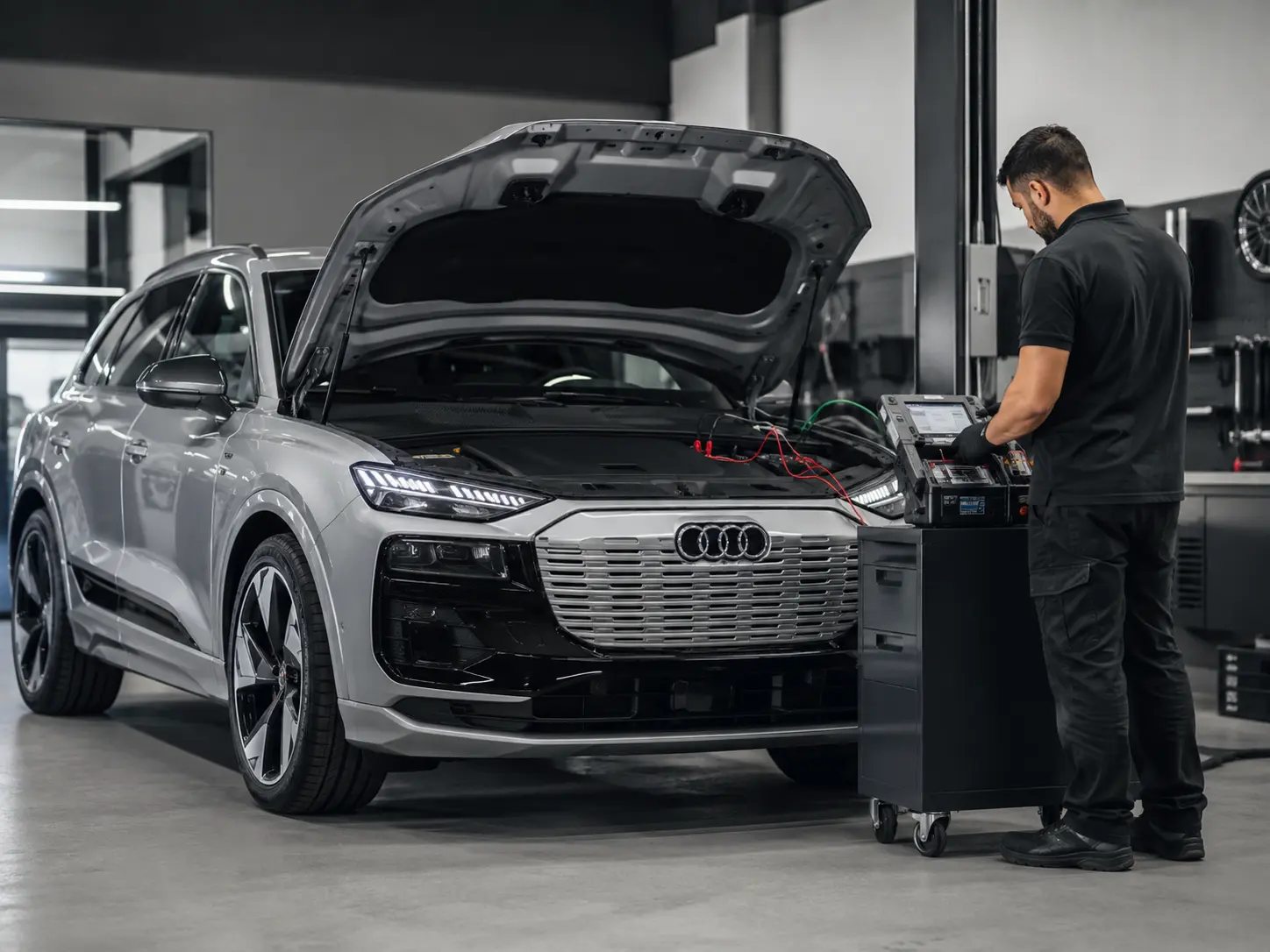
The workshop images show battery testing, low-voltage diagnosis and final checks on current Audi models. Each test is selected for the symptom rather than added automatically.


When an Audi battery should be replaced
A battery estimate should state the test result, contributing conditions and any setup required after installation. Repeated discharge needs more than another battery.
| Reported or found condition | What we check | Recommended next step |
|---|---|---|
| Low measured reserve | Battery test, age, recent charging, storage pattern, terminal and ground condition. | Replace when supported, then verify the charging system and startup behaviour. |
| Charging warning | Charging output, belt or converter context, wiring, connections, load behaviour and stored faults. | Repair the confirmed supply fault rather than replacing the battery by assumption. |
| Repeat discharge | Sleep-state current, accessory history, recent electrical work and time required for the battery to flatten. | Locate the excessive draw or usage cause before another battery is damaged. |
| Loose or corroded connection | Voltage drop, physical security, corrosion, cable and ground condition. | Restore the connection and retest before deciding the battery itself has failed. |
| Electric Audi no-wake condition | Low-voltage state, key and locking behaviour, charge status, exact messages and high-voltage warning context. | Confirm whether the issue is low-voltage and within scope before transport or deeper work. |
Example Audi battery quotations
These examples show how common Audi battery jobs may be priced. They are planning examples, not completed-work claims or fixed offers. Your estimate depends on the actual battery specification, test result, access and supporting electrical condition.
2019 Audi A4 AGM replacement
Example: AED 1,150- Suitable quality AGM battery
- Removal and installation
- Terminal and charging check
- Applicable battery registration
2021 Audi Q5 battery replacement
Example: AED 1,450- Higher-capacity AGM battery
- Installation and secure fitment
- Registration and warning review
- Startup and charging verification
2020 Audi Q7 discharge diagnosis
Example: AED 2,150- Battery and charging tests
- Sleep-state current-draw diagnosis
- Suitable AGM replacement battery
- Registration and final recheck
From battery test to handover
Tell us the starting or discharge problem, arrange the inspection, review the battery choice and estimate, then collect the Audi after installation and final checks.
- 01
Send the starting symptoms
Include model, year, battery age, warning messages, parking time and accessory history.
- 02
Test battery and supply
Measure condition, charging and connections before choosing a replacement.
- 03
Investigate repeat discharge
When needed, allow the vehicle to sleep and identify abnormal current draw.
- 04
Install and verify
Use the correct specification, complete applicable setup and recheck startup and warnings.
Extend Audi 12-volt battery reliability
Battery life depends on type, vehicle demand, heat, storage and charging behaviour. Good care starts with measured condition rather than a fixed lifespan promise.
Record age and type
Keep the installation date and battery specification with the service history. A visual label is useful, but the test result and operating context matter more than age alone. Ask which measurement supports replacement.
Consider short trips
Repeated short journeys may not restore the energy used during startup and accessory operation. Describe normal use. Charging support may be appropriate for storage, but it should match the vehicle and battery type.
Manage long storage
Before leaving an Audi parked for an extended period, ask about suitable maintenance charging and locking state. Do not improvise connections around sensitive electronics. A battery already deeply discharged may need testing before reuse.
Review accessories
Dash cameras, trackers, chargers and recent audio or security work can affect parked current draw. List every accessory and whether the discharge began after installation. The test should allow modules to enter sleep mode correctly.
Keep traction batteries separate
The 12-volt battery supports controls on combustion, hybrid and electric Audis. It is not the high-voltage traction battery. Charging, propulsion and energized battery work requires a separate scope and safety capability.
Check the completed job
After replacement, verify secure fitment, terminal condition, startup, charging and relevant warnings. Ask whether registration or adaptation was applicable and completed. Keep the battery specification and written terms with the invoice.
What to tell us about the battery problem
A concise record helps the workshop distinguish a current Audi battery symptom from old work, stored messages and normal operating behaviour. It also gives the owner a clearer point from which to approve or decline the next stage.
Before the visit
Write down the first date the Audi battery concern appeared, the odometer reading, recent maintenance and whether anyone has cleared codes or disconnected the battery. Add a dashboard photograph and a short video when sound or movement is important. Do not dismantle trim or energized systems merely to provide more information.
At check-in
Agree the main complaint in plain language and identify existing body, wheel or interior marks where access may be needed. State whether the Audi battery vehicle contains valuables, locking wheel hardware or special accessories. Confirm who can authorize additional testing and the preferred contact method.
During diagnosis
Ask for the Audi battery result to separate observation, test evidence and recommendation. If the symptom could not be reproduced, agree whether monitoring, a longer test or access to another component is justified. A lack of confirmation should not be rewritten as certainty simply to produce an estimate.
After completion
Review warning lights, fluid levels, road behaviour and the function connected to the original complaint before normal use resumes. Keep the invoice and any measurement with the Audi battery history. If a return check is advised, record the distance, time or operating condition that should trigger it.
Questions before booking
These answers cover Audi battery prices, testing, registration, repeated discharge and booking.
How do I know if my Audi needs a new 12-volt battery?
Slow starting and warnings are clues, but a condition test, charging check and connection inspection should support replacement.
Why did several Audi warnings appear after a flat battery?
Low voltage during startup can affect multiple control units. Restore the supply, then rescan and verify which warnings return.
Why does the Audi battery go flat after parking?
Possible causes include battery condition, storage duration, accessories, charging weakness or excessive current draw after the vehicle should sleep.
Does every Audi battery need registration?
Requirements vary by model and system. The workshop should confirm whether registration, adaptation or other setup applies to the exact vehicle.
Is the Audi 12-volt battery the same as an e-tron battery?
No. The low-voltage battery supports controls and wake-up functions. The traction battery is a separate high-voltage system.
Can you test the Audi charging system?
Yes, subject to model scope. The relevant alternator, converter, wiring and load behaviour should be checked with the exact powertrain in mind.
Can I buy an Audi battery before diagnosis?
It is better to confirm physical size, technology, capacity, terminal layout and setup needs first. This reduces incorrect supply and repeat failure.
Where can I book Audi battery replacement in Dubai?
Auto Repair UAE receives Audi battery enquiries at FCP, Al Quoz Industrial Area 4, Dubai. Confirm the appointment first.
Book an Audi battery test
Send the exact Audi model, year, battery age, starting behaviour, warning messages and parking history. The workshop can confirm the correct low-voltage test, replacement specification and any applicable setup. If the electrical concern appears with weak cooling or blower operation, continue with the Audi AC repair checks.