
Do Not Start a Flooded Car to Check the Damage
Do not start, jump-start, charge, or drive a flood-damaged vehicle before assessment. Keep away from electrical components and arrange recovery. Flooded car repair cost in the UAE depends on what became wet, contamination, and whether the engine was running. The planning scenarios below range from AED 1,800 for limited cabin work to AED 30,000 or more for combined damage, before VAT. Some vehicles should not be repaired. Establish a safe repair route before deciding whether the cost makes sense.
A car can look dry and still need further investigation. Equally, a wet floor does not automatically prove the engine needs replacement. The useful question is what the inspection has confirmed, what remains unknown, and how much you would need to spend from this point onward.
Find the Decision You Need
- The car has just flooded: protect people, avoid restarting, and arrange suitable recovery.
- You need a budget: compare scoped prices and three hypothetical repair estimates.
- A workshop has proposed repairs: check the findings and approval stages.
- You are unsure whether to continue: compare repair feasibility, remaining costs, and realistic vehicle value.
- You may claim on insurance: check the policy and obtain instructions before authorizing repairs.
What to Do Immediately After Flood Exposure
- Put people first. Do not enter floodwater to reach the car or retrieve belongings. Follow local emergency instructions. If there is immediate danger, contact emergency services rather than attempting recovery yourself.
- Leave the vehicle off. Do not turn the ignition on to test the windows or dashboard. Do not try a booster, repeated cranking, or a short drive to dry it.
- Keep clear of battery systems. Do not disconnect a battery, open an EV battery enclosure, touch orange cables, or unplug wet charging equipment yourself. Tell the recovery operator whether the vehicle is gasoline, diesel, hybrid, or electric.
- Document from a safe position. Record the location, approximate exposure time, visible water line, and whether the engine was running or restarted. Take photos only where access is safe.
- Arrange professional recovery. Explain any smoke, unusual heat, hissing, or electrical behavior before a truck is dispatched. The operator needs the model-specific transport instructions and a suitable destination.
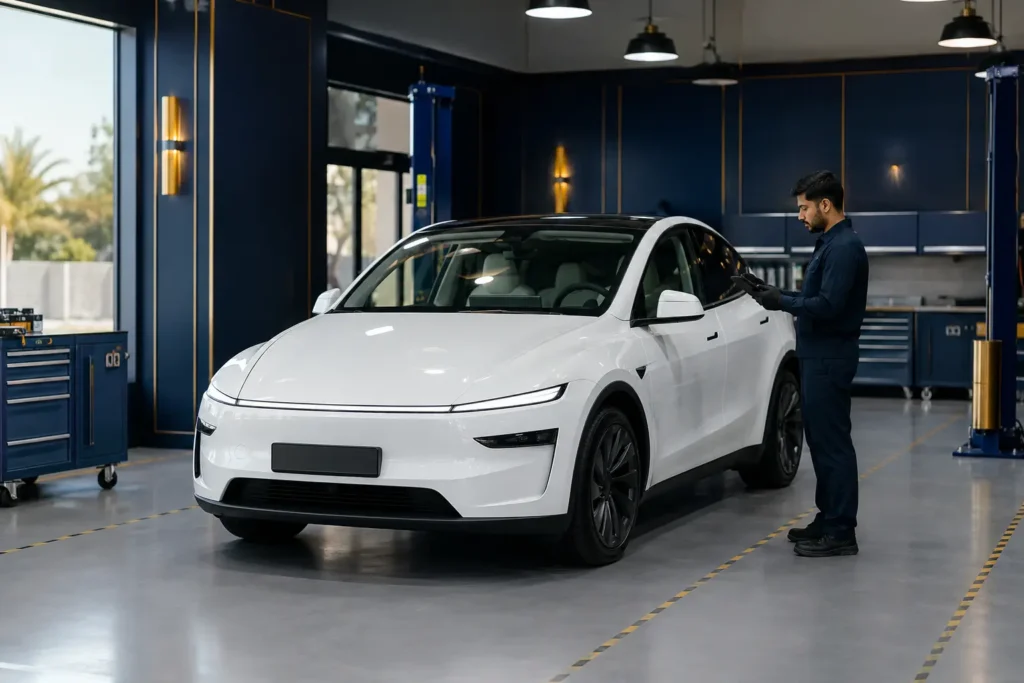
If the vehicle is smoking, heating abnormally, or making popping or hissing sounds, move away and contact emergency responders. Do not open it or attempt to move it yourself. Tesla’s submerged-vehicle guidance explains this response and requires inspection before operation. Other vehicles need their own manufacturer procedures.
Give the assessor the exposure history
Was the car parked, moving, or stalled? Did water enter the cabin? Was it salt water, muddy runoff, or water of unknown origin? What was switched on afterward?
Share what you know without guessing. A visible tide mark is useful evidence, but it does not map every affected component. The car’s angle, water movement, and component locations matter too. Avoid washing away the evidence before the assessor or insurer gives instructions.
Flooded Car Repair Cost in the UAE
These are planning estimates for the stated work, not fixed flood-repair packages or measured market averages. All figures in this cost section are before 5% VAT. For example, AED 1,000 before VAT becomes AED 1,050. Recovery, storage, replacement transport, major dismantling, and high-voltage work are excluded unless the written estimate includes them.
| Work being considered | Planning range before VAT | Scope and limits |
|---|---|---|
| Initial flood assessment | AED 450 to 950 | Exposure review, accessible condition checks, and a staged test plan. Scanning only when safe. Detailed strip-down, repairs, and EV battery testing are separate. |
| Limited cabin extraction and drying | AED 750 to 2,500 | Agreed access, water extraction, cleaning materials, and drying checks for a limited area. Replacement carpet, seats, modules, and extensive contamination treatment are separate. |
| Localized low-voltage electrical repair | AED 1,500 to 6,500 | Diagnosis and an agreed accessible wiring, connector, or component repair. Multiple modules, full harness replacement, coding restrictions, and safety systems can exceed this range. |
| Confirmed engine rebuild or overhaul | AED 6,190 to 20,950+ | Existing engine-service planning range for measured internal work. It is not a whole-vehicle flood quote; cabin, transmission, and electrical work remain separate. |
| Extensive combined damage | AED 30,000+ is possible | No dependable ceiling before assessment. Major electronics, powertrain, or high-voltage damage may make repair unsuitable or uneconomical. |
A standard scan is a different service. Our inspection and diagnostic service lists a computer scan at AED 145 to 285 before VAT. Reading codes cannot replace a flood-specific assessment. For confirmed internal engine damage, compare the scope on our engine repair, rebuild, and replacement page.
Three Typical Flood Repair Estimates
These are hypothetical planning scenarios, not actual repairs, invoices, or promises for a particular model. They combine work rather than adding every row above. Request an itemized estimate so diagnosis, removal, and refitting labor are not counted twice.
1. Limited cabin water exposure
AED 1,800 to 3,500 before VAT
AED 1,890 to 3,675 including VAT
A conventional compact car was parked and has limited wet carpeting. Assume assessment finds no submerged safety electronics, no engine ingestion, and reusable trim.
Allow for assessment, agreed carpet access, extraction, cleaning, drying checks, and refitting. New carpet, seat electronics, widespread contamination, recovery, and storage are excluded. Any such finding requires a revised estimate.
2. Cabin work plus a contained electrical fault
AED 4,500 to 11,000 before VAT
AED 4,725 to 11,550 including VAT
A conventional sedan needs cabin treatment and a localized low-voltage repair. Assume the repair route is permitted, affected parts are available, and the engine and transmission do not need internal work.
Allow for diagnosis, agreed access, drying, the named electrical repair, and applicable setup checks. Full harnesses, multiple modules, airbags, seat-belt systems, and high-voltage parts are excluded.
3. Confirmed engine damage plus other work
AED 12,000 to 30,000+ before VAT
AED 12,600 to 31,500+ including VAT
A conventional SUV stalled in water. Assume testing supports an engine rebuild and a defined amount of cabin or low-voltage work, with usable major engine castings.
Allow for measured engine work, agreed fluids, installation checks, and the listed secondary repairs. A replacement engine, damaged transmission, major harnesses, or unavailable parts can exceed the range. This is a stop-and-review scenario.
The cheaper estimate is not necessarily the better offer. Compare the included parts, removal work, tests, and exclusions. An estimate for drying alone should not be compared with one that also includes carpet replacement and electrical diagnosis.
What Changes the Estimate Most
| Exposure or symptom | What needs investigation | Decision before spending |
|---|---|---|
| Water around the wheels with no confirmed cabin entry | Exposed brakes, bearings, connectors, and underbody components | Confirm the exposure extent. Do not treat an external water height as proof of safety. |
| Wet cabin floor or moisture beneath seats | Carpet backing, floor wiring, seat equipment, and model-specific module locations | Agree on access and inspection before paying for cosmetic cleaning. |
| Engine stalled while crossing water | Intake exposure, mechanical condition, and relevant fluids | Do not restart. Confirm damage before choosing repair or replacement. |
| Dashboard-height water or several electronic faults | Multiple systems, repair restrictions, parts availability, and contamination | Pause major spending until the combined scope is established. |
| Hybrid or EV battery area exposed | Manufacturer-specific high-voltage assessment and handling | Use qualified recovery and assessment. Ordinary drying is not clearance to charge. |
A taller SUV is not automatically protected. Model year, intake arrangement, module placement, powertrain, and previous repairs can change the result. Salt water, dirty runoff, and prolonged exposure also change the assessment. A water-depth label should organize the investigation, not replace it.
Approve the Assessment in Stages
Ask for a paid-work limit and a clear deliverable at each stage. This keeps an uncertain investigation from turning into an open-ended restoration bill.
- Make the vehicle safe to handle. The workshop establishes the applicable manufacturer procedure, exposure history, and recovery or storage needs before testing.
- Record findings and uncertainties. Request photos of affected areas and a distinction between confirmed damage, suspected damage, and areas not yet accessible.
- Authorize specific access. If seats, carpet, trim, or mechanical parts need removal, agree on the cost and what the inspection should establish. Ask what refitting or disposal would cost if you stop.
- Choose the repair route. Compare the named parts, required programming, contamination work, and tests. Replacement may be required even if an exposed component briefly works.
- Review the combined total. Bring separate interior, electrical, and mechanical estimates together before authorizing major parts. Ask for revised approval if the findings change.
Ask what each test can establish
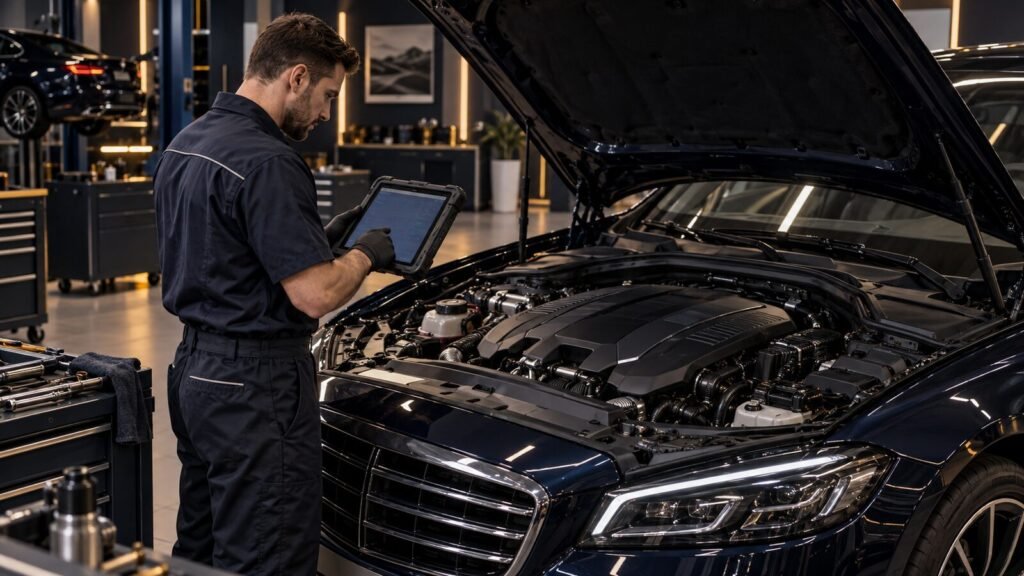
A report should explain the question being investigated, the result, and the next decision. A fault code alone should not become a parts order. Ask whether the vehicle was safe to power up and which systems could actually be tested.
For example, Toyota’s 2017 flood inspection bulletin for specified 2000–2018 US-market models treats water type and exposure separately. It requires replacement of salt-water-submerged electrical components within its scope. It is not a universal procedure for every Toyota or UAE vehicle.
Drying the Interior Does Not Clear the Whole Vehicle
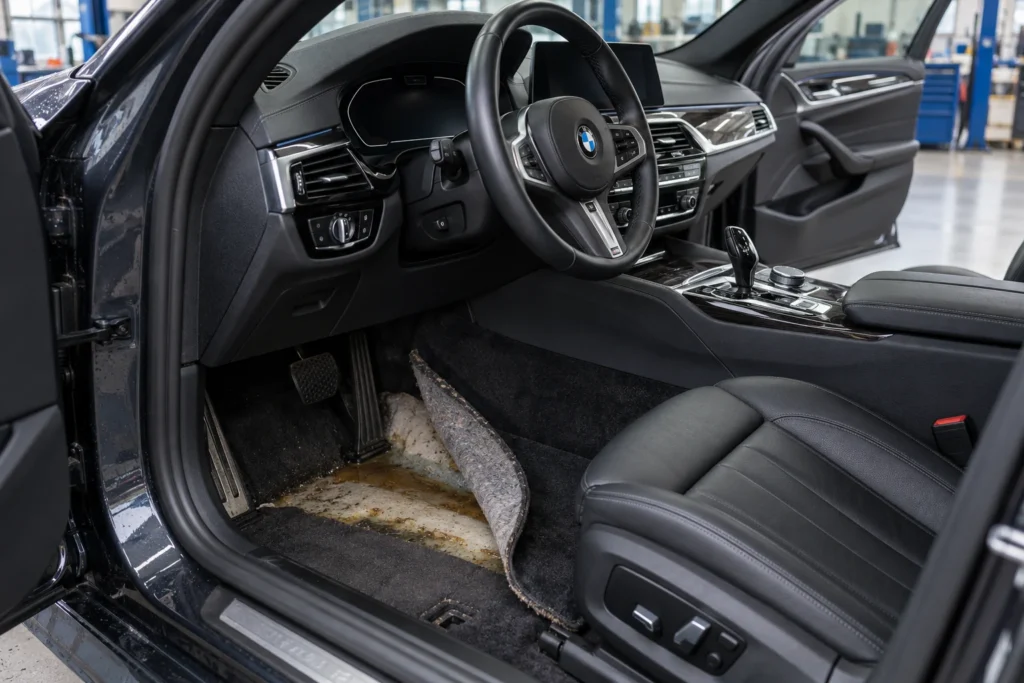
Cleaning can improve appearance without resolving mechanical, electrical, or contamination concerns. Ask what was removed, which materials were retained, what needed replacement, and how the agreed drying work was checked. A fragrance or a clean-looking seat is not a record of the work underneath it.
Separate appearance from contamination work
Floodwater may contain sewage, chemicals, and sediment. Hidden areas can retain contamination, and delayed electrical problems may appear after the car initially works. AAA’s flood-damage guidance explains why cleaning access and later failures matter.
Do not attempt to make a contaminated cabin usable by running the heater, spraying fragrance, or adding electrical drying equipment. Ask the assessor for a safe handling and cleaning plan. Do not approve a promise to eliminate every future problem.
Likewise, do not approve replacement of every fluid solely because flooding occurred. The estimate should identify each affected system, the evidence or manufacturer requirement, the specified fluid, and any further work. A fluid change does not by itself establish that internal components are undamaged.
Hybrids and EVs Need a Separate High-Voltage Decision
Do not charge, jump-start, or switch on a flood-damaged hybrid or EV to check whether it works. Ask the manufacturer or an appropriately qualified specialist for handling instructions. Tell the recovery operator about battery warnings, impact damage, heat, or unusual sounds.
NHTSA warns that damaged high-voltage systems can create shock and fire hazards. Its guidance calls for damaged lithium-ion vehicles to be kept out of garages and at least 50 feet, about 15 meters, from structures, vehicles, and combustibles. Have professionals arrange suitable storage; do not approach or relocate a suspect vehicle yourself.
Ask who will perform the high-voltage assessment, which procedure applies to the exact model and year, and whether a supported repair route exists. The conventional-car estimates above do not include traction-battery replacement. A low-voltage scan or a dried exterior cannot establish battery safety.
When to Repair and When to Walk Away
Stop approving further repair work when the workshop cannot define a safe, supported repair route or a credible remaining budget. Pausing repairs does not mean abandoning safe storage or required reporting. Discuss the next handling step with the assessor and insurer.
Continue the assessment
Exposure appears limited, the next test answers a specific question, and its cost is capped. You can still decide against repair after receiving the findings.
Consider a defined repair
The scope, parts, safety-system requirements, contamination work, and handover checks are documented. The remaining cost leaves room for uncertainty and compares reasonably with your alternatives.
Pause or walk away
Major unknowns remain, required parts or procedures are unavailable, or repeated extras erase the financial benefit. Get a second written assessment or discuss the insurer’s total-loss route.
Compare Remaining Costs With the Value You Could Recover
Do not compare the repair quote only with the car’s value before the flood. Use a realistic post-repair value that reflects disclosed flood history, and compare it with a genuine net as-is or salvage offer. Include remaining recovery, storage, transport, and other costs. Money already spent should not force approval of an otherwise poor next step.
A simple stop-spending calculation
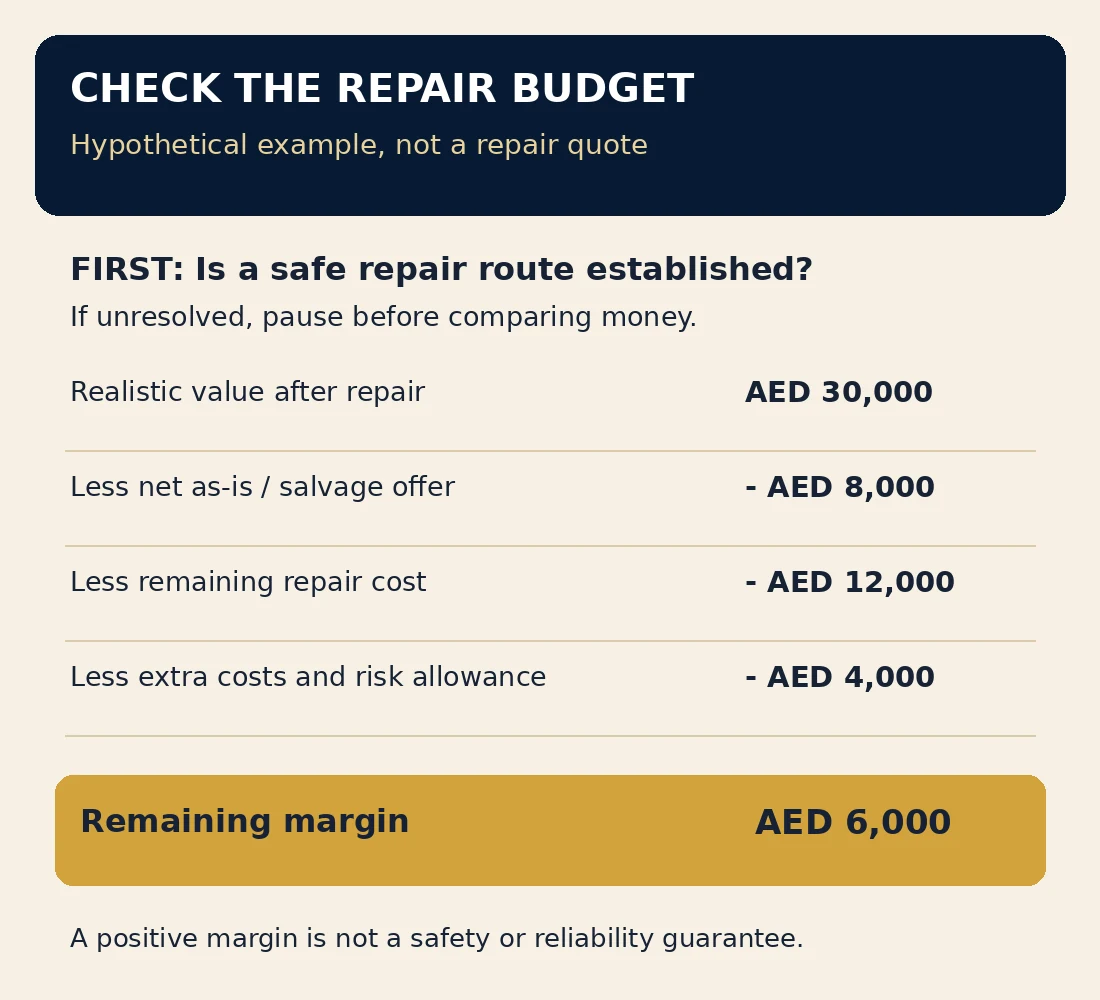
Suppose the realistic value after repair is AED 30,000, a net as-is offer is AED 8,000, remaining repairs total AED 12,000, and extra costs plus your risk allowance total AED 4,000.
AED 30,000 − AED 8,000 − AED 12,000 − AED 4,000 leaves AED 6,000. Another AED 7,000 of repairs would erase that margin. This is a prompt to reassess, not permission to accept an unresolved safety issue.
Use written figures and one consistent VAT basis. If insurance applies, compare your actual contribution and the insurer’s proposed options separately. Do not count both a settlement and salvage proceeds unless you are entitled to both.
No percentage of vehicle value can certify a repair as safe or financially sensible for everyone. For a daily-use vehicle, uncertain downtime and repeat workshop visits may matter as much as the initial quote. Ask whether an alternative vehicle would serve you better at a comparable total cost.
Check Flood Coverage Against Your Actual Insurance Policy
Do not assume that the word “comprehensive” guarantees payment for every flood-related expense. Check the schedule, endorsements, exclusions, excess, and claim instructions. Third-party liability cover by itself is not cover for damage to your own car.
For example, Sukoon’s published motor wording lists natural-disaster cover as applying when shown on the schedule, with conditions. That example does not establish coverage under your policy.
- Notify the insurer promptly and ask which incident report or authority document is required.
- Keep safe-position photos, recovery receipts, exposure details, and the assessment report.
- Confirm the approved workshop, inspection or dismantling permission, and repair authorization.
- Ask about excess, storage, recovery, replacement transport, and any proposed total-loss settlement.
Keep necessary emergency handling separate from elective repairs. Ask for the insurer’s instructions in writing, including what may proceed while the claim is assessed. The workshop can document findings; the insurer decides the claim under the policy.
What to Request Before Accepting the Car Back
A useful handover records what was repaired and what was tested. It should not promise that every hidden problem has been eliminated. Request:
- An itemized invoice matching the approved scope and any approved additions.
- Part descriptions, relevant programming or calibration records, and the applicable warranty terms and exclusions.
- Results for the affected systems and required safety checks, with any limitations clearly stated.
- Details of retained or replaced interior materials and the completed cleaning work.
- Written follow-up instructions and a contact route if symptoms return.
If warning lights, braking or steering changes, stalling, unusual heat, or burning smells appear, stop safely and arrange help. Report recurring odors or dampness too. Do not keep restarting or driving merely because a previous repair was completed.
Reduce Future Exposure Without Relying on a Car Cover
Move the car to a safer location before flooding begins, only while the route is safe. Follow official warnings and road closures. Covered parking can still flood, especially at low levels. An ordinary car cover does not make a vehicle floodproof.
Maintain seals and specified drains to address normal rainwater leaks, but do not confuse that maintenance with protection against submersion. Never enter floodwater because a taller vehicle crossed ahead of you. The National Weather Service’s flood guidance explains why flooded roads should be avoided.
Sources and How to Use This Guide
The linked manufacturer bulletin and Tesla manual show why procedures vary. NHTSA and AAA cover flood-related hazards and inspection limits. The insurance wording is an example only. Use the current instructions for your vehicle and policy. The AED scenarios and calculation are hypothetical, not customer records.
The Decision Before You Approve More Work
Judge flooded car repair cost against a documented repair route, the remaining total, and the vehicle’s realistic value afterward. Preserve the no-start rule, authorize work in stages, and pause when safety, cost, or parts availability remains unresolved. A running engine alone is not a complete recovery.
Discuss a Flood-Damage Assessment in Al Quoz 4
Contact AutoRepairUAE with the model, year, powertrain, location, water level, and whether the vehicle stalled or restarted. Share safely taken photos and any insurer instructions. We can discuss assessment scope and suitable recovery arrangements before you authorize paid work. Do not drive a flood-damaged vehicle to the workshop.
Flooded Car Repair Questions
How long should I wait before trying to start it?
There is no waiting period that makes a flood-damaged car safe to start. Waiting for the visible water to dry is not a substitute for assessment and any required repairs.
Can I pay only for an inspection and then stop?
Agree on the assessment fee, access work, reporting, storage, and refitting charges before authorization. Ask for a decision point before parts are ordered. An assessment does not have to become a full repair.
Does a failed start prove the engine is hydrolocked?
No. Electrical supply, controls, or mechanical damage may prevent starting. Do not test the theory by cranking again. Tell the assessor what happened and let the inspection establish the cause.
Will a second opinion require paying twice?
Possibly. Share the first report, photos, estimates, and authorized work to reduce duplication. Ask the second assessor which findings can be used and which checks must be repeated.
Should I accept used replacement modules to reduce the bill?
Only consider a part when its condition, compatibility, traceability, programming support, and permitted application are established. A cheaper module that cannot be matched or tested is not a useful saving.
Is a repaired flood car a good used-car purchase?
A low price is not enough. Require disclosure, repair records, and an independent inspection appropriate to the exposure. If the seller cannot explain the damage or permit inspection, walking away is reasonable.