Slow start or several warnings
Battery condition, charging, terminals, and grounds are checked before treating every warning as a separate failed component.
Independent Geely workshop in Al Quoz 4
A warning light, hesitant gear change, or AC that turns warm in traffic? Book Geely repair in Dubai at our independent workshop in Al Quoz 4. We check the cause and explain the repair before you approve paid work.
Start with your model and what you notice. The initial workshop inspection is free, and you receive a written estimate for the next steps.

A message on the dashboard can feel more serious than it is, or signal something that needs immediate attention. Describe what you notice. You don’t need to diagnose it yourself.
If safe, take a photo while parked and note whether the car was cold, warm, moving, or idling. Stored codes and freeze-frame data can help show the conditions when a fault appeared.
Avoid clearing codes or disconnecting the battery just to hide the warning. These actions may remove useful clues without fixing the cause.
Stop safely for overheating, lost oil pressure, heavy smoke, fuel leaks, or a change in braking or steering control. Call to discuss safe transport.
Battery condition, charging, terminals, and grounds are checked before treating every warning as a separate failed component.
Note whether it happens during acceleration or after warming up. Ignition, fuel, boost, cooling, and mechanical checks depend on the findings.
Describe the change in gear engagement and whether it occurs hot or cold. Fluid service and internal gearbox repair are different decisions.
Weak airflow and warm air need different checks. For vibration, mention speed, braking, road impacts, or recent tire work.
Services and repairs
Rough running, reduced power or an engine warning can involve air, fuel, ignition, boost, wiring, cooling or mechanical condition. The engine repair service shows when compression, leakage, oil-pressure or cooling evidence may be required.
Delayed drive, harsh selection, flare, judder or noise requires the exact gearbox, operating temperature, fluid history and road behavior. Use the transmission assessment when shifting is the main complaint.
Coolant loss, rising temperature and poor cabin cooling are different investigations. Airflow, refrigerant, fan control and cooling-system circulation should not be compressed into one top-up. See the car AC repair page for cabin-cooling diagnosis.
Slow starting, repeated discharge or many unrelated warnings can begin with battery condition, charging performance, terminals, grounds or current draw. Test supply stability before recommending a control unit.
Knocks, pulling, steering effort and uneven wear require tire, wheel, bushing, joint, damper and geometry checks. An alignment result is interpreted with the physical condition of these parts.
Noise, vibration, pedal change and an ABS warning are recorded separately. Wheel-speed information, tire size, friction wear and recent collision or glass work can point to different next tests.
Estimated Geely repair prices
Geely minor service is estimated at AED 550–900, while focused computer diagnosis is AED 250–450. Maintenance and fault diagnosis cover different work. The planning ranges below vary with model, access, parts, and condition. They are not final VAT-inclusive totals; the written quote confirms VAT and the amount payable.
Relevant module scan, warning review, and accessible electrical checks. Extended tracing is quoted separately when required.
Correct engine oil, oil filter, general inspection, and service reset where supported. Additional filters depend on the model.
Engine oil service with applicable filters, due spark plugs, and wider inspection. Fluid checks do not include all fluid replacements, belts, or repairs.
Pads and installation for the front axle, with a brake inspection. Discs, sensors, caliper repairs, and fluid replacement are extra if required.
Suitable battery installation with charging checks. Registration or setup is included only when applicable and confirmed.
Cooling performance, pressure, fan, accessible leak, and control checks. Refrigerant recharge, leak repair, and replacement parts are separate.
Typical Geely job budgets
These typical job estimates show the scope behind a budget. They are not completed customer jobs or fixed offers. Your written quote confirms parts, added work, and VAT treatment.
Correct engine oil, oil filter, inspection, and service reset using the specification confirmed for the vehicle.
AED 740Front pad replacement with brake inspection and final road check. Disc replacement is not included.
AED 890Correct battery installation with terminal, charging, and starting-system checks.
AED 960Geely service requirements change with the model and generation. The model name is enough to start your inquiry. The year, VIN, and fitted equipment help us select exact parts later.
The current UAE Coolray uses a 1.5-liter turbo engine and seven-speed dual-clutch transmission. A DCT uses clutches to engage drive, so takeoff complaints require the correct checks. Do not apply one Coolray fluid or parts specification to every year or to Cityray without checking fitment.
The current UAE Monjaro uses an eight-speed automatic and four-wheel drive. That is a different transmission arrangement from the Coolray DCT. Starray and Okavango equipment also varies. Match the gearbox, drivetrain, and suspension before selecting fluids or parts.
Sedan models have their own engine, transmission, brake, and filter applications. Service history helps avoid replacing recently renewed items. For an imported car, the source market can matter when ordering electronics or matching software.
Battery-electric and hybrid vehicles are not interchangeable service categories. The EX5 and Geometry C need EV-specific maintenance, while hybrid versions also have combustion-engine requirements. Tell us the model and concern; we explain the relevant inspection and any specialist support needed.
After glass, bumper, steering, or suspension work, cameras and radar may need checks or calibration according to the applicable procedure. Mention what was replaced. A warning alone does not establish that calibration or a new sensor is the answer.
We begin with the reported problem, then use measurements to narrow it down. Paid diagnostic work is agreed separately from the free initial inspection.
We compare your description with the car’s present condition and reproduce the symptom when it is safe.
Battery voltage, connections, accessible fluid levels, visible damage, and communication faults can explain several symptoms at once.
Scan data is compared with the relevant pressure, temperature, electrical, or mechanical test. A fault code guides testing; it does not prove a part has failed.
You receive the findings and a proposed repair or further test. The estimate identifies exclusions, and approved work is checked against the original concern.
For more on what code reading can and cannot tell you, see our computer diagnostic service.
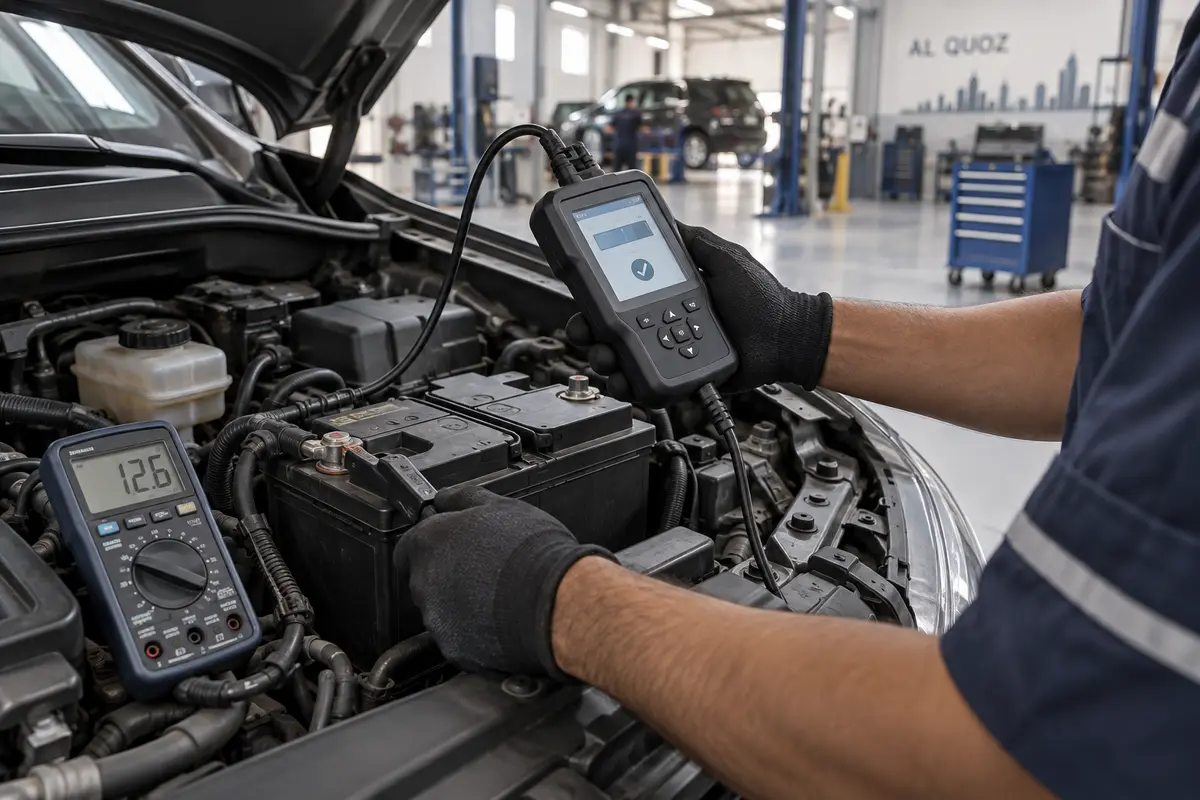
Several warnings appearing together do not automatically mean several modules have failed. Battery condition, terminal connections, charging output, and voltage drop help us decide what needs attention first.
If the battery keeps going flat, replacement alone may not solve it. An accessory staying awake or an abnormal current draw needs a separate check.
Gasoline, hybrid, and electric care
Identify the engine and transmission before choosing oil, fluid, filters, spark plugs, cooling components or a service interval. A warning may require measured diagnosis rather than a routine package.
First establish whether the concern belongs to the 12-volt network, charging equipment, thermal management, propulsion battery or a mechanical chassis system. We explain the equipment, software access, parts availability, and specialist support required for high-voltage work after discussing your concern.
Dubai operating context
Heat alone is not a diagnosis. Journey pattern, parking, load, road condition and previous work give temperature and voltage data useful context.
Repeated short journeys can leave limited time for battery recovery. Long parking periods, accessories and repeated unlocking may affect a low-voltage complaint, so usage belongs in the test plan.
Extended idling can reveal fan, airflow or supply problems that do not appear at road speed. State whether cooling changes while stationary, moving or after heat soak.
Passenger load, tire pressure, wheel damage and underbody contact can affect steering, vibration, tire wear and suspension noise. Report the impact before geometry is adjusted.

Does the AC become warm only at a standstill? Does the warning appear after an overnight stop? Tell us when the problem happens, including recent battery changes or repairs.
You can check tire pressures against the vehicle label and record visible leaks from a safe position. Do not open a hot cooling system, touch orange high-voltage cables, or continue driving through an overheating warning.
The useful comparison is the total job and expected result. A cheap part can become expensive if fitment is wrong, setup is missing, or the surrounding damage has not been checked.
A genuine Geely part, an aftermarket replacement, and a used assembly are different purchases. The quote should state the chosen type, fitment, availability, and any actual coverage. A shared platform or similar connector is not enough to prove interchangeability.
Keep required work separate from optional improvements. If an initial test cannot establish the cause, the next diagnostic stage should be priced before the repair expands.
Maintenance and records
The applicable owner information, powertrain, mileage, age and use determine the schedule. A universal package cannot cover every Geely model or source market.
Record oil specification, quantity, filter reference and reset. A dashboard reminder is useful, but it does not identify the correct material by itself.
Inspect level, condition, leakage evidence, hoses, radiator area and fan behavior. Repeated top-ups should lead to diagnosis rather than another refill.
Identify the gearbox and applicable procedure before selecting fluid or discussing an interval. Existing shift symptoms remain a diagnostic complaint.
Record friction wear, fluid condition, tire pressure, tread, damage and uneven wear. Alignment follows suitable wheel, tire, steering and suspension checks.
Measure battery condition and charging performance, then consider parking and journey patterns. Replacement specification and any required setup should be documented.
Choose filters by application. Reduced airflow, odor, warm air and uneven vent temperatures are separate observations that may require different tests.
Bring earlier invoices even when the work happened outside Dubai. Fluid specification, installed part numbers and a note about dismantling can prevent repeated work. Accessories such as cameras, trackers, audio systems, chargers and non-original lighting should also be included in the history. The electrical repair guide explains how supply, protection, grounds and sleep behavior are checked.
A short message is enough to start. Year, mileage, warning photos, and earlier invoices are useful follow-up details when available.
Choose a workshop visit or free pickup and delivery. Describe any access problem and whether the car starts, rolls, steers, and brakes.
We explain the inspection findings, parts options, labor, additional testing, and expected timing. Paid work begins after your approval.
The repaired function is checked, with a road test when appropriate. Keep the invoice and work summary, including any maintenance left for later.
Estimate clarity
The same symptom can lead to different repair costs. These are the main factors that change your quote and completion time.
Visit our Al Quoz 4 workshop or arrange free pickup and delivery. Start with your model, location, and what needs attention.
Overheating, unsafe brakes, or a vehicle that cannot move normally needs a transport plan. Electric and four-wheel-drive Geely models may require specific recovery instructions. Do not improvise towing or open a high-voltage battery cover.
Ask the supplying dealer about any warranty, recall, or service-package entitlement. Eligibility depends on your vehicle and its terms. An independent inspection does not approve a manufacturer claim.
Looking after another brand? Find its service in our Chinese car repair directory.
The listed minor service estimate is AED 550–900 and major service is AED 1,100–2,100. The fitted engine, due items, parts, and inspection findings affect the quote. VAT and the final payable total are confirmed in writing.
Yes. The initial workshop inspection is free. Focused diagnostics, extended electrical tracing, dismantling, or specialist testing are separately priced before work starts.
No. Start with the Geely model and a short description. We request the VIN when exact parts, fluids, or procedures need to be matched.
Free pickup and delivery are available. Share the location and whether the vehicle starts, rolls, steers, and brakes. A paid dedicated on-site inspection can also be arranged, with the fee confirmed first.
No. The current UAE Coolray has a seven-speed dual-clutch transmission, while the current Monjaro uses an eight-speed automatic. Other models and generations can differ. Fluid and repair procedures must match the actual gearbox.
Yes, you can contact us about EX5, Geometry, or hybrid concerns. Charging, the 12-volt supply, chassis, and high-voltage systems need different checks. We explain the required diagnostic access and specialist support for the work rather than assuming the traction battery has failed.
Yes. If a warranty, service package, or recall may cover the concern, check its terms with your supplying dealer first. Auto Repair UAE is independent and does not approve Geely manufacturer warranty claims.
Routine maintenance may be completed the same day when parts and capacity allow. Intermittent faults, internal repairs, and ordered components take longer. The estimate gives the expected schedule after assessment.
Tell us your model and what needs attention. We’ll help arrange the initial inspection, explain any paid diagnosis, and plan collection if needed.