Slipping or flaring
Engine speed rises without matching acceleration, especially during an upshift or under load. The cause may involve low pressure, worn friction material, incorrect fluid, a valve-body fault, or clutch wear.
Ford gearbox specialists in Al Quoz 4
Get the cause of slipping, jerking, delayed engagement, fluid leaks, or gearbox warnings properly diagnosed before paying for major parts. We inspect Ford automatic, manual, PowerShift, and selected 4×4 driveline systems, then explain the practical repair choices and estimated total.
Free workshop inspection and free pickup and delivery. Dedicated on-site inspections are available with a separate visit fee.
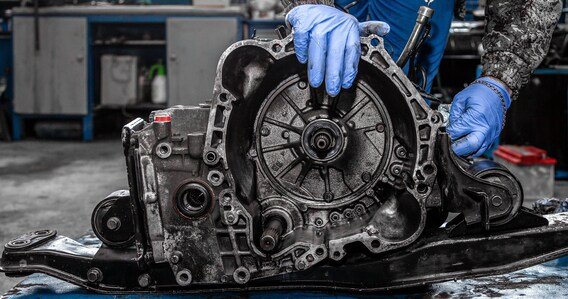
Start with the symptom
A transmission symptom does not automatically mean the complete gearbox has failed. A weak battery, engine fault, damaged mount, low fluid, wiring issue, speed sensor, solenoid, clutch assembly, valve body, torque converter, or internal wear can create similar behavior. Accurate diagnosis protects you from replacing expensive parts that are still serviceable.
Engine speed rises without matching acceleration, especially during an upshift or under load. The cause may involve low pressure, worn friction material, incorrect fluid, a valve-body fault, or clutch wear.
A strong bump when selecting Drive or changing gear may come from adaptations, mounts, fluid condition, control faults, solenoids, or internal pressure problems. The operating conditions matter.
If Drive or Reverse takes several seconds to engage, stop repeatedly revving the engine. Fluid loss, pressure leakage, clutch wear, or control faults can worsen when the vehicle is forced to move.
Red, brown, or dark fluid can escape from a pan seal, cooler line, axle seal, connector sleeve, or casing joint. Finding the source is essential before topping up or authorizing a service.
A transmission warning, wrench light, or restricted gear mode is the vehicle protecting itself. Stored codes guide testing but do not prove which part should be replaced.
Whining, rattling, shuddering, or vibration may involve the transmission, torque converter, clutch, driveshaft, differential, wheel bearing, or engine mounts. A road test helps separate them.
Plan the likely spend
These market-based ranges help you compare the likely repair paths. They are not a final quote. The Ford model, transmission type, fault, fluid specification, parts choice, programming needs, and damage found after inspection determine the total. Your written estimate will state the approved work and inclusions before repair begins.
| Repair choice | Estimated total | Usually includes | Best suited to |
|---|---|---|---|
| Diagnostic assessment | AED 250 to 650 | Scan, visual checks, fluid assessment, road test when safe, and initial fault direction | Warnings, shifting complaints, noises, or an uncertain cause |
| Fluid and filter service | AED 750 to 1,850 | Correct-specification fluid, applicable filter or pan service, leak check, and level procedure | Scheduled maintenance or suitable fluid-related concerns without confirmed internal damage |
| Solenoid or valve-body repair | AED 2,200 to 6,500 | Applicable control component work, fluid, seals, assembly labor, reset, and testing | Pressure-control or shift faults supported by diagnosis |
| Clutch or actuator repair | AED 2,800 to 8,500 | Applicable clutch or actuator parts, removal labor where required, setup, and road testing | Manual clutch faults or diagnosed PowerShift clutch and actuator concerns |
| Transmission rebuild | AED 6,500 to 15,000+ | Removal, disassembly, inspection, selected internal parts, seals, fluid, refitting, and testing | Internal wear or damage when the existing unit is a sound rebuild candidate |
| Replacement transmission | AED 7,500 to 18,000+ | Suitable replacement unit, installation materials, fluid, fitting, setup, and testing | Severe damage or cases where replacement offers better value than rebuilding |
Prices are estimates in AED. The written quote confirms VAT treatment, parts condition, programming, and any optional work. No additional repair is started without your approval.
Choose the right level of repair
A fluid service is maintenance, not a cure for every shift complaint. It can be appropriate when the fitted transmission is serviceable, the fluid condition supports the procedure, and no major internal failure is present. A targeted repair makes sense when testing identifies a leak, sensor, wiring fault, solenoid, valve body, clutch component, actuator, mount, or cooler problem.
A rebuild retains the original casing while worn or damaged internal parts are inspected and replaced. It can offer good value when parts are obtainable and the hard components remain reusable. A replacement may be more sensible when damage is extensive, contamination is severe, the casing is damaged, or a suitable replacement assembly provides a clearer cost and turnaround.
We explain which choice addresses the diagnosed cause, what is included, and what could change after disassembly. You can compare the options before approving the work.
Discuss the repair choicesProtect the vehicle
Do not continue driving if the vehicle loses drive, repeatedly drops into neutral, leaks heavily, smells burnt, overheats, makes grinding noises, or lurches unpredictably. Continued use can turn a limited repair into major internal damage and may be unsafe in traffic.
A short workshop trip may be possible for a mild warning or occasional shift concern when the vehicle engages normally, has no active leak, and remains predictable. If you are unsure, describe the symptom by phone or WhatsApp first.
Free pickup and delivery can remove the risk and inconvenience of bringing the Ford to Al Quoz 4. A dedicated on-site inspection can also be arranged for a separate fee when a mobile assessment is more suitable.
Diagnosis before parts
Tell us the Ford model and what it does. We check relevant control modules and record codes and operating data. A code is treated as a starting point, not automatic permission to replace a component.
We assess fluid level and condition where the system permits, look for contamination, and inspect the pan, lines, seals, cooler connections, wiring, mounts, and nearby driveline parts.
When safe, a controlled road test checks engagement, shift timing, shudder, noise, temperature, load response, and whether the symptom changes between cold and warm operation.
Further electrical, pressure, adaptation, or mechanical checks are selected from the findings. We then provide the repair choice, estimated total, parts basis, and likely timing.
After approval, the agreed work is completed. Fluid level procedures, programming or relearning when applicable, leak checks, stationary checks, and road testing support the handover.
Transmission diagnosis also considers the rest of the vehicle. Poor engine running can feel like transmission hesitation. Low system voltage can cause misleading module faults. Failed mounts can produce a harsh clunk. Driveshaft, CV joint, transfer-case, or differential problems can create vibration and noise under load. Cooling faults can raise transmission temperature even when the internal components are initially serviceable. Checking these relationships avoids an expensive guess.
Ford-specific care
Shudder, hesitation, warning messages, or poor engagement can involve clutch wear, actuators, control modules, seals, adaptations, wiring, or battery voltage. Replacing a clutch without checking the control and mechanical conditions can leave the original complaint unresolved. Diagnosis should confirm the fault pattern and fitted transmission before parts are ordered.
Harsh shifts, delayed engagement, leaks, overheating, or a shudder may require fluid checks, software and adaptation review, mount inspection, valve-body testing, cooler assessment, or internal evaluation. Model year, engine, drivetrain, and transmission identification affect the correct fluid and repair plan.
Workload, towing, sand, heat, and 4×4 use can influence fluid temperature and driveline wear. A complaint under acceleration may come from the transmission, torque converter, propshaft, differential, transfer case, or mounts. Testing under the conditions that trigger the symptom is especially valuable.
Imported or performance-oriented vehicles may have different calibrations, parts references, cooling equipment, or prior modifications. You can still request an inspection with the model and symptom. VIN or modification details can be provided later if needed for accurate parts matching.
Useful cost scenarios
These scenarios show how the repair choice changes the total. They are estimates, not claims about completed customer vehicles. The final price depends on inspection, parts selection, vehicle condition, and the work stated in the written quote.
Work: Automatic transmission fluid and filter service with transmission-pan leak correction.
Parts and condition: Correct-specification fluid, applicable filter or pan components, seal materials, labor, level procedure, leak check, and road test. No internal damage assumed.
Work: PowerShift clutch-related repair after diagnosis of shudder and poor takeoff.
Parts and condition: Applicable clutch components, installation labor, setup or relearning, and road testing. Control module or actuator replacement is not assumed.
Work: Diagnosed automatic transmission valve-body repair for harsh and inconsistent shifting.
Parts and condition: Applicable valve-body or solenoid work, seals, fluid, fitting labor, reset, and testing. Major internal hard-part damage is not assumed.
Know what you are approving
Transmission parts can be new, remanufactured, rebuilt, or used depending on the component and available repair path. These descriptions are not interchangeable. A rebuilt original unit, a remanufactured assembly, and a used replacement can have very different contents, histories, lead times, and prices. Your quote should identify the proposed basis clearly enough for a fair comparison.
Fluid must match the fitted transmission specification. Color alone does not establish compatibility, and a universal claim should not replace the correct specification. The filling and level procedure may depend on temperature and vehicle position. Too little, too much, or incorrect fluid can cause poor operation or damage.
If disassembly is necessary, the initial range may change when internal wear becomes visible. We explain the findings and obtain approval before moving beyond the agreed work. Ask whether programming, adaptations, seals, fluid, cooler cleaning, labor, and testing are included when comparing quotes from different workshops.
From first message to handover
Send the Ford model and a short description of the symptom or service needed. That is enough to start. If a warning photo, VIN, mileage, or previous repair information will help with diagnosis or parts matching, it can be requested as an optional follow-up.
Choose a workshop visit in Al Quoz 4 or request free pickup and delivery. A dedicated on-site inspection can be arranged for a separate fee when a mobile assessment is preferable. At the workshop, the free inspection establishes the next sensible checks. Some faults require paid in-depth diagnosis, disassembly, or specialist testing; that scope is explained before it begins.
Once the cause is sufficiently clear, you receive the recommended work and an estimated total. Repair starts only after approval. Timing depends on diagnostic depth, parts availability, programming, and whether internal inspection is necessary. Straightforward services or external repairs may be completed sooner than rebuilds or replacement jobs. After the repair, applicable fluid-level checks, leak checks, fault-code review, setup, and road testing are completed before handover. You receive an explanation of the work and any relevant follow-up guidance.
Common questions
When repair requires a matched valve body, control unit, seal kit, or assembly, review the Ford spare parts sourcing process.
Estimated totals range from about AED 750 for suitable fluid and filter service to AED 15,000 or more for a major rebuild. Replacement assemblies can range from roughly AED 7,500 to AED 18,000 or more. Diagnosis, model, transmission type, damage, parts condition, and programming determine the written quote.
The workshop inspection is free. If the fault requires in-depth testing, disassembly, or a specialist procedure, that additional diagnostic scope is explained before it starts. Dedicated on-site inspections are available with a separate visit fee.
Yes. Free pickup and delivery are available in Dubai. If the Ford is losing drive, leaking heavily, overheating, or behaving unpredictably, avoid driving it and request collection.
Not always. A code identifies a detected condition or affected circuit. Fluid level, voltage, wiring, mechanical wear, software behavior, or another system can trigger related codes, so testing should support the parts decision.
Only when the diagnosis and transmission condition support that service. Fluid cannot restore worn friction material or repair a failed component. Servicing the wrong fault can waste money, so inspection comes first.
Neither choice is automatically better. Rebuilding can be good value when the existing unit has reusable hard parts and suitable components are available. Replacement may be clearer when damage is extensive or a suitable assembly provides a better cost and timing.
Diagnosis and minor external work may be completed sooner, subject to capacity and parts. Internal repairs, rebuilds, and replacement jobs take longer because removal, parts sourcing, assembly, programming, and testing may be required. The estimate includes the expected timing once the repair path is known.
Send the Ford model, the symptom or service needed, and whether you prefer a visit or pickup. You do not need to diagnose the vehicle. VIN, mileage, warning photos, or repair history can be supplied later if needed.
Get a clear next step
Tell us the model and what the vehicle is doing. Choose a free workshop inspection in Al Quoz 4 or request free pickup and delivery. For other Ford systems and services, return to Ford Repair Dubai.